Few modern European states have aspired to empire as consistently as France.
From the unsuccessful candidacy of Francois I for the crown of Holy Roman Emperor in 1519, to the conquest of a vast colonial demesne by France's republican regime in the nineteenth and twentieth centuries, its governing elite never ceased to believe in France's imperial calling.
France was a major participant in European colonial expansion after 1500 and often the main adversary of the age's dominant global empire: the Habsburg Empire, from the election of Charles Quint—instead of Francois—as Holy Roman emperor until the eighteenth century; and the British Empire, from the Seven Years' War of 1756-1763 to the partition of Africa on the eve of World War I. France's belief in its universalist mission persists to this day, as exemplified by the preservation of French sovereignty over remnants of earlier imperial efforts in the Americas (Guyana, Martinique, Guadeloupe), the Indian Ocean (Reunion, and Mayotte, which became France's 101st department on March 31, 2011) and Australasia (New Caledonia, French Polynesia). It is even possible to interpret France's leading part in the process of European integration since the 1950s as the latest manifestation of a long tradition of projecting French influence beyond national borders and of increasing French global power through complex mechanisms of collaboration with allies or auxiliaries.The results of France's sustained efforts at empire-building may appear, at first sight, limited or short-lived. Unlike Spain, Britain, or the United States, France never came close to enjoying the status of global hegemonic power. Unlike China, the Ottoman Empire, or Russia, it achieved regional hegemony—over continental Europe—only for brief spells, most notably under Louis XIV at the end of the seventeenth century and under Napoleon at the turn of the nineteenth. Frequent disappointments, combined with the discomfort engendered by the high level of violence and oppression that accompanied France's imperial ventures, leave little room for patriotic nostalgia.
This perhaps explains why many French historians still treat France's attempts at empire-building as peripheral events or aberrant deviations from France's destiny as a unitary and homogenous nation-state.But in recent decades, Anglophone and a growing number of French historians have persuasively challenged the notion that the French nation- state was exclusively or chiefly the product of domestic events and forces. On the one hand, sociologists
David Todd, An Imperial Nation-State In: The Oxford World History of Empire. Edited by: Peter Fibiger Bang, C.A. Bayly,
Walter Scheidel, Oxford University Press (2021). © Oxford University Press. DOI: 10.1093/oso/9780197532768.003.0034. and historians of international relations have increasingly analyzed the making of the nation-state in France as a means of increasing the mobilization of resources in the face of growing military and economic competition between European powers, in Europe and overseas: in this view, even the French Revolution of 1789—the foundational moment in the history of the French nation-state—was to a large extent a response to the rise of British power overseas and new rivals (Prussia, Russia) on the European continent. On the other hand, intellectual and political historians have become more sensitive to the role played by empire-building in successive attempts by the French state to preserve domestic stability: the solidity of the absolutist monarchy after 1650, of the Napoleonic regime after 1800, and of the Third. Republic after 1870 all coincided with a new wave of imperial expansion. Some historians have also called into question the leading role traditionally attributed to the central state in French imperial ventures. From the seventeenth century onward, merchants in Atlantic and Mediterranean port cities, buccaneers in the Caribbean, Huguenot financiers, and later industrialists often took the early initiatives that led to the creation of new French possessions overseas. After 1800, soldiers, sailors, and missionaries frequently undertook territorial and spiritual conquests in defiance of official instructions.[2220] It was largely to satisfy these expansionist interest groups that the French state engaged, repeatedly, in empire-building.
While historians of France have become more aware of its imperial dimensions, historians of empire have reappraised the significance of the French contribution to the gradual reinvention of European imperialism, from the collapse of mercantilist empires in the Americas between 1750 and 1820 to the age of high imperialism and colonial scrambles in Africa and Asia between 1880 and 1914. This contribution was cultural and ideological, with the vigorous affirmation of the superiority of European civilization, of which France was allegedly the finest representative: paradoxically rooted in the universalism of the Enlightenment, the mission civilisatrice (civilizing mission) served as the main justification for all modern European imperialisms. It was also economic and scientific, as with the early experiments with the liberalization of colonial trade or the development of an empire-wide network of scientific exchanges in the late eighteenth century. And it was political and military, with the invention of new forms of collaboration, with indigenous populations or rival European powers, and of a new type of colonial proconsul, bent on social engineering, under Napoleon.
France's imperial inventiveness after 1750 resulted from a growing chasm between its ambitions and actual means. Imperial challengers tend to be more alert than dominant empires to the possibilities of new instruments of conquest and methods of governance. Moreover, each imperial setback left France's power base, the European metropole, essentially intact and therefore offered an opportunity to experiment with a new approach. The disastrous outcome of the Seven Years' War in 1763, the collapse of Napoleon's empire in 1814-1815, and the military defeats
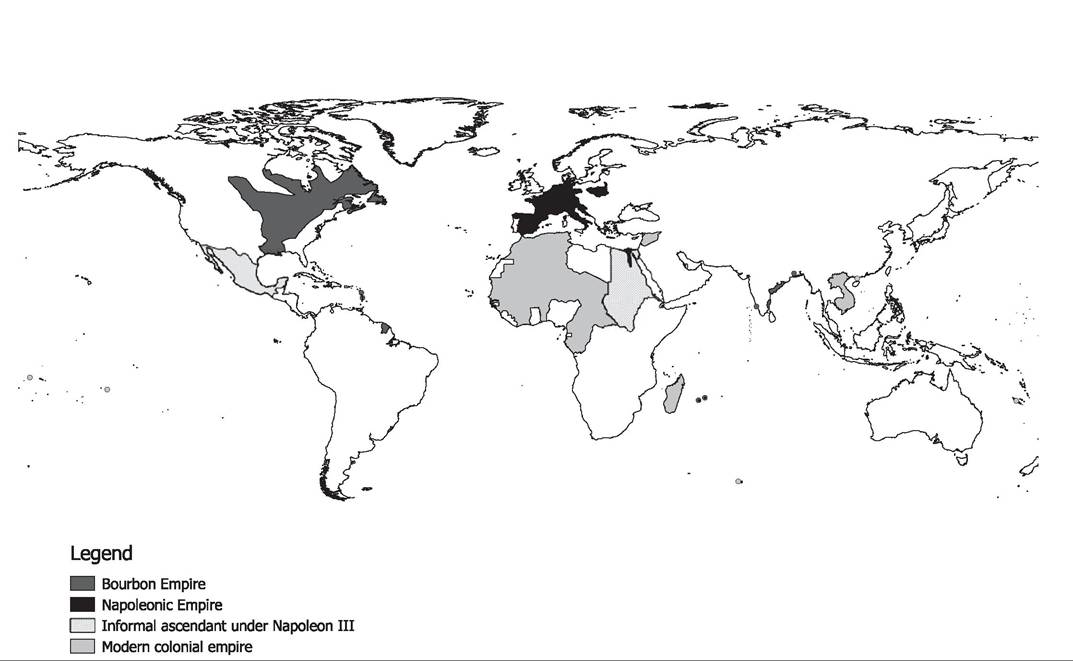
Map 34.1. The French Empire.
Copyright: David Todd.
AN IMPERIAL NATION-STATE: FRANCE AND ITS EMPIRES 943
that brought down the regime of Napoleon III between 1867 and 1870 were each followed by a partial or complete reinvention of the French empire.
This chapter will successively consider the four main phases of French imperialism, or French empires: the Bourbon empire until 1789; the Revolutionary-Napoleonic empire of 1789-1815; France's economic and cultural informal empire of the mid-nineteenth century; and the new republican territorial empire after 1870.The chasm between France's imperial ambitions and actual capacity to project power is also the root of a common misconception about French imperialism: its supposed rigid adhesion to a monolithic replication, beyond national borders, of the policies of centralization and administrative uniformity pursued in metropolitan France, or what might be described as colonial absolutism or Jacobinism. Until recently, many historians tended to accept at face value the claims put forward by successive French regimes that imperial conquests were not mere colonies but extensions of metropolitan France: new provinces under the Ancien Regime, new departements during the Revolutionary and Napoleonic Wars and later in Algeria, or at least territories, in North America or Sub-Saharan Africa, whose populations were destined to become full members of the French national community once the process of “francization” or “assimilation” was completed. Many contemporaries sincerely believed in such ideals, and the rhetoric of assimilation helped to mobilize metropolitan resources toward imperial expansion. But on the ground, limited resources implied an extreme pragmatism: French empires were mostly motley collections of territories, where local political, social, and economic circumstances determined the course of events to a far greater extent than decrees from Paris.
A salient example of the weakness of official centralization was the strong French propensity to seek and cultivate alliances, often on a basis of equality, with non- ethnically French colonial populations. For over a century, good relations with indigenous tribes helped the French make up for their low numbers and resist British expansion in North America.
The French revolutionary regime only succeeded in repelling invaders in the West Indies and conquering half of Europe thanks to the fabrication of new types of collaborators: emancipated black slaves in Saint- Domingue and foreign Jacobins in France's sister republics. Napoleon's decision to rescind the abolition of slavery in 1802 and his increasing disregard for the political and material interests of France's satellite states after 1805 played a decisive role in the demise of Napoleonic rule in overseas colonies and Continental Europe. As much as the official universalism of France's successive empires, in its Catholic or republican incarnations, this high level of collaboration with colonial populations helps to explain the slightly greater level of racial fluidity in the French than in the British and other modern European empires. But when collaborators were not necessary, as in Algeria, where European settlers made up 15 percent of the population, racial discrimination became as entrenched as in the rest of the European colonial world.Perhaps the least trumpeted form of imperial collaboration practiced by France was the global partnership gradually forged with Britain after 1815. Anglo-French rivalry remained a major feature of European colonial expansion in the nineteenth century, but it became increasingly emulative and cooperative. France and Britain waged many imperial wars after 1815, but never against each other and often—against the Ottoman Empire, Argentina, Mexico, Russia, China, and finally Germany in 1914—as allies. Competition still occasionally erupted into crises, for example over Egypt in 1840 and 1882. Such rivalry culminated with the clash of Fashoda in 1898, which seemed to bring the French and British empires to the brink of a global military conflict. But these crises originated in French aspirations to alter the terms of this informal alliance rather than in an earnest desire to defy Britain's superiority overseas, and always ended with a diplomatic retreat and recognition by France of its junior status in the Anglo-French global condominium.
The long-term trend of Anglo-French imperial relations in the nineteenth century remains best described by the notion of Entente Cordiale, a phrase coined in the 1820s and which gained wider usage in the wake of the agreement that settled outstanding colonial disputes between the two countries in 1904. Contemporary outbursts of rhetorical Anglophobia mostly served to conceal the frequent function of the French empire as an auxiliary of its British rival.This critique of rhetorical appearances is not intended to dismiss the importance of ideas in the history of French empires. On the contrary, French ideas about empire made several decisive contributions to the development of European imperialism. The high concentration of Orientalist erudition in Paris and the global curiosity of the French Enlightenment were major factors behind the military and scientific expedition of Egypt in 1798, the first self-proclaimed Western attempt to regenerate an allegedly decadent Eastern society. The various strands of positivism, which dominated French intellectual life in the nineteenth century, from the global industrializing fervor of Henri de Saint-Simon and his disciples to the pseudo-scientific demonstrations, by the philologist Ernest Renan and others, of the superiority of European races or culture, cultivated the sense of a European or Western mission to bring material and moral improvement to the rest of the world. Combined with the emancipatory universalism of French republicanism, these ideas helped to fashion what became the mission civilisatrice after 1870, or what Jules Ferry (premier in 1880-1881 and 1883-1885) described as a “duty to civilize inferior races.”[2221]
The irony of the patrie of civilization, the rights of man, and democracy providing high-minded justifications for the exploitation of other nations was not always lost on contemporaries. From Denis Diderot's condemnation of European greed and ruthlessness in the Histoire des deux Indes at the end of the eighteenth century, to the indignation of radical republicans after Ferry's speech of 1885, to the hostility of communist intellectuals to capitalist imperialism in the twentieth century, France was also home to a vibrant tradition of anti-colonial ideas. Nor was this irony lost on colonized populations. It is likely that the tension between the emancipatory rhetoric of French imperialism and the practical prevalence of discrimination and humiliation helped to nurture some of the most radical critiques of foreign domination, from Johann Gottlieb Fichte's Address to the German Nation (1808) to Frantz Fanon's The Wretched of the Earth (1961), and some of the most violent and successful revolts against colonial rule, from the Haitian Revolution of 1791-1804 to the Indochinese and Algerian wars of independence of 1946-1962. The high level of bitterness and violence of French decolonization was rooted, in part, in the frustrations engendered by the false promise of assimilation.
More on the topic Few modern European states have aspired to empire as consistently as France.:
- PART VI THE GREAT CONFLUENCE
- 39 Nations Afloat
- The Legacy of Roman Law
- WHY COLONIALISM?
- 40 The Nordic Indies
- 48 Continents Divided, Oceans Conjoined
- From the Circus to the Capital
- Introduction The Bible