Funding
Before examining the close relationship between finance and the navy, it is necessary to outline the Venetian fiscal system between the Late Middle Ages and the Early Modern Period.
From the thirteenth to the seventeenth centuries, most revenues came from indirect taxes that were levied on both trade and consumption. It is quite probable that, between the mid-thirteenth and mid-fourteenth centuries, peacetime income was enough to cover all the state's regular needs. The state was nevertheless compelled to seek new ways to finance the expense of growing military commitments, a consequence of expanding dominions. By the mid-fourteenth century, the Republic's budget amounted to about 250,000 ducats (over 10,000 kilos of silver). Before the Black Death, the population of Venice itself was around 100,000. At the same time, the French monarchy's budget can be estimated at about a million livres (44,000 kilos of silver), with a population totaling nearly a million people. It therefore seems likely that Venice, even if we take account of the population of its extended dominions, was able to mobilize comparatively large financial resources considering its limited population.[1647]The health of state finances depended on sound economic and military foundations. Venice managed to play a crucial part in international trade thanks to both the capability of its merchants and the effective action of its mariners and soldiers. Emblematic of this was Venice's handling of salt production and distribution in the Adriatic.[1648] From the thirteenth century onward, Venice imposed a monopoly over the salt trade in the Adriatic, placing tight controls on the coastal towns that produced it. Salt was imported to Venice and then redistributed through excisemen—with high returns for state finance—to both Venetian subjects and to neighboring states.
This hegemony over the salt trade was the result of an aggressive policy, pursued by means of military force, in order to create an asymmetrical relationship between salt producer and consumer, which rendered a considerable profit to Venetian mediators.A further example, emblematic of the use of violence for economic ends, can be seen in Venice's assertion of sovereignty over the northern Adriatic. As early as the mid-thirteenth century, a squadron of galleys regularly patrolled the northern end of the Adriatic—which Venetians called the “Gulf”—ostensibly to defend a sort of right to control shipping.[1649] Though there was no backing for this in universally recognized rights, Venice had imposed its jurisdiction over those waters and demanded tribute from coastal towns within the area. All ships entering the area were subject to inspection by the galleys of the Republic. A Venetian sea space had been created, with no formal legitimacy in international law, but sanctioned by the exercise of military power.
Despite these events—which seem to present a clear progression and motive for Venice's expansion—it is nevertheless difficult to determine with certainty the overall link between Venice's economic expansion and its military development. Despite the existence of a stable nucleus of war galleys, war fleets were mostly composed of merchant ships that were requisitioned for war in case of need. This meant that the permanent bureaucratic structures for naval organization were quite minimal, and that most of the machinery set in motion in wartime was quickly dismantled with the coming of peace. This flexibility mirrored the commercial character of the empire, which kept costs at a minimum to safeguard commercial profits. Venice was nevertheless able to deploy 100 galleys, even after making peace with Genoa in 1299, in order to keep the Levantine commercial routes safe.[1650] In a context of great uncertainty, traders were burdened by the costs of protection, something that affected the final cost of goods significantly.
As Frederic Lane argues, “different enterprises competing in the same market often pay different costs of protection, perhaps as tariffs, or bribes, perhaps in some other form.”[1651] Because of this, the state that provided protection more efficiently than others guaranteed advantages to its own traders. In the Venetian case, as late as the fourteenth century, protection costs were mostly borne by foreign traders and consumers. Venice's import and export of costly Eastern goods like spices provided high returns that were ultimately paid by European buyers. Furthermore, military costs, though high, were unlikely to undermine the structure of state finance, since the state managed to recover from any financial crisis associated with war relatively quickly.The elasticity of the state fiscal mechanisms relied on a system of forced loans that were imposed on Venetians in case of need. Urban elites were strongly opposed to ordinary direct taxation. One of the prerogatives that differentiated town dweller from peasant were non-returnable direct taxes: the former usually did not pay them. In Venice, as well as in Florence or Genoa, the richest citizens were initially asked to lend money voluntarily to government in case of need, and the state committed to paying it back in a short time. In the meantime, it paid interest on the loan. The system was unable, in the end, to cope with growing state expenditure, and so from the end of the twelfth century, it began to impose interest-bearing forced loans. All citizens were required to lend to the state according to their wealth, which was assessed and recorded in public registers. Loans were—at first—reimbursed. Later, however, increasing difficulty in returning the principal led to the development of funded debts. In 1262, the Venetian government acknowledged its momentary incapacity to repay creditors, and therefore committed certain tax revenues to the regular payment of 5 percent annual interest, and all such loans were eventually transformed into long-term loans.
War had thus prompted a crucial financial innovation: difficulties in covering wartime spending spurred the adoption of a solution that allowed government to bring in huge amounts of money at moderate cost, while at the same time burdening citizens as little as possible. In addition to its financial effects, funded debt had political implications: Venetians had become the state's creditors, and their wealth had become directly involved in the formulation and execution of government policy.The foundations of Venetian power in the eastern Mediterranean were economic, financial, and also ideological. The war fleet was commanded by patrician merchants and crewed by paid sailors from Venice and abroad. The money for war expenses and interest payments on the funded debt mostly came from customs duties. The forced loan mechanism converted Venetians' financial resources into effective military power that, in turn, helped to broaden and strengthen the material base from which to draw further financial resources. War was thus perceived to be a matter that concerned the whole city, since it was thought to be the most powerful means of preserving Venice's economic and political power. In the fifteenth century, however, this relationship between private resources and public spending was broken when Venice expanded its dominions in the Italian Peninsula and when the Ottoman Empire emerged as a rising power in the Mediterranean.
The war against Genoa in 1378- 1381 caused a severe financial crisis. Government forced loan demands grew, but interest payments on old loans were simultaneously cut. The interest rate on credit, meanwhile, was reduced to 4 percent, and the market price of state bonds dropped to 18 percent of par. Subjected to such pressures, the forced loans system was pushed beyond the limits of tolerance. From the mid-fifteenth century onward, therefore, the state looked for new ways to raise revenue. It resorted to direct taxation, a practice that became semi-regular by the mid-fifteenth century and then entirely regular during the sixteenth.
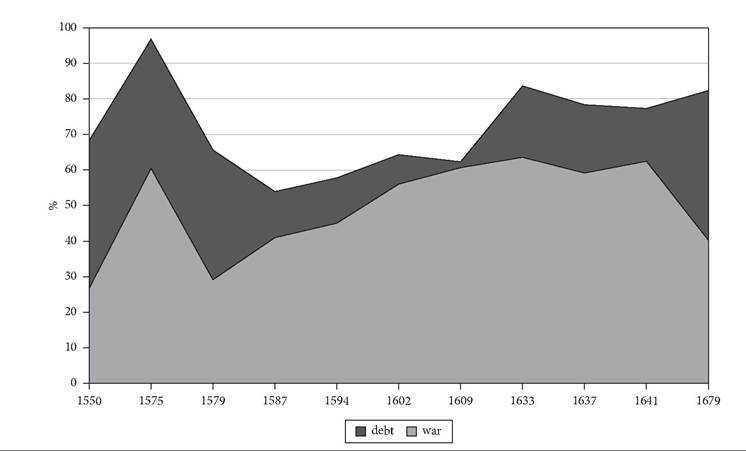
From the early sixteenth century, forced loans were seldom used, and the government entered the open credit market. New series of loans were launched to raise money among investors. Underwriting was a free choice, the interest rate was higher than that of the old funded debt's Monti, and bonds were tradable and tax-free. The deficit finance mechanism was thus improved through financial innovations, and this was a crucial step toward creating a more efficient state debt. These innovations were prompted by the increasing needs of military spending both at sea and on land.The fifteenth century began with Venetian territorial expansion in the mainland, and included a long war against the Ottomans in 1463-1479. It ended with the need for a titanic war effort. In 1499, the Venetian land army conquered Cremona, not far from Milan, and at the same time the Republic had to face both the Ottoman fleet in the Aegean area and Ottoman cavalry raids in the eastern mainland. Venice deployed about 20,000 soldiers in the Italian Peninsula and between 20,000 to 25,000 men in the fleet. The size of the military machine was impressive: the land army was as large, quantitatively, as the French and Spanish, and the fleet was probably the most powerful among the Christian states.* [1652] If we consider the Venetian-Ottoman War of 1570-1573, the picture does not change. The military forces deployed were the product of a well-tested administrative and financial machine. In 1571, according to Venetian records, the infantry distributed throughout the Levant fortresses and embarked in the Armata numbered over 30,000. The fleet consisted of 130 light galleys and 9 galleasses. An estimate of the men serving under the symbol of St. Mark gives a total of at least 55,000, and consequently the ratio between Venice's total population and military conscripts was 36 to one.[1653] In the years following Lepanto, the Venetian forces were reduced, with the army now numbering about 10,000 soldiers in the fortifications, and the navy numbering some 6,000 sailors and oarsmen. These figures suggest that we should conduct a careful examination of some features of the Venetian state's structure. Figure 22.1 shows that a considerable percentage of revenue was devoted to funding the military and servicing the public Figure 22.1. Military machine and debt service (as percent of state expenditure). Source: Pezzolo 1990, 124; 1994, 324-25; 2006a, 77. debt. The picture that emerges is not very different from those concerning other state finances. Considering that state debt was due primarily to military spending, it would seem that war and the structure of the military constituted the single greatest state expense. It is interesting to note that the growth of military spending can also be credited to high inflation in the sixteenth century: between the mid-sixteenth and the early seventeenth centuries, the cost of a light galley doubled, for example. This growth rate was, however, lower than the price increase for foodstuffs over the same period. Naval spending (i.e., on the fleet and arsenal) accounted for 20-30 percent of the total. Between the mid-sixteenth century and the 1640s, relatively speaking, Venice spent more on its fleet than England.[1655] From the 1550s to the 1630s, funds earmarked to the navy roughly doubled—keeping up with rising prices—while state expenditure nearly doubled (see table 22.1). Unlike England, however, the Venetian state does not seem to have invested in technological innovation. The Republic’s navy maintained relatively high standards, but it was certainly inferior to the navies of the new seventeenth-century powers—namely, England and the United Provinces.
More on the topic Funding:
- Article 4.11 Midsized issuers welcome funding scheme
- The Role of the Asset-Backed Commercial Paper Market in Funding Mortgages
- Economics
- Stress Tests and Liquidity Requirements
- Ashe Jeffrey, Neilan Kyla J. In Their Own Hands: How Savings Groups Are Revolutionizing Development. Berrett-Koehler Publishers,2014. — 220 p., 2014
- 10 Cross-compliance and the Polluter Pays Principle
- Conclusion
- Article 10.1 Big investors replace banks in $4.2tn repo market
- Does It Last?
- Where We Stand Today
- Kinds of Collective Responsibility
- Introduction
- It was early 2008. By this time, I had heard many stories from people in Mali, Cambodia, El Salvador, and Guatemala about how Saving for Change had changed their lives.
- Conduct on Fees and Costs
- The Challenges of Military Organizations
- After years of promoting savings groups, I have identified nine principles that explain why the number of savings groups has grown so quickly,
- Preface