The Frontiers Department and Indirect Rule
The Department of Frontiers (lifan yuan, tulergi golo be dasara jurgan) was the last of the Qing governments to be created, but it was already well established when the Qing conquest of north China began.
The origins of the department lay in the “Mongol Department” (monggo yamun) established in 1634 to administer tribute and communications from Mongol groups not already incorporated into the Eight Banners—that is, primarily, the Chakhar, Tumet, and later the Khalkha populations. In 1638 the name was changed to Department of Frontiers, but its primary business remained the management of Mongol affairs—both within the Qing territories and beyond its borders. Its officials were all Manchus (or Manchu-speakers whose identities had been resolved administratively as Manchu) and Mongols.[1997] It communicated to Mongols in Mongolian, and to the Qing court in Manchu. In the march of the Qing conquests through Mongolia, Tibet, and Eastern Turkestan, the Frontiers Department became the comprehensive government for administration outside of China proper. It had its own treasury and personnel office, its own diplomatic reception courts, translation offices, law code, and judicial system. Appointment or confirmation of Mongolian, Turkestani, or Tibetan clerics, tax and tribute collection, and adjudication of disputes were all under the jurisdiction of the Frontiers Department.[1998] As was the case for all the Qing governments, the process of conquest and consolidation, as well as developing relationships with continental neighbors, caused seepage of jurisdiction and authority. The Eight Banners supplied most of the officials to the Frontiers Department, whether they were appointed to military posts or not. Military campaigns in western Mongolia and in Eastern Turkestan required coordination of both Frontiers Department and Eight Banner policies.[1999] The strategic significance of the southwestern provinces of Sichuan and Yunnan to the Qing position in Tibet caused the administration of these areas to be under the Frontiers Department for a time; the Qing policy of assimilation and progressive regularization of administration in the Southwest, however, gradually put these matters under the authority of the civil government.[2000]Perhaps the most complex relationship was with Russia.
For the most part, communications with the Russian government were handled distinctly from those of the states whose embassies reported to the “guest ritual” venues of the civil government. There may have been two reasons for this. First, the Qing and Russian empires had been competing for dominance of the Amur River region since the mid-seventeenth century. The Qing were victorious until the nineteenth century, but the history of conflict had constructed a sense of imperial rivalry and a concept of equality between the empires that was partly reflected in the political language of the Frontiers Department.[2001] Second, Russian involvement in Mongolian trade was of sufficient volume that disputes in the trade zone were frequent. Mongols subject to the Qing sometimes strayed into Russian territory, and Russians sometimes violated Qing borders. Russian merchants based in cities of Mongolia such as Urga complained of thefts, swindles and assaults, while Chinese and Mongol merchants lodged charges of Russian misconduct. Tariffs and transport taxes were often under negotiation. The volume of Russia-related problems in Mongolia was high enough that the Frontiers Department had more than enough business to fill the agenda of its legal and trade offices. It was the natural venue in many ways for negotiation and ratification of the treaties of Nerchinsk (1689) and Kiakhta (1727) that marked the borders, established the sanctions for violation of the borders, and regulated trade across the borders. Nevertheless, the Russian delegations to Beijing to begin negotiations of the Nerchinsk Treaty and complete the Kiakhta Treaty included visits to the guest ritual courts of the civilian government.As the conquests spread through Mongolia, East Turkestan, Tibet, and Yunnan, the Frontiers Department took primary responsibility for establishment of indirect rule. This was the method by which most of present-day Mongolia and Tibet were
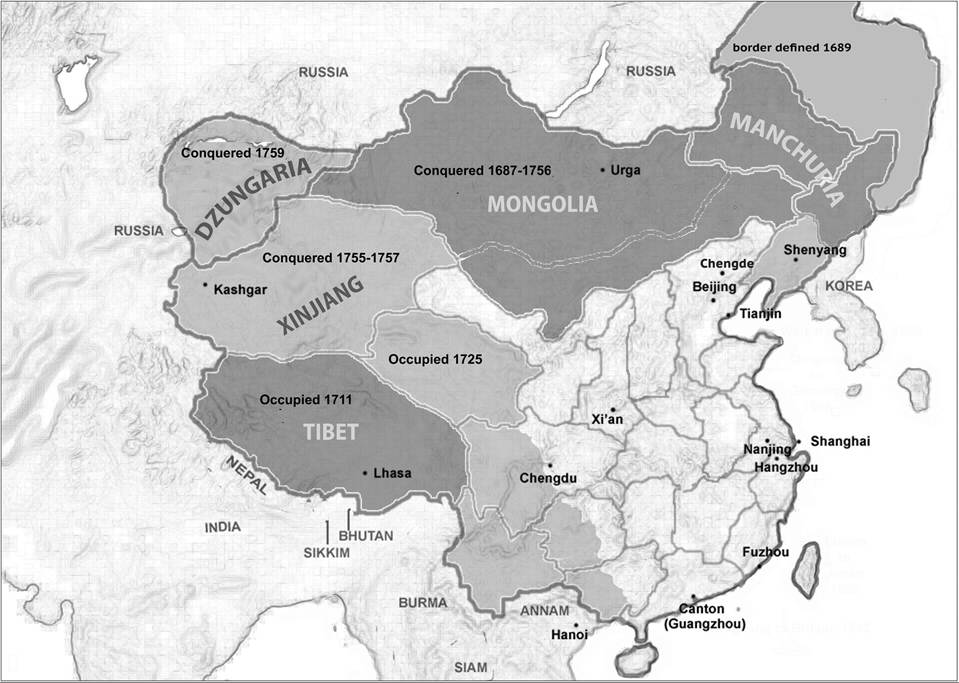
THE QING EMPIRE 821
Map 29.1.
The Qing Empire at Its Greatest Extent, ca. 1800. Copyright: Pamela Kyle Crossley.governed, as well as the Tarim Basin. Before the early eighteenth century it was the preferred method for governing Yunnan province, but over the eighteenth century Yunnan shifted from indirect to more direct rule, as the Frontiers Department receded and administration by the civil government advanced. The responsibilities of the Frontier Department for these territories were comprehensive. Cooperative local elites were confirmed and recognized through the Department, laws were administered through its legal bureaucracy, tribute and taxes were collected, commercial licenses granted, hunting and herding were regulated, and local elites were trained in Qing court etiquette and transported to Beijing or Chengde for occasional audiences. The Frontiers Department coordinated the political and economic integration of large zones federated to the empire without sustained or thorough military confrontation and occupation until the mid-nineteenth century. The Frontiers Department lost its function as the medium of Russian communications when foreign treaty powers forced the creation of a new foreign ministry in 1861; the department survived in name until 1908, when its name was changed slightly (to lifanbu, or Frontiers Office) for the remaining three years and some months of the empire.
More on the topic The Frontiers Department and Indirect Rule:
- 7.2 Some indirect correctives to the problems of judicial rule-making
- In 1864, the French government established a Protectorate over the small and politically weak country of Cambodia, and by this act consolidated their indirect rule over this part of what was then known as Indochina.
- Chapter 13 The New Frontiers
- The rule of law as a rule of human conduct.
- CHAPTER 2 The Muslim World at the Frontiers: Al-Andalus
- Omitting intermediate entities in models of indirect interactions
- Indirect species interactions can have large effects
- A Case of Non-commodified and Indirect Economic Imperialism
- CONCEPT 14.1 Competition can be direct or indirect, vary in its intensity, and occur between similar or dissimilar species.
- Chapter 12 Appendix IV: Comments from the Department of Defense
- CONCEPT 16.3 Communities can be characterized by complex networks of direct and indirect interactions that vary in strength and direction.
- Pediatric Emergency Department Considerations
- Pediatric Emergency Department Considerations
- Chapter 11 Appendix III: Comments from the Department of Agriculture
- Department Chair's Note
- Chapter 13 Appendix V: Comments FROM THE DEPARTMENT OF HEALTH and Human Services
- Chapter 15 Appendix VII: Comments from the Department of Homeland Security
- STEPHANIE SPECK Bundeswehr Institute of Microbiology, Department of Virology and Rickettsiology, Munich, Germany
- HR&CE (Hindu Religious and Charitable Endowments Department) and Traditional Community Rights over Folk Temple