The Outer Provinces
The Aztecs controlled the outer provinces through both direct and indirect methods. In many areas, local kings and nobles were invited to ceremonies in Tenochtitlan, and in some cases marriage alliances were established with important provincial dynasties.
Unlike ancient empires that employed more direct forms of rule, the Triple Alliance did not invest in the construction of roads, cities, or other infrastructure in provincial areas. But the indirect forms of control should not obscure the presence of more direct channels of administration and the role of military threat. Many examples of imperial style objects and carvings have been found in provincial areas, and one notable feature of these is the prominence of military and imperial symbols and themes (Figure 24.3).Detailed comparisons of written, pictographic, and archaeological data reveal the specific ways in which the Aztecs targeted the most important city-states in each region in order to achieve control with a minimum of effort. In this strategy, Aztec administrative governors were sent to rule directly the principal city-state of an individual province (often the provincial head town). These officials were typically accompanied by military forces, settlers, and/or tax collectors, to reinforce the Aztec presence. When available, archaeological data attest to this strong presence, with significant concentrations of Aztec artifacts in the capitals of the major polities; temples
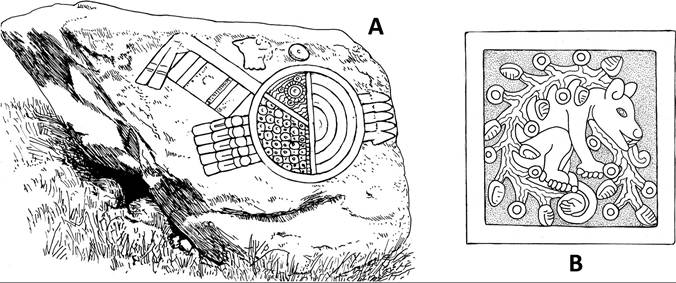
Figure 24.3. Imperial style stone relief carvings from the province of Cuauhnahuac showing military and political themes. A: shield and arrows, a symbol of warfare, from Cuernavaca. B: name glyph of the emperor Ahuitzotl (r. 1486-1502), from the Temple of Tepozteco at Tepoztlan.
Drawings by Emily Umberger; reproduced with permission.
and palaces were often redecorated with Aztec architectural ornaments; Aztec sculptures were displayed in visible areas; and imported Aztec censers, templemodels, and other ritual paraphernalia were used in religious ceremonies.
In dealing with important but less powerful polities, the Aztecs tended to establish social relationships with local authorities (e.g., gift giving, attendance at imperial celebrations) and to encourage their cooperation with a slighter Aztec presence (perhaps a tax collector or small garrison). Finally, they did not engage themselves in the smallest city-states: it was not necessary because they were already controlled by a more powerful city-state. This mechanism allowed the Aztecs to maintain a firm control of the outer territory at a minimal expense. Imperial impact on a local area was low, but control was maintained.[1725]
More on the topic The Outer Provinces:
- The Central Provinces
- The Outer Empire
- Ill ROME AND THE PROVINCES
- 1 The Ukrainian-Speaking Provinces before the Great War
- Addressing Adverse Formalisation: The Land Question in Outer Island Indonesia
- Provincial and Provinces: The Basis of Provincial Jurisdiction
- The idea that Earth has unlimited capacity to provide for human desires and absorb human wastes was undermined when the first pictures of the planet from outer space were published.
- Structure and Functioning of Ear
- Roman law did not require documentation to make a marriage valid, though often contracts were drawn up stating the terms of the dowry [see Part I.D].
- Sufism
- EPILOGUE Closing the Curtain Reflecting on things past
- Socioeconomic Developments in Dnieper Ukraine
- Politics and the formalization of sharia