The peace process, its collapse and attempts to revive it
The environment which allowed for the construction of a workable and sustainable Middle East peace process began to emerge in the late 1980s as the result of a combination of international, regional and domestic factors.
At the international level, the collapse of the Soviet Union removed the Cold War framework which had been an obstacle to conflict resolution. At the regional level, the 1990 Iraqi invasion of Kuwait, which was supported by the PLO, revealed to the majority of Middle Eastern players, as well as the remaining superpower, theUnited States, that regional stability could only be achieved if the Arab-Israeli conflict was resolved, as this would undermine the legitimacy of either Arab nationalists or Islamists who advocated expansion, revolution or war in the name of the liberation of Palestine. Finally, at the domestic or Israeli-Palestinian level, the intifada made Israeli occupation increasingly costly and difficult at a time when an expected one million Jews from the former Soviet Union needed to be absorbed. It also raised uncomfortable questions about the nature of the Israeli state, democracy and human rights. All these factors together made it possible for the United States, together with Russia and the European Union, to provide a framework for talks. In addition, the Great Powers also provided numerous sticks and carrots to get Arabs and Israelis to the negotiating table: carrots, such as desperately needed loan guarantees for Israel, and sticks, such as reminders to the PLO that it had backed Saddam Hussein in the Gulf War and therefore was not in a position to make demands.
Great Powers
Traditionally those states that were held capable of shared responsibility for the management of the international order by virtue of their military and economic influence.
The Madrid Conference which opened on 30 October 1991 officially initiated a peace process which divided the negotiations into bilateral and multilateral tracks.
The bilateral tracks aimed at achieving separate peace treaties between Israel and its Arab neighbours Syria, Lebanon, Jordan and the Palestinians. The multilateral track was designed to resolve broader regional problems such as water, the environment, arms control, refugees and economic development. Although the framework was put in place, the negotiations themselves quickly became hostage to domestic politics as well as popular fear and mistrust. Indeed, it was not until the 1992 Israeli elections and the replacement of Yitzhak Shamir's centreright Likud government with Yitzhak Rabin's centre-left Labour government that real negotiations rather than posturing started to take place.The key to peace with the Arabs was an Israeli-Palestinian agreement as none of the Arab states was otherwise willing to sign any treaty with Israel. Cautious Israeli-Palestinian talks were initiated in early 1993 in Oslo out of the limelight of the media and the official negotiations, which by that point had been moved to Washington. The first contacts took place between Israeli academics such as Ron Pundak and Yair Hirschfeld and Palestinian representatives. As progress was made, Israeli academics were upgraded to civil servants and lawyers, ultimately including Foreign Minister Shimon Peres. The product of the negotiations was the Declaration of Principles (DOP), more commonly known as the Oslo Accords, signed on 13 September 1993 on the White House lawn by Rabin and Arafat.
While falling short of establishing a Palestinian state, the DOP provided for mutual recognition and outlined arrangements for Palestinian interim selfgovernment, election of a Palestinian Legislative Council, Israeli redeployment and final status negotiations. Under the Rabin administration Israeli-Palestinian negotiations proceeded with a series of smaller arrangements and agreements, most notably the 1994 Cairo Agreement which included provisions for Israeli military withdrawal, the transfer of authority to the Palestinian Authority (PA) and Palestinian police force, and the 1995 Israeli-Palestinian Interim Agreement which aimed at broadening Palestinian autonomy, but also addressed security, elections, economic relations and the release of prisoners.
The DOP also opened the way for negotiations with the Arab states. Jordan was the first to follow suit with a full peace treaty in October 1994. With few contentious issues to resolve, the absence of major conflict since 1967 and a history of secret amicable relations, this treaty was easily concluded. Negotiations with Lebanon and Syria were, in comparison, more problematic. The most difficult issue here was Syria's insistence on a full return of the Golan Heights and a peace treaty based on mutuality, equality and reciprocity in all areas including security.
Hamas
The acronym for Harakat al-Miiqaivarna al-lslamiyya (Islamic Resistance Movement). Emerged during the first intifada in 1987 in the Gaza Strip.
Rabin's assassination on 5 November 1995 and the 1996 election of the Likud leader Benjamin Netanyahu as prime minister put an end to further progress in Israeli-Palestinian relations and to Israeli-Syrian negotiations, as well as severely disrupting normalization with Jordan. While Netanyahu under American pressure concluded two more agreements with the Palestinians - the 1997 Hebron Agreement and the 1998 Wye Accords — the former was at best only partially implemented, and the latter not at all. In the meantime the Palestinians in their own 1996 elections endorsed Arafat's leadership of the PA. However, as relations with Israel deteriorated, Arafat and the PA were increasingly challenged by the rejectionist left-wing Popular Front for the Liberation of Palestine (PFLP) and the Democratic Front for the Liberation of Palestine (DFLP) as well as the Islamist Hamas. Their charges of a political sell-out were further exacerbated by the increasing corruption within the PA; both resulted in considerable disillusionment for the Palestinians with their own leadership and the peace process as a whole.
see Map 18.2
The election of Labour leader Ehud Barak in May 1999 set in motion the collapse of the peace process when efforts to restore the negotiations with the Palestinians and Syria ultimately failed.
Barak chose to start with Syria but his reluctance to commit himself to a full withdrawal to the 4 June 1967 line, despite acknowledging the fact that Rabin had made such a commitment, left the Syrians feeling that Israel had backtracked and was therefore lacking seriousness and goodwill. Barak then moved towards final status negotiations with the Palestinians, making what Israel considered ‘an unprecedented offer'. For the Palestinians, however, the offer did not go far enough as it failed to meet Palestinian needs on the status of Jerusalem, the future of Israeli settlements, Palestinian refugees and viable Palestinian statehood. While the Israeli offer, which had in fact been an American bridging proposal, failed to meet Palestinian expectations and while the Camp David Summit itself was marred by Barak's lack of interpersonal skills, it was ultimately Arafat who made the decision to walk out of the talks. This decision-making error was only surpassed by the Palestinian decision to launch another uprising — the second intifada.The so-called al-Aqsa intifada erupted on 29 September 2000 and was triggered by the visit of Likud leader Ariel Sharon to the Temple Mount/Haram ash-Sharif on the previous day. Sharon's visit aimed at shoring up Israel's claim to a united Jerusalem as well as undermining Barak. The widespread violence that followed was the result of anger at Sharon's presence but also of long-term pent- up Palestinian frustration with a peace process perceived as supporting Israeli hegemonic ambitions, of discontent with the lack of change in the everyday life of the average Palestinian, of dissatisfaction with their own leadership, and of rage
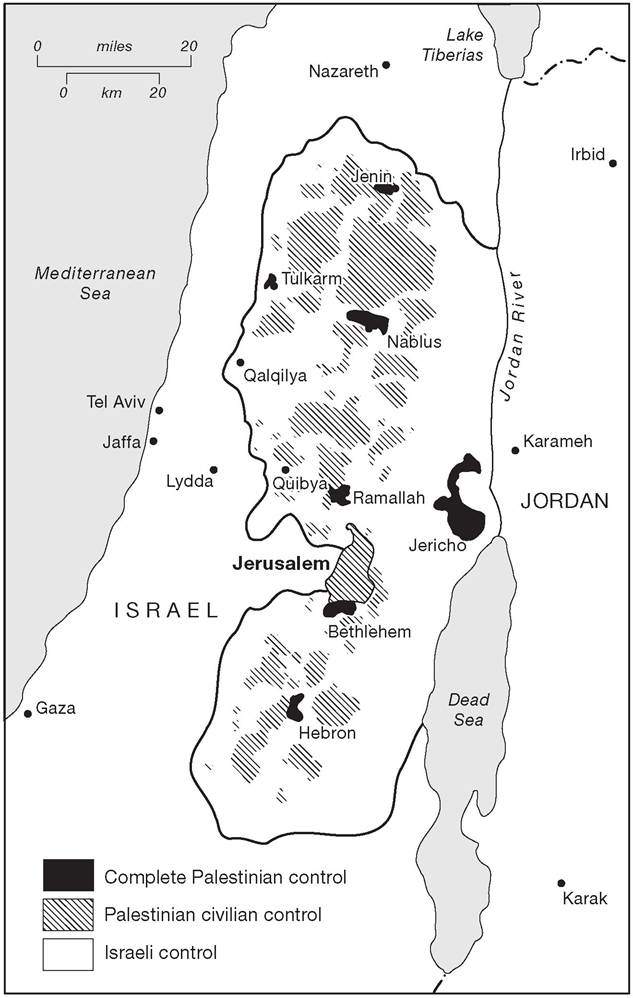
Map 18.2 The West Bank in 2000
Source: After Bregman (2003)
Hizb'allah (Arabic: Party of God)
Lebanese Shi'a Islamist group which emerged in reaction to the 1982 Israeli invasion of Lebanon. Its primary aim until the Israeli withdrawal in May 2000 was the liberation of southern Lebanon.
felt particularly by a younger, profoundly alienated, generation. The extent of the violence took both Israel and the PA by surprise. The latter quickly moved towards harnessing the uprising in order to use it as leverage against Barak. Indeed, Arafat embraced it as the core of his post-Camp David strategy. Harnessing the intifada, however, proved impossible as there were too many disparate armed groups involved, many of which originated from the rejectionist camp and thus had no interest in co-operating with the PA. While the first days of the second intifada were reminiscent of the 1987 uprising, the nature of the protest quickly changed as firearms appeared on the street. What had been popular demonstrations turned into a volatile mixture of riots and attacks carried out by, amongst others, the PFLP, DFLP, Fatah Tanzim, Hamas and Islamic Jihad loosely organized into the ‘Nationalist and Islamic Forces of Palestine'. The Israeli security forces and settlers became the prime targets in a strategy inspired by the one Hizb’allah had successfully used to compel Israel to pull out of southern Lebanon in May 2000.
The ease with which Palestinians reverted to violence shocked Israeli society and prompted Barak to resign and call for new elections. It was in this context that a final effort was made by the Barak administration to close a deal with the Palestinians. These talks opened on 21 January 2001 in Taba, Egypt, with the Israeli elections only two weeks away. They were not as high profile as the previous summit. Neither Barak, Arafat nor the Americans were present. The negotiations themselves made substantial progress on the issues. After a week both sides stated that they ‘had never been closer to reaching an agreement'. The gaps on the scale of withdrawal, the settlements and security arrangements were reduced. In an unprecedented move the Palestinian delegation for the first time presented a map showing their acceptance of Israel's annexation of Jewish neighbourhoods in East Jerusalem.
An Israeli minister, Yossi Beilin, in a reciprocal move, put forward a proposal for Israel to take in a quota of refugees over a number of years. This proposal, however, was not supported by the Israeli negotiating team. In the end, no agreement was concluded as the timing was simply not right. The Israeli public did not want its government to make such important commitments right before the elections. The Palestinian representatives feared that even if commitments were made they would not be upheld by a new Israeli government. And in any case, what was on offer at Taba, while significantly closer, still fell short of the minimum that the Palestinians could accept.The next peace initiative came in spring 2002 and was proposed by Saudi Crown Prince Abdullah at the Arab League meeting in Beirut, being adopted by the League on 28 March. The Arab Peace Plan called for a full normalization between the Arab states and Israel in the context of a final settlement. The Arab peace message, however, was lost when on the same day a Palestinian suicide bomber killed thirty people celebrating Passover in the Park Hotel in Netanya. Five more bombings followed over the next five days. The Arab Peace Plan did not stand a chance. There have been a number of attempts to revive the plan since 2002, the most recent in spring 2007. None has so far been successful.
In July 2002 the ‘Quartet' of the US, EU, UN and Russia picked up the tattered pieces of the Arab Peace Plan and put together the so-called ‘Roadmap for Peace'. However, it was not until the appointment of Mahmoud Abbas as Palestinian prime minister in April 2003 that the ‘Roadmap’ was officially initiated so that neither the US nor Israel had to deal with Arafat. The ‘Roadmap’ was a performance-based plan in three phases, which ultimately envisaged a safe and secure Israel co-existing with a viable, sovereign and democratic Palestine. The first phase focused on ending the violence on both sides, followed by a normalization of Palestinian life, the building and rebuilding of Palestinian institutions and civil society, and the dismantling of settlements begun since March 2001. The second phase saw democratic Palestinian elections, a new democratic Palestinian constitution, comprehensive security performance, and the creation of a Palestinian state with provisional borders and sovereignty as a way station to a permanent status settlement. The third phase would produce a permanent status agreement and result in the end of the Israeli-Palestinian conflict. This would come in the context of an international conference and would be based on UN Security Council Resolutions 242, 338 and 1397, including a just and fair solution to the Palestinian refugee situation, the status of Jerusalem and full normalization. The ‘Roadmap’ was endorsed by both Israeli and Palestinian leaders as a way forward but it has so far not been implemented. Moreover, with the election of Hamas it has been questioned whether the Palestinians are still committed. Nevertheless it remained the ‘only game in town’ as far as the international community was concerned.
In the absence of a political solution, violence on the ground only intensified. Hamas’s Qassem rockets and its suicide bombings proved so effective that they were copied not just by other Islamists but also by secular Palestinian groups. With violence ruling the day, the earlier revival of the revolutionary structures was further reinforced and the opportunity arose for the re-emergence of the ‘insiders’, the local leadership of 1987-92. The rejectionists were also strengthened and Hamas, in particular, started to mount a credible challenge to Fatah. This led to battlefield competition between Hamas’s Izz al-Din al-Qassem Brigades and Fatah’s Al-Aqsa Martyr Brigades, increasing the militancy of all Palestinian armed groups. Israel, now under Prime Minister Ariel Sharon, opted for a strategy of unilateral disengagement. Underlying this strategy was Sharon’s belief that Arafat was not a partner, that the Oslo process was finished and that there would not be an immediate resumption of negotiations. Sharon’s separation strategy comprised four key elements. First, to isolate Arafat and the PA politically in order to force the former to resign and the latter to reform. Second, to target the PA structures militarily in order to weaken Arafat’s power base and to punish it for participating in the violence against Israel. Third, to ‘decapitate’ Hamas and Islamic Jihad by arresting or killing their leaders as well as destroying their command structures and support bases in order to reduce their military capacity and threat against Israel. And fourth, to separate Israeli and Palestinian territory physically in order to make Israel’s border more defensible. This territorial separation started with the building of a fence along the West Bank and was followed by disengagement from Gaza and the northern West Bank in August 2005.
As Israeli strategy was implemented Palestinian popular opinion started to shift away from supporting an ineffective, internationally isolated PA towards supporting Hamas, which was seen as doing something about the occupation and which had not agreed to unacceptable compromises with Israel. This became clear with the death of Arafat in November 2004. The US and Israel hoped that his successor, Mahmoud Abbas (Abu Mazen), who was elected president of the PA on 9 January 2005, would be able to bring the violence under control, reform the PA and resume negotiations. However, despite the fact that Abbas received agreement from Hamas in March 2005 that they would honour a ‘period of calm', he was perceived as weak by Israel and the US as well as by the Palestinian population. Only a year later, on 25 January 2006, Hamas won the legislative elections, taking 74 out of 132 seats. The Hamas victory was not necessarily the result of popular desire for an Islamic state, but a reflection of how disillusioned the people were with Fatah.
The election of Hamas was a challenge for Israeli Prime Minister Ehud Olmert who had succeeded Sharon after the latter had suffered a stroke and fell into a coma on 4 January 2006. It was also a challenge for Fatah which refused to accept the Hamas victory, resulting in conflict that erupted between Hamas and Fatah cadres as well as their supporters. And finally it was a challenge for the international community which reacted by freezing development funds and economic aid. Not surprisingly this had an overall detrimental impact on the already ailing Palestinian economy. Israel, backed by the US, announced that there would be no resumption of talks under these circumstances as they did not negotiate with terrorists. Abbas, who vacillated between trying to bring Hamas in from the cold and marginalizing it completely, found himself, in turn, marginalized by the Hamas prime minister, Ismail Haniyyeh, as violence on the ground turned internecine. By spring 2007 the Palestinians were embroiled in a civil war, with the result that Abbas dismissed the Hamas government.
The collapse of the Hamas-led coalition government also gave impetus to the renewal of negotiations. On 27 November 2007, after a seven-year period without talks, President Mahmoud Abbas met with Prime Minister Olmert in Annapolis under the auspices of the US and the Quartet in order to talk about the resumption of negotiations with the aim of concluding a final status agreement by the end of 2008.
More on the topic The peace process, its collapse and attempts to revive it:
- The Oslo peace process: law and transition
- What is the Steinmeier Formula, and why did it become a stumbling block in the peace process?
- What was “New Russia,” and why did President Putin revive this concept?
- Article 16.2 India cuts interest rate to revive growth
- British attempts to appease Japan
- 12. The Soviet Collapse
- 26 Stagnation and Attempts at Reform
- Stagnation and Attempts at Reform
- The Peace to End all Peace?
- Justifiable Inequality? Five Attempts to Defend the Prohibition of the Veil
- The Real Dominos: The Soviet Union’s Sudden Collapse
- How did the Zelensky administration react to the attempts to embroil Ukraine in American politics?
- Polarization and Collapse
- Glacial Period: Conflicts and the Collapse of Circulations
- The collapse of the Grand Alliance
- Who were the dissidents, and how did they contribute to the collapse of communism?
- The Disintegration and Collapse of the Western Roman Empire
- What religions came to prominence in Ukraine after the Soviet collapse?
- The Swedish War and Collapse of the Polish-Lithuanian Kingdom
- 3 Political Collapse, Revolutions, and Social Upheavals, 1917-1923