What are individuals?
As we've seen, it can be a challenge to determine the size or density of a population, because it is necessary to know how many individuals are present within the population. For some species, there is an added challenge— determining what constitutes an individual.
How can there be confusion over what an individual is? Consider the quaking aspen trees (Populus tremuloides) in FIGURE 9.3. Like many plant species, an individual aspen can produce genetically identical copies of itself, or clones.
Aspens produce clones by forming new plants from root buds, while species such as clover and strawberries do so by forming new plants from buds located on horizontal stems, or “runners” (FIGURE 9.4). Among animals, many corals, sea anemones, and hydroids can form clones of genetically identical individuals, as can some frogs, fishes, lizards, and many insects. Some plant clones can grow to enormous sizes (e.g., covering 81 ha, or 200 acres, in aspen clones) or live for extremely long periods (e.g., 43,000 years in the case of Lomatia tasmanica, a rare shrub found in Tasmania, Australia).
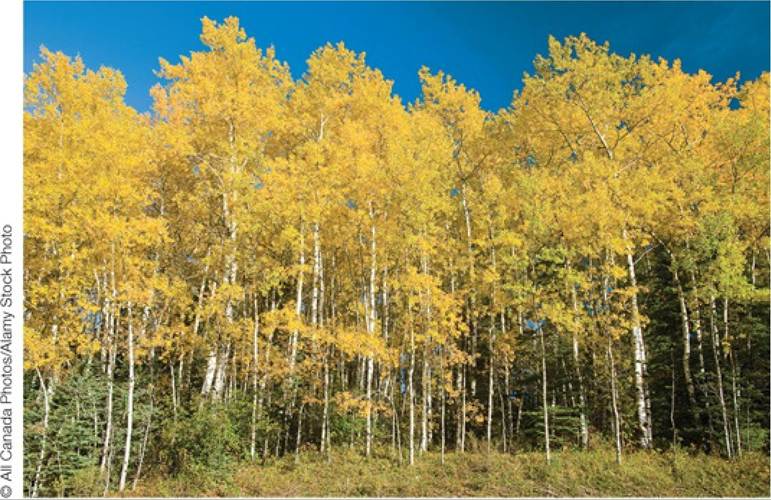
FIGURE 9.3 Aspen Groves: One Tree or Many? These quaking aspen (Populus tremuloides) growing in western Colorado could represent multiple different genetic individuals, each established from a seed. However, it is also possible that each of these aspens is part of one “tree,” having been produced asexually from the root buds of a single genetic individual. View larger image
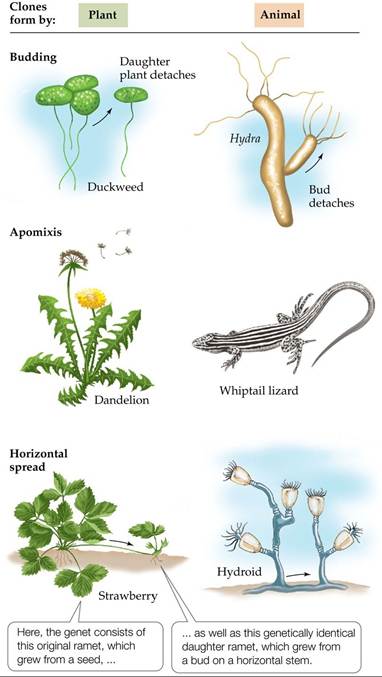
FIGURE 9.4 Plants and Animals That Form Clones Manyplantsandanimalsreproduce asexually, thereby forming clones of genetically identical individuals. Examples of asexual reproduction include budding (in which clonal offspring detach from the parent), apomixis (in which clonal offspring are produced from unfertilized eggs; also known as parthenogenesis), and horizontal spread (in which clonal offspring are produced as the organism grows).
How might groups of genetically identical individuals be identified in clones that form by budding? By apomixis? By horizontal spread?
View larger image
To cope with the complications that result from the formation of clones, biologists who study such organisms define individuals in several different ways.
For example, an individual can be defined as the product of a single fertilization event. Under this definition, a grove of genetically identical aspen trees is a single genetic individual, or genet. However, members of a genet are often physiologically independent of one another, and they may in fact compete for resources. Such actually or potentially independent members of a genet are called ramets. In strawberries, for example, a rooted plant is considered a ramet because it can persist even if it is not connected to the rest of its genet (see Figure 9.4). Whether we view a patch of strawberries or a grove of aspen trees as one individual or many depends on what we are interested in. If we are interested in evolutionary change over time, the genet level may be more appropriate. In contrast, if we are interested in how independent physiological units compete, the ramet level may be more appropriate.The most direct way to determine how many individuals live in a population is to count all of them. This sounds simple enough, and it is possible in some cases, as for the lizards on one island, and other organisms that are confined to small areas, are easy to see, or do not move. But complete counts of organisms are often difficult or impossible. Consider the chinch bug (Blissus Ieucopterus), an insect that attacks crops such as corn and wheat. This insect can cover large areas and reach densities that exceed 5,000 individuals per square meter, making it impractical to count all the individuals in a population. In such cases, a variety of methods can be used to estimate abundance. Let's discuss some of those methods next.
More on the topic What are individuals?:
- Populations evolve, individuals do not
- THE ROLE OF INDIVIDUALS
- 7 INDIVIDUALS
- Narrative Construction of Individuals and Groups
- A population is a group of individuals of the same species that live in the same area at the same time and interact with one another.
- Individuals within species differ in their life histories
- Populations and Individuals
- THE ROLE OF INDIVIDUALS
- Route of Infection and Transmission Between Individuals
- MODULATION OF APOPTOSIS IN THE THYMUSES OF INFECTED INDIVIDUALS
- Grounding Collective Obligations in Demands on Individuals
- Individuals respond to environmental variation through acclimatization
- Individuals often alter their foraging decisions when predators are present
- Blaming Collectives as a Way of Evoking Collectively Tainted Guilt in Individuals
- We accept as a standard truth that we are separate from all other people: we are alone, we are individuals, we are each one of a kind.
- Marriage was one of the fundamental institutions of Roman society, as it joined not only two individuals but two families.