Optimal Muscles to Study for Rest Activity
In evaluating an infant or young child for a generalized disorder, specific muscles are chosen to permit
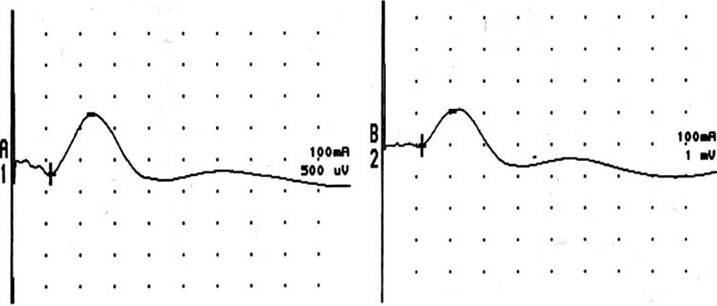
Figure 7.5 Phrenic nerve conduction study in a 13-year-old child with C2 traumatic spinal cord injury.
A1 is the compound muscle action potential (CMAP) amplitude obtained on the right side and B2 is the CMAP obtained on the left side. Latencies are approximately 5 milliseconds and amplitudes from baseline to peak 1 mV. The viability of the phrenic nerves allowed placement of a phrenic nerve-diaphragm pacer for ventilation.evaluation of insertional and spontaneous activity. The distal hand (first dorsal interosseous) and foot muscles of infants usually have minimal voluntary activity due to immature motor control at this developmental age, making them good sites to assess spontaneous activity. In addition, extensor muscles such as the vastus lateralis and gastrocnemius in the legs and the triceps in the upper extremities are useful sites for the evaluation of insertional and spontaneous activity.
In the neonate and young infant, foot and hand intrinsic muscles exhibit high levels of end-plate noise because of the relatively larger end-plate area in the immature muscle. This end-plate activity may be confused with fibrillation potentials. Fibrillation potentials and positive sharp waves are not typically observed in the full-term normal newborn.
More on the topic Optimal Muscles to Study for Rest Activity:
- Optimal Muscles to Study for Rest Activity
- TECHNICAL FACTORS OF NEEDLE ELECTROMYOGRAPHY
- Metabolism of skeletal muscle
- B Hypotheses: Always Under Construction
- Contraction of skeletal muscle
- The heart
- Muscular System
- Article 15.2 Recent deals signal market’s reopening in the same old style
- Cellular Anatomy and Morphology
- Necropsy: The Postmortem Examination