Cilia-Associated Respiratory Bacillus Infection
Cilia-associated respiratory (CAR) bacilli are widespread and significant respiratory pathogens in rats, commonly infect rabbits, and probably infect mice at a higher rate than is currently recognized.
The CAR bacillus is an unclassified, Gram-negative, motile, nonspore-forming bacterium that is closely related genetically with Flex- ibacter spp. and Flavobacterium spp. members of the gliding bacteria group. CAR bacilli possess considerable antigenic diversity among isolates from different host species, and the host range is generally restricted to the host of origin. CAR bacilli from various host species are sufficiently different that they may represent different genera. In breeding mouse populations, CAR bacillus is transmitted from infected dams to pups shortly after birth, and infection can be inefficiently transmitted among adult mice by direct contact, but airborne transmission to mice in adjacent cages does not appear to occur.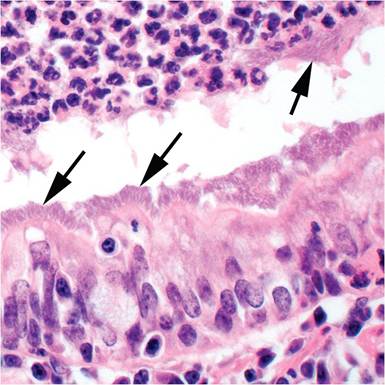
FIG. 1.66. Respiratory mucosa of a mouse experimentally monoinfected with cilia-associated respiratory (CAR) bacillus. Note rafts of bacteria (arrows) on the epithelial brush border and within the exudate.
Experimental, and probably natural, infections may be inapparent with no discernable lesions. The organism has been associated with chronic respiratory disease in conventional B6 and B6 obese mutant mice dying with the disease. Chronic suppurative cranioventral bronchopneumonia with marked peribronchiolar infiltration with lymphocytes and plasma cells and luminal neutrophilic exudation were evident microscopically. Warthin-Starry silver impregnation staining revealed typical filamentous CAR bacilli among cilia. Although disease can be experimentally induced by CAR bacillus monoinfection (Fig. 1.66), natural outbreaks of disease in mice seem to be associated with viral infections, including Sendai virus and PVM. Chronic respiratory disease and seroconversion have been produced in BALB/c mice inoculated intranasally with the CAR bacillus, but B6 mice developed less severe lesions and lower antibody responses.
Diagnosis is achieved by silver staining of respiratory tissue to reveal characteristic organisms among cilia of the respiratory epithelium. Organisms can be grown in cell cultures, cell culture medium, and embryonated hens' eggs. Serologic assays utilize bacterial lysates, which are prone to considerable nonspecificity due to cross-reactivity with other bacteria. PCR can be utilized to detect mild or subclinical infections in rodents and can be applied to nasal, oral, and tracheal swabs, with the oral cavity being the most suitable noninvasive site for detecting early infection.
More on the topic Cilia-Associated Respiratory Bacillus Infection:
- Mycoplasma pulmonis Infection: Murine Respiratory Mycoplasmosis
- Anthrax (also known as Charbon, Milzbrand) is an infectious disease caused by the bacterium Bacillus anthracis.
- RESPIRATORY DISEASES
- D/D RESPIRATORY DISTRESS
- Respiratory Disorders
- Respiratory Failure
- RESPIRATORY DISTRESS
- CLINICAL EVALUATION OF RESPIRATORY DISEASE
- COMMON RESPIRATORY PROBLEMS
- RESPIRATORY FUNCTION
- Respiratory System
- ACUTE RESPIRATORY FAILURE