Rat Adenovirus Infection
Disease due to adenovirus in rats is absent, but lesions, consisting of intranuclear inclusions within small intestinal enterocytes, represent incidental findings (Fig. 2.5). Intranuclear inclusions have been induced by treatment of rats with chemotherapeutic agents, presumably activating subliminal infection.
Attempts to isolate the rat adenovirus have failed.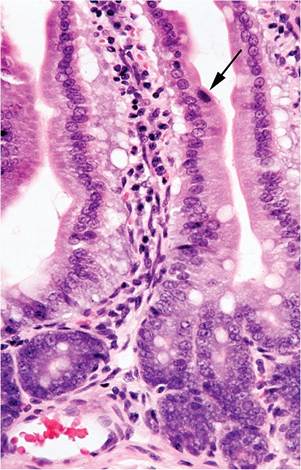
FIG. 2.5. Small intestine from a rat, illustrating an adenoviral intranuclear inclusion body (arrow) in villus epithelium. Enteric adenoviral inclusions are typically located in nuclei of enterocytes that have lost their basal polarity.
Serological surveys indicate that rats commonly sero- convert to mouse adenovirus MAdV-2. Rats could not be infected with mouse adenoviruses MAdV-1 or MAdV-2, suggesting that rats are naturally infected with serologically related but rat-specific adenovirus(es).
More on the topic Rat Adenovirus Infection:
- Adenovirus Infection
- Rat Polyomavirus Infection
- Rat Theilovirus Infection
- Rat Cytomegalovirus Infection
- Rat Papillomavirus Infection
- Rat Coronavirus Infection: Sialodacryoadenitis
- Streptobacillus moniliformis Infection: Rat Bite Fever
- ADENOVIRUS HAEMORRHAGIC DISEASE OF DEER
- CHAPTER 14 ADENOVIRUS INFECTIONS
- Rat
- Coronavirus Infection: Mouse Hepatitis Virus Infection
- Picornavirus Infection: Mouse Encephalomyelitis Virus Infection
- Arenavirus Infection: Lymphocytic Choriomeningitis Virus Infection
- Arterivirus Infection: Lactate Dehydrogenase-Elevating Virus Infection