Historical Phases, Territorial Fluctuations, and International Standing
From its maximum extent in the fourth century ce (Britain to Arabia, the Atlantic to Armenia), the later Roman Empire was eventually reduced, before its fall in the mid-fifteenth century, to Constantinople, the Peloponnese, and a few cities.[1254] This reduction occurred in stages, and was not linear.
The empire tended to suffer relatively swift and catastrophic defeats, but then recovered gradually, albeit always only partially, before suffering another major defeat and loss of territory: one step forward, two steps back, for eleven hundred years. In other words, the empire was systematically prone to crisis and vulnerable to sudden attack, but had strong powers of resilience, recuperation, and consolidation.In the sixth century, the eastern empire under Justinian had not only reconquered many provinces of the fallen western empire but was recognized as the one and only imperium Romanum by the barbarian successor kingdoms. It was the most powerful and prestigious state in its own part of the world (the oikoumene) and exercised a loose cultural and even nominal political hegemony over its neighbors. In the east, it faced a peer empire, Sasanian Persia, with which it was evenly matched. All this changed in the seventh and eighth centuries.
The invasions of the late sixth and seventh centuries reduced the empire's territory, population, and resources to a fraction of their previous levels. Specifically, the Lombard settlements left Italy a patchwork of contested regions, and eventually limited the Byzantine presence to the south. The Avar and Slav settlements did the same in the Balkans and Greece, limiting the empire to coastal cities (e.g., Thessalonike, Athens, and Corinth), and outposts on the Adriatic coast. Out of the chaos there, groups emerged that are labeled later as “Croats,” “Serbs,” “Bulgars,” and others, though it remains unclear how they were politically structured and ethnically identified.
Finally, the momentum of the Arab conquests carried into the ninth century. After attacking Constantinople itself in the seventh and eighth centuries, forces from the Caliphate raided Asia Minor on a regular basis. The empire had to take a defensive position behind a border zone along the Tauros Mountains. Arab and Berber armies conquered Crete and Sicily in the ninth century. During this period, then, the empire's international standing was downgraded from hegemonic to regional.The Caliphate was a much larger world and was religiously and ideologically independent of Rome. The Roman empire was now a smaller embattled state on its periphery, a position it had never occupied before. Everywhere it had to make accommodations with barbarian peoples who had settled within its territories, close to its cities. While it remained “the empire” in western eyes, it was less able to project power and authority. As it was no longer able to protect Rome against the Lombards, the popes gradually turned to the Franks for assistance and alliance, and eventually they sponsored spiritually the establishment of a separate western empire. The post-Roman west thus began to forge a neo-Roman identity around the papal-Frankish axis that increasingly left Byzantium out of the picture.
Yet the empire had greater staying power than its rivals and outlived many of its own “heirs.” Between the seventh and ninth centuries, it managed to open a corridor of control between Constantinople, Thessalonike, and Greece, and began to convert the Slavs settled there to Greek-speaking Christianity and make them into Roman subjects. We have almost no information about how this assimilation was carried out, but evidently it was, though the nature and extent of Slavic settlement remain contentious topics. It is likely that they had disrupted imperial control more than the local demography, and that control was gradually restored through imperial intervention (especially by Justinian II, Nikephoros I, and Basileios I).
At the same time, however, the pagan Bulgar Khanate had evolved by the ninth century into the Christian Bulgarian state, a major rival on the very doorstep of Constantinople. In the ninth century, Byzantium managed to restore control over southern Italy and (more indirectly) the Adriatic coast. Its western imperial rival, the Carolingian Empire had, after all, quickly fragmented and declined. And the Caliphate also began to decline and disintegrate during the ninth century, opening up opportunities in the east.Byzantium had begun to respond with raids of its own into Arab territory already in the eighth century. In the late ninth and early tenth centuries, it went on the offensive in eastern Asia Minor, conquering Tephrike in 879 (the stronghold of a rebel heretical group, the Paulicians, who were allied to the empire's Muslim enemies) and Melitene in 934 (conquered by the leading general Ioannes Kourkouas). Byzantium also made major inroads into Armenia. The Armenian and Georgian principalities began to tilt more toward a Roman alliance (i.e., nominal allegiance
THE BYZANTINE EMPIRE (641-1453 Ce) 453
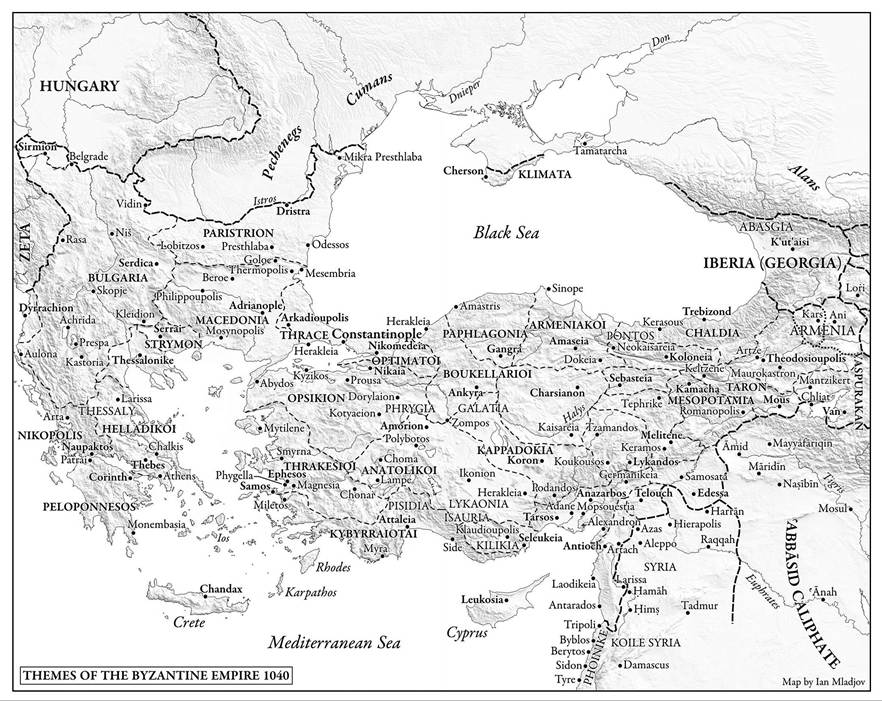
Map 16.1. The Byzantine Empire, 1040 ce.
Source: Attaleiates, Kaldellis, and Krallis, 2012, The History, pp. 620-621. Copyright: Ian Mladjov, Harvard University Press, and Dumbarton Oaks Medieval Library.
in the eyes of Constantinople). But at the same time, the empire remained vulnerable to Bulgarian aggression (especially under its dynamic tsar Simeon) and to raids from Crete and the Muslim cities of the Cilician thughur, the militarized frontier, which engaged in religious war against Byzantium.
Taking advantage of a secure, long peace with Bulgaria and the terminal decline of the Abbasid Caliphate, the Byzantine command under the leadership of Nikephoros Phokas (subsequently emperor) initiated a policy of conquest in the south and east. Crete, Cyprus, the whole of Cilicia, Antioch, and parts of northern Syria and Mesopotamia were annexed, their Muslim populations mostly expelled or converted, and the hostile emirate of Aleppo was reduced to tributary status.
This was also enabled by a gradual shift from frontier defense forces to full-time professional soldiers, led by competent officers. The latter, however, were also a danger to the emperors. After suppressing two major military revolts, Basileios II, the longest reigning Roman emperor (976-1025), conquered the Bulgarian Empire in 1018, which had again become hostile in the 970s. After this phase of conquest, Byzantium attained another apogee of power and international prestige. It was regarded throughout the west (as far as England) and north as the gold standard of imperial power, and its forms and trappings were widely imitated.[1255] It had no credible rivals. Its tax system was the most efficient, its armies powerful and well organized, its culture ancient, its capital the largest and most magnificent city in Christendom, and its Church projected Orthodoxy to foreign people (including the Rus'). This was the most “imperial” that Byzantium ever became, especially in terms of rule by Romans over non-Romans (such as the Bulgarians, Armenians, and others). Moreover, a number of Caucasian kings and princes either bequeathed their realms voluntarily to the empire or were pressured to do so, and so the empire added Taron, Tao, and, with the momentum continuing in the eleventh century, Vaspurakan, Ani, and Vanand.Those last acquisitions, however, were paradoxically the front of a storm cloud. In the eleventh century, the empire was hammered by a triple threat that it barely survived. The Caucasian princes had abdicated in the face of a new enemy who was harassing them from the east. The Seljuk Turks had conquered Persia, Mesopotamia, and, after the defeat of the emperor Romanos IV Diogenes at Mantzikert (1071), all of Asia Minor, which was the empire's heartland. At the same time, Pechenegs crossed the Danube and claimed a portion of its estuary. And the Normans had entered southern Italy, which they wrested completely from the empire by 1071.
In 1080-1085, the Norman adventurer Robert Guiscard set his sights on conquering the empire's Balkan territories, but was defeated by Alexios I Komnenos (1081-1118), as was his son Bohemond, when he tried again (1108). The empire had survived, and Alexios had adroitly used the passage of the First Crusade (1096-1097) to recover western Asia Minor from the Turks, who had established the Sultanate of Rum there.Alexios founded a dynasty that would reign for over a century (though all subsequent dynasties were descendent from the Komnenoi, including many in western and eastern Europe). Byzantium was no longer head and shoulders above all its potential peers, but it was still richer and more powerful than any one of them. While it had lost central Asia Minor, it retained the richer coastal plains and held Bulgaria. A new development was the rise of the maritime Italian republics. Venice in particular had offered critical assistance during the Norman wars and was rewarded with lucrative tax exemptions in imperial ports. According to some historians, this suppressed Byzantine trade (though it may have boosted production). It was generally an age of economic and demographic growth, but tensions began to build with the west over theological issues as well. There had been a number of diplomatic flare-ups with the popes, and the two churches had come to realize that they had some incompatible beliefs and practices. The population of Constantinople became increasingly Latinophobic, whereas the “Greeks” were seen as potentially heretical in the west and were criticized for not assisting the Crusades. There were arrests and massacres of Latins in Constantinople, followed by reprisals by Venetian fleets and Norman armies. The split between the “Catholic” and “Orthodox” churches dates roughly to this period, though the respective terms used at the time were “Latin” (or “Roman”) and “Greek.”
This tension came to a head when the armies of the Fourth Crusade sought first, in 1203, to extort money from Constantinople, and then captured the city in 1204, burning much of it in the process, sacking it thoroughly, destroying many of its artistic treasures, and then carving the empire up among themselves.
A Latin patriarch was installed in the Hagia Sophia and the Byzantine administration collapsed. In fact, Byzantium had been coming apart at the seams already after ca. 1180, for reasons that remain unclear but include provincial disaffection with imperial taxes. Local lords had been asserting and even declaring their independence, and the events of 1204 enabled more of them to do so; Bulgaria had also declared independence. So Byzantium broke up into a patchwork of small lordships, Latin Crusader states (such as the principality of Achaea or Morea, in the Peloponnese), Venetian commercial hubs (including coastal forts, and even islands such as Crete), and the Byzantine successor states as the refugee leadership tried to consolidate what ground it could and fight back. The latter included the so-called Despotate of Epeiros in western Greece, the empire of Nikaia (Nicaea) in Asia Minor, and the empire of Trebizond in the east. These all fought each other for decades, until the empire of Nikaia managed to recapture the capital and expel the Latins in 1261, subdue (though not outright conquer) some of its rivals, and recreate the empire of the Romans, albeit in a diminished form. The ruling dynasty was henceforth, to the end of the empire (1453), the Palaiologoi.The period from the Arab conquests to the Fourth Crusade (641-1204) constitutes the middle Byzantine period in modern historiography. Sometimes the Komnenian era (1081-1185), and its appendix, the related Angeloi dynasty (11851204), are bracketed as a distinct subperiod. The twelfth century was the only period during which Byzantium and its western peers were roughly on a par, and it is significant that they failed to find a viable modus vivendi, whether politically, ecclesiastically, or culturally. The era from 1204 to 1453 constitutes the late Byzantine period, with Nikaia (1204-1261) often bracketed as a distinct subperiod. The late empire competed at a disadvantage against many of its rivals. It quickly lost Asia Minor to bands of Turkish raiders capitalizing on the breakup of the Sultanate of Rum, but it did gradually reconquer the Morea (or Peloponnese) from the Latins. Bulgaria remained independent, and Crete and other cities and islands remained Venetian. Pera (Galata), across the Golden Horn from Constantinople, became a Genoese colony. The Genoese were brought in to counterbalance the Venetians, but this merely imported the rivalry between the two cities to imperial territory. Byzantium now lacked a fleet and was always vulnerable to renewed aggression by western powers. The emperors had to walk a thin line: to fend off attack, they promised the papacy that they would enforce Catholicism on their subjects, but the latter were extremely hostile to the idea. Emperors had to decide whether they would persecute their Orthodox subjects or face Catholic wrath. Some intellectuals converted to Catholicism, especially those who sought to make a career teaching in the west, but when foreign rule became inevitable, many Byzantines chose to deal with the Turks, who would leave their religion and identity intact.
The late empire was now only one player among many, and its position degraded over time, especially as the Palaiologoi fought many civil wars among themselves and, in the fourteenth century, struggled over union and a new theological controversy (Hesychasm). All this enabled the Serbs to expand at the empire's expense in the mid-fourteenth century (especially under Stefan Dusan, 1331-1355), and the Ottoman Turks to expand in the Balkans at everyone's expense after 1354. By 1400 it was an empire in name only (and possibly not even that, as its formal appellations did not include any term that corresponds to our “empire”). Byzantium had become an Ottoman vassal and was completely surrounded. It would have fallen then had not Timur, the Central Asian warlord, suddenly defeated the Ottoman sultan Bayazid I, extending the life of Byzantium by half a century. Constantinople fell in 1453 to Mehmet II, the Peloponnese was conquered by 1460, and the independent postByzantine “empire” of Trebizond fell in 1461. It is not clear whether late Byzantium deserves much space in a world history of empire, as it was the target of imperial predation by others, especially Latins, Turks, and Serbs.
More on the topic Historical Phases, Territorial Fluctuations, and International Standing:
- Territorial Integrity and Historical Claims
- Let us say that “epistemic individualism” is the position that a person's epistemic standing (what she knows, what she reasonably believes, etc.) is ultimately up to her, and is in that sense independent of the epistemic standing of other people.
- A CLASSIFICATION SCHEME: FIVE PHASES
- Most people think of international organizations in general as parts of an effort to prevent international war.
- Phases of the Gait Cycle
- Observations on the Problem of “Historical” and “ Non-historical ” Nations
- Finding an International Equilibrium in Times of Globalisation and Redesign of International Institutions
- Fluctuations in population size can increase the risk of extinction
- Fluctuations and growth
- Endogenous fluctuations
- A Large Standing National Army
- Part 3 PHASES OF IMPERIAL EXPANSION AND CONTRACTION
- The first of the five phases was by far the longest, lasting roughly three and a half centuries.
- CASE 15: Not Standing on Ceremony
- Challenging the parliament's standing