In the course of just 75 years, the Spanish Empire went from being a leading transoceanic political entity to being a second-ranked player.1
During the Seven Years' War (1756-1763), in which Spain fought alongside France and lost, Spain's position still appeared to be strong. However, by 1830 and the end of the internal and external conflicts sparked by Napoleon's invasion, the empire's geographic extension and military capacity had visibly and inexorably diminished.
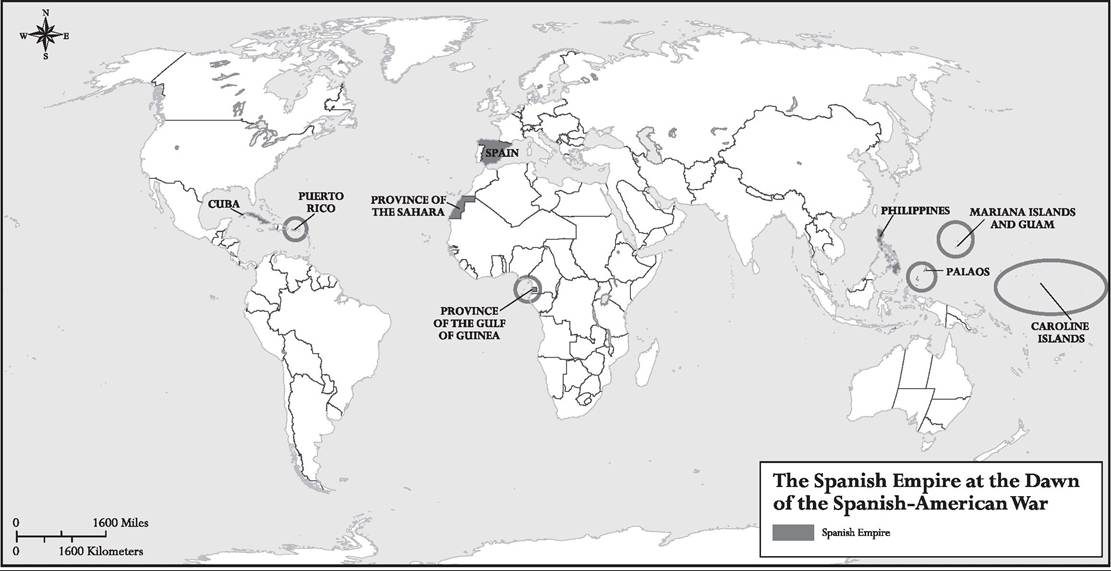
The territorial losses in 1810-1820, as a result of the independence movements in America, could be seen as a preview of the definitive end in 1898, when the new rising power, the United States, dismantled Spain's sovereignty over its last three important possessions: Cuba, Puerto Rico, and the Philippines. Between the final blow to the Greater Empire in Upper Peru in 1824 and the Spanish-American War in 1898, all attempts to expand the colonial influence, either in the Caribbean or upon the former colonies on the continent or in mainland Asia, in the 1850s and 1860s, ended without results.Understanding the decline entails a clear grasp of two key issues: what the Spanish Empire actually was, and which features distinguished it from similar political entities. The Spanish colonial world did not develop along the same lines as those of Britain, Holland, or France.2 The critical difference lay in the very basis of the project and the chronology of its particular build-up. The Spanish presence in America was, from the start, based on intensive mining of precious metals that were essential for international commerce and the consolidation of sophisticated monetary systems in Europe and Asia. This pattern relied upon a combination of forced Amerindian labor and wage labor (plus the slavery of Africans in New Spain's mining districts). Those productive arrangements were embodied within the sophisticated social fabric and legal solutions that emerged in the aftermath of the demographic collapse of pre-Columbian societies.
Later, the British and French empires in America used convict labor and indentured servants and African slavery in their central colonial zones, while their northern frontiers, New England and1 These pages are part of a research effort funded by the Spanish Ministry of Science and Innovation, project HAR2012-39352-CO2-01.
2 The best comparative study is Elliott 2006.
Josep M. Fradera, Late Spanish Empire In: The Oxford World History of Empire. Edited by: Peter Fibiger Bang, C.A. Bayly, Walter Scheidel, Oxford University Press (2021). © Oxford University Press. DOI: 10.1093/oso/9780197532768.003.0036.
990 JOSEP M. FRADERA
Map 36.1. The Spanish Empire at the Dawn of the Spanish-American War. Copyright: Oxford University Press.
New France, were devoted to agriculture and the collection of hides. In the end, Spain's competitors occupied geographically limited enclaves where they actively traded cloth and spices between Asia and Europe at the same time as they built, along with the Portuguese, a large-scale economy of sugar and tobacco based on African slavery - products that were in high demand in European countries. The fierce inter-imperial competition in trade and conquest in North America and the Caribbean, the Indian Ocean, and Southeast Asia starting in the seventeenth century can thus be seen as the manifestation of the shifting balance of power among rivals whose productive models and institutional and social structures were quite distinct from one another.
In analyzing the eighteenth and nineteenth-century decline, one must be careful to avoid commonplaces adopted by contemporaries who were also engaged in a fierce ideological battle. In this sense, insofar as its long-range social and economic organization is concerned, the Spanish imperial complex can be seen as the integration of three related empires: that of peninsular individuals and corporations, both lay and ecclesiastic; that of the Crown; and that of the colonists themselves.
In general terms, the distribution of private and royal American precious metals reflects almost exactly the long-run relationship among the imperial power, its capacity to collect revenue, and the ability of individuals—merchants, bankers, lenders, insurers, shipowners, and sailors—to raise money. In addition, the empire offered the possibility of promotion, wealth, and privileged access to political posts, an obvious way for peninsular bureaucrats and church officials to expand their careers.[2282]The Crown's extractive and regulatory functions among colonial societies, and between these societies and the metropolis, were established in the late sixteenthcentury. The passage of precious metals both guaranteed and expressed the supremacy of the monarchical state and its will to exercise control over a significant part of American resources, and to make the Americans pay for most of their own defense. This latter demand found expression in the transfer of earmarked financial resources from one part of the empire to another, known as situados. These financial instruments ensured steady redistribution from richer areas to those unable to generate sufficient resources to provide for themselves. The northernmost part of New Spain, Chile, the captaincy general of Venezuela and Cartagena de Indias, the viceroyalty of Rio de la Plata, and, most especially, the Philippines and the Spanish Antilles (Santo Domingo, Cuba, and Puerto Rico) received enormous amounts, which were also partly channeled to the metropolis through commerce between Spain and America.[2283]
The empire of the colonists was established after the conquest and the initial settlement in order to meet the needs of two strategic economic sectors: precious metal mining and transatlantic trade. Food, clothing, and transport supplied by the local economies all became notably independent throughout the seventeenth century, relatively unscathed by the waning and waxing of European political powers immersed in warfare. This was the zone that became the site of the most important transactions between pre-European productive and social organizational forms and those that slowly came to be regarded as defining the nature of colonial society. In the eighteenth century, demographic growth in some regions and increasing trade boosted the importance of the colonial economy, which was of concern to the Spanish Crown, that desperately needed to augment its resources. The colonial economy and transatlantic trade generated income that flowed into the Crown's tributary or tax structure, which in turn distributed resources through the aforementioned situados, which finally stimulated commerce and agriculture and extended beyond the Crown's fiscal jurisdiction.
More on the topic In the course of just 75 years, the Spanish Empire went from being a leading transoceanic political entity to being a second-ranked player.1:
- Founded in ca. 1300, within less than a century the Ottoman state had become the dominant power in Asia Minor and a major political player in the Balkans, having swallowed the tsardom of Bulgaria and reduced Serbia to vassalage.
- The Spanish Empire
- The Extension of the Spanish Empire and Dominion in the South Atlantic and Pacific
- 36 Late Spanish Empire
- 28 The Habsburg Monarchy and the Spanish Empire (1492-1757)
- Roman law entered medieval political reflection in the late eleventh century as the law of the universal Roman empire, an organization foretold by Old Testament prophecy as the last empire to rule the world before Apocalypse and hallowed by Christ himself who had lived under the Caesars.
- Almost seven years of war and civil strife had left the Bolshevik-controlled parts of the former Russian Empire in shambles.
- RANKED PRIESTHOODS
- 5 The Political Economy of Empire
- The Islamic Empire: From Political to Cultural Unity
- For close to 150 years, from the late 18th to the early 20th centuries, Ukrainians lived in two empires: about 80% of them were subjects of the Russian emperors, and the remainder inhabited the Habsburg empire.*
- Great Power Competition and the World Wars in Trans-Imperial Perspective
- Terrestrial and oceanic NPP are nearly equal
- Acelebrity among Ukrainian writers and highly ranked in the national pantheon, Leonid Pervomais’kyi defies classification.
- Armitage David, Bashford Alison et al. (eds.). Oceanic Histories. Cambridge University Press,2018. — 338 p., 2018
- Atmospheric and Oceanic Circulation