The Spectacularisation of violence
As violence is logically linked to warfare, the dissemination of representations of fights and battles necessarily implies the frequent presence of scenes of violence in ancient Mesopotamian and Syrian visual media.
Although, as already noted, violence does not automatically derive from war, it is, however, true that the most significant representations and enactments of violence in the region have a warlike nature: torture, killing and any other forms of oppression and aggression seem to find their most ‘natural' explanation and raison d’etre in war contexts. Other forms of violence are represented: context scenes and duels between animals and heroes that can be attributed to cultic and religious phenomena often occupy the figurative space of cylinder seals showing friezes of alternating figures of animals and men fighting and confronting each other.[1186]Violence in war contexts is present on several types of visual media and it is reflected in different pictures encompassing several aspects, degrees and dimensions of aggression and abuse: the repetition and, to a certain extent, creation of canonical representations of violence result in the existence of real monuments to war where violence is clearly exhibited, becoming the tangible trophy and proof of the victory and outcome of the conflicts.
At the same time, within the spectacularisation of aggression, it cannot be excluded that representations of violence reflect a degree of ritualisation, which would explain the regular repetition and canonisation of scenes. In particular, the decapitation of enemies is frequently represented, and not only the beheading but also the collection of heads are important moments that are purposely emphasised.11 The violent actions against precise and selected parts of the human body are represented as crucial moments of the fight and the result of the action (the cutting and dismembering of the body's integrity) reflects the ultimate achievement of the war (the violence enacted on the enemy bodies seals the event and guarantees its success).
Heads, hands and other dismembered parts of enemy bodies work as the trophies of war that are collected, counted and exhibited in the triumph.[1187] [1188] Severed heads are the most meaningful diachronic and transverse example, showing how this part of the body is deliberately chosen for its intrinsic properties (the presence of the senses of sight, smell, taste and hearing).[1189] [1190]Severed enemy heads occupy an important role in the visual media of the ancient Near East. Since Neolithic times the heads of humans had been collected, transformed (the decayed parts of skulls were reconstructed using painted clay) and used within private rites and cults.14 In later periods, since the third millennium bce, they had been the favourite trophy in war. Heads suffered the most violent acts (cuts and injuries, right up to the most extreme action of beheading) and became a recurrent figurative theme in
Representations of Violence: Ancient Mesopotamia and Syria representations of war. Soldiers of the armies of ancient Mesopotamia and Syria, from the third to the first millennium bce, are represented beheading enemies, collecting and transporting heads and displaying them as a clear sign of their triumph and proof of their virtue on the battlefield.15
The head is, therefore, the most physical and tangible expression of the trophy of war. Heads are not only piled up in heaps in front of the officials of the Assyrian army, but are clearly held and exhibited in the hands of each soldier. This image has a very long tradition and goes back to representations of war of the third millennium bce. Beyond the above-mentioned Neolithic representations of beheaded figures in the Neolithic period (the paintings from Qatal Huyuk),16 severed heads of enemies are represented in the narrative of war. One of the best preserved examples is the inlays dated to the Early Bronze Age IVA found in the Royal Palace G at Ebla (Syria) (see Figure 31.3).
The soldiers of Ebla are represented holding heads in their hands or carrying heads in backpacks. Texts from the State Archive of Ebla also register the delivery of severed heads of enemies to the king of Ebla.17 The soldiers of Ebla's careful collecting of the severed heads was intended to be concluded in front of the king of Ebla, who received the ‘gifts' and, presumably, rewarded his men. The scenes and archival registrations of severed heads at Ebla in the third millennium bce anticipate a custom that was to be well documented and widely represented in the first millennium bce during the Neo-Assyrian period in northern Iraq. Assyrian reliefs along the walls of the palaces of the Assyrian kings, as well as the official inscriptions of the chancellery register, include the cutting and counting of the severed heads of enemies, with Assyrian soldiers represented delivering the heads or even playing with them. A relief from the throne room in the North-West Palace of Assurnasirpal II at Nimrud (BM 124550) shows Assyrian soldiers coming back from the battlefield and throwing heads in the air.18 This example also15 Rita Dolce, ‘The “Head of the Enemy” in the Sculptures from the Palaces of Nineveh: An Example of “Cultural Migration”?', in D. Collon and A. George (eds.), Nineveh. Papers of the 49th Rencontre Assyriologique Internationale, Part One (London: British Institute for the Study of Iraq, 2004), pp. 121-31; Rita Dolce, ‘Tetes en guerre en Mesopotamie et en Syrie', in S. D'Onofrio and A.-C. Taylor (eds.), La Guerre en tete (Paris: L'Herne, 2006), pp. 33-46; Karen Radner, ‘Fame and Prizes: Competition and War in the Assyrian Empire', in N. Fisher and H. van Wees (eds.), Competition in the Ancient World (Swansea: Classical Press of Wales, 2011), pp. 37-57.
16 James Mellaart, Qatal Hüyük: A Neolithic Town in Anatolia (New York: McGraw-Hill, 1967), p. 167, fig. 47, pls. 45, 48-9.
17 Alfonso Archi, ‘Two Heads for the King of Ebla', in M.
Lubetski, C. Gottlieb and S. Keller (eds.), Boundaries of the Ancient Near Eastern World: A Tribute to Cyrus H. Gordon (Sheffield: Sheffield Academic Press, 1998), pp. 386-96.18 Paul Collin, Assyrian Palace Sculptures (London: British Museum Press, 2008), p. 47.
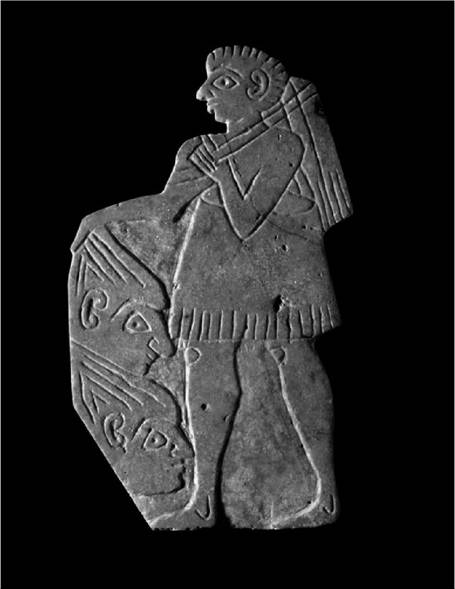
Figure 31.3 Inlay TM.88.G.256+257, Ebla, Royal Palace G (S.4443): a soldier of Ebla carrying the heads of two enemies.
shows that the enemy heads were part of the booty of the campaign: they were collected and brought back to camp, while the headless corpses were left on the battlefield to the mercy of birds of prey and wild animals.
Ebla and Assyria are similar with regards to another interesting aspect: a text from Ebla (TM.75.G.2429) records ‘6 shekels of tin to be melted in 54 shekels of copper: decoration for the head of Ilba-Isar which (is) on the gate of the king'.[1191] As rightly suggested by Alfonso Archi, the delivery of metal was for the support of the severed head of Ilba-Isar that was exhibited at the (palace or, more probably, city) gate of the king: exhibition of severed heads and corpses of the enemy by the city gates was common in the Assyrian period. The inscriptions of Assyrian kings clearly state that the bodies and heads of enemies were hung up in front of the city walls, and enemy kings were deported to Assyria and there exhibited at the city gate together with animals such as bears (thus highlighting the similarity of enemies with the less noble animals).[1192]
I erected a pile in front of his gate; I flayed as many nobles as had rebelled against me (and) draped their skins over the pile; some I spread out within the pile, some I erected on stakes upon the pile, (and) some I placed on stakes around about the pile. I flayed many right through my land (and) draped their skins over the walls. I slashed the flesh of the eunuchs (and) of the royal eunuchs who were guilty.
I brought Ahi-iababa to Nineveh, flayed him, (and) draped his skin over the wall of Nineveh. (Thus) have I constantly established my victory and strength over the land Laqu. (Assurnasirpal II)[1193]As for Nabu-usabsi of the (land of Bit)-Silani (lit. ‘son of Silani'), I defeated him on the outskirts of the city of Sarrabanu, his city. Moreover, I impaled him before the gate of his city, while making (the people of) his land watch. (Tiglath-pileser III)[1194]
In a pitched battle, [they captured him (Nergal-usezib) alive and brought him] before me. At the Citadel Gate of Nineveh, [I bound him] with a bear. (Sennacherib)[1195]
These examples, from third millennium Syria and first millennium Mesopotamia, show how violence was exhibited following specific actions and political agendas. The presence of the enemy (either alive, as a corpse, or as a body part) by the city gate points precisely to the intention of giving the outcome of the king's military campaign the highest visibility. Being the preeminent point of entrance and exit, the city gate marks the boundary between the city and the outside and was the obligatory passage for all people entering or leaving. As a consequence, the enemy remains exhibited
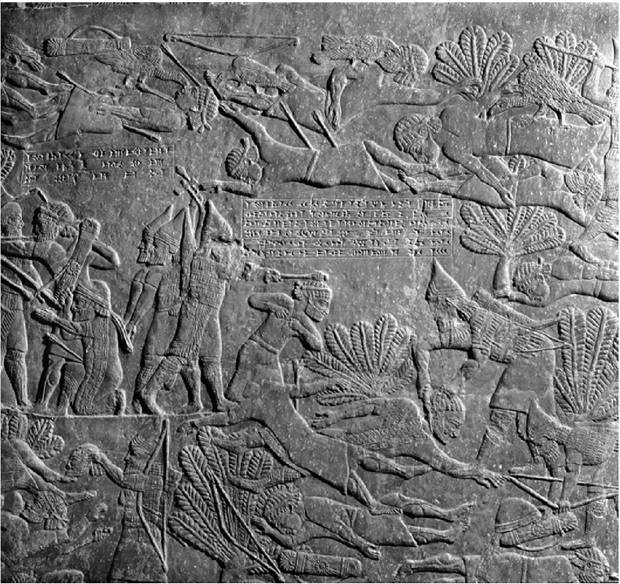
Figure 31.4 Beheading of king Teumman by an Assyrian soldier.
there were surely seen by quite a large number of people (and this clearly was the intention, as in fact King Tiglath-pileser III explicitly says).
Aggression and the mutilation of the bodies of enemies did not solely involve the head. The importance of the head possibly depended on the fact that it made the enemy recognisable, at least temporarily.[1196] In this respect, the case of the head of Elamite king Teumman, killed by the soldiers of Assyrian king Assurbanipal, is probably the most famous example (see Figure 31.4).[1197] Looking at the representations of Teumman's head in the Assyrian reliefs from both the South-West and North Palaces at Nineveh, it is possible to accurately follow its ‘journey' from the battlefield to the city of Arbela and finally to Nineveh, where, according to the most common interpretation, it is represented hanging from a tree in Assurbanipal's garden.[1198] But other enemy body parts suffered mutilation, including hands, arms and legs.
Once a living body or corpse had been mutilated (a direct form of violence: first level) they were abandoned with the precise intention of erasing the memory and identity of the individual (an indirect form of violence: second level). While the head is a symbol of identity and identification, the beheaded and mutilated body is totally anonymous. The intervention of birds of prey and other animals causes the complete disappearance of even the smallest fragments of the corpse (a casual form of violence: third level). Pictures show birds of prey attacking the dead bodies of enemies lying on the ground: the upper register of the Stele of the Vultures shows vultures devouring the last remains (hands and arms, but also heads) of the soldiers of Umma,[1199] while the lower register of the stele of Sargon of Akkad (Sb1) shows vultures and dogs eating and destroying the bodies of the enemy soldiers.[1200]Violence in war has different levels of cruelty. In particular cases violence is used to retain the identity of individuals that have been killed and, more precisely, beheaded. This is particularly the case for important figures, such as the enemy king or high officials: these heads or bodies, which were exhibited in front of cities, at the gates, could still be identified by name. On the other hand, violence is used to erase identity, and bodies are purposely mutilated so that they can no longer be identified as a person: representations of war in both Mesopotamia and Syria in fact show corpses of beheaded and mutilated enemies lying on the ground while being attacked by animals or overwhelmed by chariots. Beheading, however, is not the distinctive element: only selected heads undergo a specific (ritual) treatment; others were not detached, as is seen in the stele of Sargon of Akkad (Sb1) or in the seal impressions from Mari;[1201] or, even when detached from the body, they were simply collected in heaps to be counted (as on the Assyrian reliefs) or left to be attacked by animals (as in the bottom register of the stele of King Dadusha of Eshnunna, from the eighteenth century bce.[1202] The latter scene shows two rows of cut heads with birds of prey disfiguring the faces, the clear intention being the annihilation and denial of recognisability of the features of the character).
In all cases, the effect of violence is doubled: enemies are killed during the fight and, even when dead, their corpses are still mutilated with deliberate determination. Texts and pictures of the third millennium bce provide evidence of this additional post-mortem aggression. In particular, the third register of the Stele of the Vultures of Eannatum of Lagash shows men carrying baskets of earth to cover a heap of enemy corpses.[1203] This detail does not refer to the burying of the dead soldiers of the army of Eannatum, but, on the contrary, displays the wording of contemporary royal inscriptions where the kings refer to the raising up of piles of bodies that are left on the battlefield in what we could label a temporary spectacularisation of the violence, since these heaps were destined to vanish.[1204] In a letter sent by Enna-Dagan, king of Mari, to an unnamed king of Ebla, the king of Mari lists the conquests made by himself and his predecessors that always end with the raising up of heaps of corpses.
Thus (says) Enna-Dagan king of Mari to the king of Ebla: Aburu and Ilgi, in the territory of Ba‘lan, lanupu, king of Mari, conquered; he left on the mountain on Labanan a mound (of bodies)... And Iblul-Il, lking of Mari, took possession of Gallab'I,... and of the Ganum (of Ebla) and conquered Abarsal at Zahiran; and Iblul-Il, king of Mari, left sev[en] mounds of bodies.[1205]
Heaps of bodies, severed heads, impaled bodies and corpses and enchained enemy kings at the city gates all show different levels of violence (the enemy kings at the city gates could have been exhibited while still alive, so we can speak of a psychological humiliating violence), but they could all be grouped as examples of open-air monuments: violence is therefore directly exhibited in places where it was supposed to be seen by many.
As for the visual representations of violence, where were those pictures displayed? Monuments of war (that also display violence) were differently arranged and displayed within the urban space: they could be placed outdoors or inside temples and palaces. The third millennium bce inscriptions of the kings of Lagash record that King Umma, when he deliberately declared war on Lagash by crossing the boundary, destroyed the stele that had been placed there to define the limit between the two city-states.[1206] On the other hand, both inscriptions and archaeological contexts show that monuments were mostly displayed in temples and palaces. The temple in Mesopotamia was not simply a religious space but a socio-economic structure that managed and administered properties, lands and goods. Conversely, temples in Syria exclusively managed the cult, while palaces had a properly political and economic role.
What does this difference imply? Can we conclude that there was a different audience? Can we simply distinguish between religious (Mesopotamian) and secular (Syrian) spectators? Of course not, and the relationships between pictures and observers, between the one who commissioned the work and the audience, and indeed between the one who commissioned the work and the work itself, are much more complex and articulated. In sum, if works in temples were created for the gods, this does not mean that works outside temples did not address the divine world. Equally, works in palaces could, erroneously, lead to strictly a-religious interpretations, even though it is clear that gods, although not physically present in the palace, were nevertheless the recipients of the visual message. This aspect can also be singled out in the Assyrian period, when representations of violence, and precisely those derived from war, were exclusively located in palaces.[1207]
In this analysis of the spectacularisation of violence, can we conclude that the focus is the content of the representation, the narrative of violence, notwithstanding the place (context) where it is displayed? I think this question opens new perspectives for trying to understaand the reasons for the representation of violence (the why) and the question of the intended audience (the whom). As a consequence, studies on the use and meaning of violence in ancient societies must also take into consideration questions of where and how pictures of violence were enacted, showing the effect of images on the people looking at them.
More on the topic The Spectacularisation of violence:
- Violence against the Self, State Violence and Interpersonal Violence
- Within the world history of violence the Bible is relevant for our reconstructions of the lived experience of violence among ancient Israelites and Judeans;
- The theme ‘religion and violence' or ‘religious violence' gained worldwide attention after the terrorist attacks on the Twin Towers and the Pentagon in 2001.1
- The Interwar Moment: Violence versus Non-Violence
- Violence and representations of violence abound in the literature of ancient and late antique Judaism and Christianity.
- The advent of the Early Historic period in northern India in the sixth and fifth centuries bce saw the emergence of monarchical and oligarchic states and the beginnings of a sustained discussion of the relationship of kingship with violence and non-violence.
- Chapter IV Growing Up with Violence in Northern Ireland: Making Meaning of Institutionalized Violence
- The archaeological evidence for violence and for the symbolic representation of violence in Iron Age Europe is abundant and complex.
- Violence, Non-Violence, the State and the Nation: India, 1858-1958
- Imperial Chinese society accepted and even lauded certain types of violence. Fundamental views of sanctioned violence developed in reaction to that culture's particular views of masculinity.
- This chapter examines the diverse communities of Britain from the ninth century bce to the early fifth century ce, and uses a Web of Violence model to examine the archaeological and primary source evidence for violence in both periods.
- Werner Reiss, author of the most detailed recent discussion on the subject of violence in the Greek world, defined violence as ‘a physical act', stating further that it is a ‘process in which a human being inflicts harm on another human being via physical strength’.1
- To ask what state-sanctioned violence meant in medieval Japan (1185-1615) is to be confronted with two attendant questions: what counted as violence; and what counted as state-sanctioned?
- Kingship, Violence and Non-violence in Indian Thought, c. 500 bce to 500 ce
- Towards a Theory of Violence