Woodrow Wilson, the First World War and the Americas
If Theodore Roosevelt typified the hard-nosed realpolitik outlook in American foreign policy, Woodrow Wilson, who defeated Roosevelt in the 1912 presidential elections, exemplified the missionary and moralistic impulse that would resonate heavily in American rhetoric throughout the twentieth century.
A well-known political scientist, former president of Princeton University, and the governor of New Jersey at the time of his election, Wilson was the first Democrat to assume the presidency in the twentieth century. His domestic programme, New Freedom — in contrast to Roosevelt’s New Nationalism — was mainly aimed at solving domestic problems and included a strong states-rights (as opposed to strong federal government) agenda, low tariffs and an end to special privilege. A moralist to a fault, Wilson relished public speaking and was extremely intolerant of his critics. In contrast to his Republican predecessors, however, Wilson had little experience in foreign affairs. Yet it was foreign policy that presented Wilson with his toughest challenges as he tried to take his message of reform to the outside world. The problem was that the realities and pressures that Wilson had to contend with at home and abroad did not match his noble dreams. As a result, Wilson found himself engaging in a series of reversals during his eight-year presidency.In Latin America, Wilson had the grand notion of abandoning the aggressive gunboat diplomacy that had, in the year of his election to the presidency, been symbolized by the dispatching of marines to Nicaragua. In a major speech in October 1913 Wilson captured his high-minded ideals by claiming that ‘the United States will never again seek one additional foot of territory by conquest’. Instead, Wilson maintained, the United States
will devote herself to showing that she knows how to make honorable and fruitful use of the territory she has, and she must regard it as one of the duties of friendship to see that from no quarter are material interests made superior to human liberty and national opportunity.
In short, the protection of American economic and strategic interests in Latin America by force seemed to have little room in Wilson’s version of the Monroe Doctrine.
The reality turned out to be very different. At the time that Wilson delivered this speech, Mexico, the United States' closest neighbour to the south, was in a vortex of revolution that had begun in 1911 when the dictatorship of Porfirio Diaz had been overthrown. The new president, Francisco Madero, had, apparently, been a ‘Wilsonian' believer in democracy and constitutional rights, but unfortunately he was killed a month prior to Wilson's inauguration. Victoriano Huerta, the new military dictator, thus became the target of Wilson's wrath and Mexico the first country where the United States intervened in the name of ‘good government'. In practice, this meant that Wilson backed Venustiano Carranza's constitutionalist movement, which was based in the northern parts of Mexico. In 1913—14 the United States began selling arms to Carranza's movement and Wilson's secretary of state, William Jennings Bryan, worked to isolate Huerta diplomatically. When this did not work, American troops intervened in April
1914, causing Huerta's government to crumble. By August 1914 Carranza was in control of Mexico City.
The Mexican civil war was, however, far from over and dragged Wilson into a far more complex situation than he had envisioned. Carranza, for one, condemned the intervention as illegitimate and his troops came close to fighting against the Americans. Moreover, already by the end of 1914, Pancho Villa had split with Carranza and challenged his former boss's legitimacy in northern Mexico. As the infighting continued, Villa enraged the Americans by crossing the border into New Mexico in January 1916, prompting another American invasion to capture the illiterate but skilful guerrilla fighter. Despite Mexican demands and repeated engagements between American and Mexican troops, General John J.
Pershing's troops remained in Mexico until early 1917. At that point Mexico held elections and ratified a new constitution, and consequently the United States officially recognized the Carranza government. The intervention, however, left behind a strong anti-American sentiment and did little to persuade the Mexicans that Wilson's election had meant an end to strong-arm tactics in America's dealings with its southern neighbours.In fact, under the cloak of moral diplomacy, Woodrow Wilson intervened in the Caribbean even more than his Republican predecessors had done. In July
1915, after a series of revolutions and counter-revolutions, Wilson ordered the marines to Haiti to restore order. The Americans ended up supervising presidential elections and forcing the new Haitian government to sign a treaty that gave the United States control over the island's customs houses, finances and the military. In effect, the Platt Amendment was extended to Haiti, where the marines remained until 1934. In 1916 the marines landed in the Dominican Republic and remained there for the next eight years under similar terms as in Haiti. In the meantime, the United States continued its occupation of Nicaragua and engineered the election of the pro-American General Emiliano Chamorro to the presidency in 1916. Indeed, as the Europeans fought each other on the old continent, the United States secured its control over the ‘American lake' (and over the access routes to the Panama Canal) in a way that hardly fitted the Wilsonian ideas of self-government and constitutionalism. Central Americans thus found their independence limited by the Wilsonian version of the Monroe Doctrine.
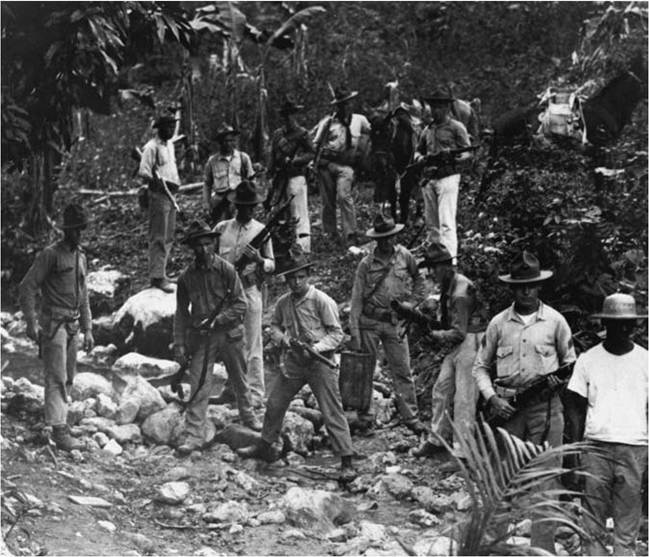
Plate 6.1 US marines are led by a guide to look for bandits in Haiti, 1919. (Photo: Time Life Pictures/US Marine Corps/National Archives/Time Life Pictures/Getty Images)
More on the topic Woodrow Wilson, the First World War and the Americas:
- CASUAL COMMITMENT AND WOODROW WILSON
- When Christopher Columbus landed on the shores of the Americas in 1492, the rulers of the major European powers realised that the world was much larger than they had thought.
- From European war to World War
- The Coming of World War II
- The Coming of World War II
- World War I and Western Ukraine
- World War I and Western Ukraine
- 45 Soviet Ukraine after World War II
- Palestine and the Second World War
- CHAPTER EIGHTEEN THE FIRST WORLD WAR
- From the Second World War to the Treaty of Rome
- Urbanization in Ukraine since the Second World War
- The Second World War and empire
- World War II
- World War I
- The long-term causes of the First World War
- The First World War in East Asia
- 31 Western Ukraine during World War I
- Ukrainians in the First World War
- On 4 February 2005, military guards welcomed guests arriving at the Livadia Palace near Yalta, as they had done sixty years earlier on the first day of the Yalta Conference, which brought together Franklin D. Roosevelt, Winston Churchill, and Joseph Stalin to discuss the shape of the world after the Second World War.