KEY DIAGRAM 5
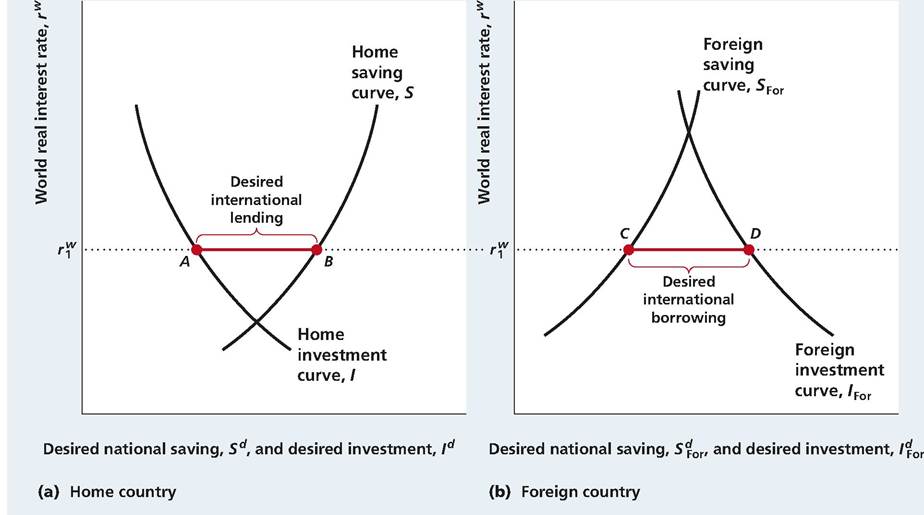
National saving and investment in large open economies
This diagram shows the determination of national saving, investment, and the current account balance in large open economies—that is, economies large enough to affect the world real interest rate.
Diagram Elements
■ The figure consists of two saving-investment diagrams, one for the home country and one for the foreign country (representing the rest of the world).
■ The world real interest rate, rw, measured on the vertical axis, is the real interest rate faced by both countries in the international capital market.
■ The saving and investment curves in the home country (S and I) and in the foreign country (SFor and IFor) are the same as the saving and investment curves presented before (Key Diagram 3 and Key Diagram 4).
Analysis
■ This case differs from the case of the small open economy (Key Diagram 4) in that the world real interest rate, rw, is determined within the model, not given.
■ Goods market equilibrium for large open economies requires that the desired international lending of one country equal the desired international borrowing of the other. Equivalently, because a country's international lending equals its current account balance, goods market equilibrium requires that one country's current account surplus equal the other country's current account deficit.
■ The world real interest rate adjusts to achieve goods market equilibrium. In the diagram r1w is the equilibrium world real interest rate, because at that interest rate the home country's desired international lending (its desired national saving less desired investment, or distance AB) equals the foreign country's desired international borrowing (its desired investment less desired national saving, or distance CD).
Factors That Shift the Curves
■ The saving and investment curves in the two countries are shifted by the same factors as in Key Diagram 3 in Chapter 4 and Key Diagram 4.
■ The world real interest rate changes when desired national saving or desired investment changes in either country. Any change that increases desired international lending relative to desired international borrowing at the initial world real interest rate will cause the world real interest rate to fall to restore equilibrium in the international capital market. Changes that increase desired international lending relative to desired international borrowing include an increase in desired national saving or a decrease in desired investment in either country. Similarly, a decrease in desired national saving or an increase in desired investment in either country reduces desired international lending relative to desired international borrowing and raises the world real interest rate.
►
More on the topic KEY DIAGRAM 5:
- EXERCISE ON QUANTITATIVE REASONING
- SNAP 2008
- Preface
- Corporate social and ethical responsibility
- Keeping the Memory Alive: The Physical Continuity of the Ficus Ruminalis
- Structural elements of SHD at the local level
- Chapter 28 ICT Infrastructure Framework for Microfinance Institutions and Banks in Pakistan: An Optimized Approach
- Mutualists are in it for themselves
- Why study the digital and software?
- Urbanization and growth