phylum Acanthocephala
Introduction
The acanthocephala, or “spiny-headed worms” (acantho: spiny; cephala: head) are a small, monophyletic phylum of unsegmented obligatory parasitic worms (Kennedy 2006); all are characterized by bilateral symmetry (Crompton and Nickol 1985).
They appear to be evolution- arily old organisms with distant relationships to Rotifera or Priapulida (Monks 2001); however, they generally are viewed as a separate phylum and are commonly discussed with the “roundworm” parasites of animals (DeGiusti 1971, Amin 1985) Acanthocephala are round in cross section, typically with a cylindrical or slightly flattened body. The body wall encloses a body cavity (pseudocoel), and they have separate sexes (Richardson and Nickol 2008). Acan- thocephala usually are white to cream in color, but may range to yellow or even orange.The adult body is divided into two major regions (Fig. 3.10). The praesoma comprises a retractile armed proboscis (spiny head) and unarmed neck. The metasoma (trunk) includes the body wall around the pseudocoel, which in turn includes sex organs and excretory organs. The outside tegument includes a set of channels (lacunar system); this lacunar system is organized differently among the classes of Acanthocephala (Crompton and Nickol 1985). Acanthocephala have no digestive tract and, like cestodes, obtain their nutrients through their surface integuments (Roberts and Janovy 2000); however, acanthocephala do have a central ligament which often has a superficial similarity to an intestinal tract.
The acanthocephalan proboscis is invagin- able and retractile, and covered with spines (Miller and Dunagan 1985). In the definitive host, it is embedded in the intestinal wall, and can lead to severe granulomatous, hemorrhagic enteritis. A fatal peritonitis can occur when the proboscis penetrates through the intestinal wall. Commonly, small numbers of worms are tolerated well, but heavy infections can be fatal.
All acanthocephalan species for which life cycles have been confirmed require vertebrates as definitive hosts and arthropods as intermediate hosts (Nickol 1985). They also share the characteristic with nematodes of having no asexual reproduction among larval forms, in contrast to many Platyhelminthes. Acan- thocephalans parasitic in terrestrial definitive hosts usually use insects, often species of Coleoptera or Orthoptera, for intermediate hosts. Acanthocephalans parasitic in aquatic definitive hosts commonly use microcrustacean species such as Amphipoda, Copepoda, Isopoda, Decapoda, or Ostracada (Nickol 1985). Some acanthocephalans also use paratenic hosts between the arthropod and the definitive host (Nickol 1985); this may occur when an intermediate host is eaten by a vertebrate host which is unsuitable as a definitive host; in that case the cystacanth penetrates the vertebrate’s gut, encysts, and ceases development until eaten by a suitable definitive host (Cole 1999).
Acanthocephala rarely dominate the helminth communities of their definitive hosts (Kennedy 2006). Diet appears to be an important determinant by which terrestrial vertebrate hosts are infected. Acanthocephala normally are not found in strict herbivores and are somewhat uncommon in strict carnivores. They are more common in species with an omnivorous diet or in some predators that ingest paratenic hosts (Kennedy 2006).
Adult acanthocephala are parasites of the small intestine of their definitive hosts. Only eggs exist outside of the host, free in the environment, and transmission from one definitive host to another requires that eggs be ingested by appropriate invertebrate hosts (Fig. 3.11). Eggs pass out with the feces and may overwinter in the environment, where they commonly become embryonated. The acanthor is the larval stage that emerges from the egg after ingestion by an arthropod. Often spindle-shaped, with a row of rostellar hooks, it penetrates through
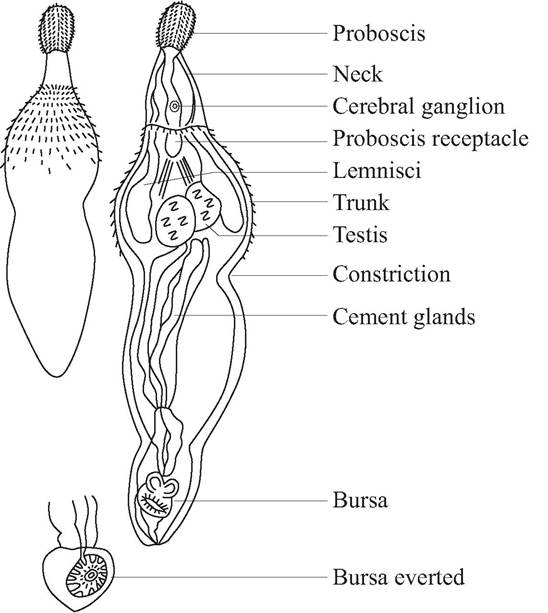
FIGURE 3.10 Generalized anatomy of acanthocephala (McDonald, 1988; Courtesy of Malcolm McDonald and the U.S.
Fish and Wildlife Service).the alimentary canal wall into the hemocoel and develops into an acanthella. The acan- thella often develops the proboscis and other basic organs. The acanthella often is capable of changing the behavior of the intermediate host in such a way as to make it more noticeable and even more attractive to the definitive host for which it serves as food (Nickol 1985; Moore 1995, 2002). Once the acanthella is ingested, it encysts; the cystacanth (juvenile) is the final stage in the invertebrate or paratenic host and is infective for the definitive host.
Acanthocephala infect all classes of vertebrates (Cole 1999). By one assessment, about 2,600 species of acanthocephala were estimated to exist (Poulin and Morand 2004). A considerable number of acanthocephala have been reported from wild mammals (DeGiusti 1971) and wild waterfowl (McDonald 1988); most acanthocephala do not cause serious pathology in their definitive hosts, and only a limited number of groups are of concern to wildlife studies (App. 1: Table 2). Most commonly, the spiny proboscis of the acantho- cephalan may penetrate the intestinal mucosa of the host, causing some inflammation and sometimes hemorrhagic enteritis. Each point of attachment is a potential source of secondary bacterial invaders such as Staphylococcus spp., Streptococcus spp., or Pasteurella multocida. Smaller numbers of the worms can be tolerated relatively well, but with heavier infections some may penetrate the intestinal wall, leading to a peritonitis and likely death.
One set of organisms will be addressed as an example. Several other species will be summarized briefly at the end of this section. Additional information about wildlife parasites is available at other sources (DeGiusti 1971, Crompton and Nickol 1985).
More on the topic phylum Acanthocephala:
- THREE Nematodes, Acanthocephala, Pentastomes, and Leeches
- phylum Nematoda
- INTRODUCTION TO PHYLUM Platyhelminthes
- PHYLUM PENTASTOMA
- CONTENTS
- CONTENTS
- CONTENTS
- CRYPTOSPORIDIUM
- Encephalitozoon cuniculi Infection: Encephalitozoonosis; Microsporidiosis
- INTRODUCTION TO PROTOZOA
- LEECHES (ANNELIDA: HIRUDINEA)
- GENERAL INTRODUCTION
- Boon Andrew. The Ethics and Conduct of Lawyers in England and Wales. Hart Publishing,1999. — 808 p., 1999
- Griffiths-Baker Janine. Serving Two Masters: Conflicts of Interest in the Modern Law Firm. Hart Publishing,2002. — 227 p., 2002
- Grisso T.. Evaluating Competencies: Forensic Assessments and Instruments. 2nd edition. — Springer,2002. — 564 p., 2002