The Inca Imperial Trajectory and Its Sources
Any discussion of how the Incas accomplished their unprecedented configuration of social power in one of the world's most diverse regions must work intimately with documents written after European invasions commenced in the 1530s.
The Incas did not preserve their histories in writing, relying instead on the khipu, a patterned assemblage of knotted cords that recorded numerical information and could be used as a mnemonic device for recounting narratives of the past. The first Spaniards to write about the Inca realm were bedazzled by its abundance of gold and silver, and they struggled to interpret the Andes through a kaleidoscopic model of the Other that had developed over a century of Iberian expeditions against Moors, Caribs, and Aztecs. Unable to communicate directly with native Andeans in the earliest years of the European invasion, the first Spaniards wrote accounts to glorify their own efforts to ransack, convert, and rule over the Inca realm. Evolving intellectual expectations among early modern Europeans compounded the challenge of interpreting and describing the Andes as sui generis.1 Even when Spanish and native Andean authors began to describe Inca imperialism in detail, the resulting1 E.g., Pagden 1982.
R. Alan Covey, The Inca Empire In: The Oxford World History ofEmpire. Edited by: Peter Fibiger Bang, C.A. Bayly, Walter Scheidel, Oxford University Press (2021). © Oxford University Press. DOI: 10.1093/oso/9780197532768.003.0025.
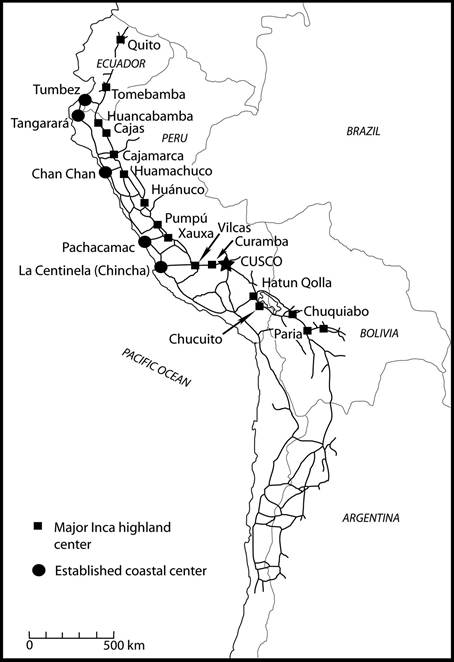
Map 25.1. The Inca Empire.
Copyright: R. Alan Covey, How the Incas Built Their Heartland, Ann Arbor: University of Michigan Press, 2006.
chronicles were steeped in the politics and ideologies of Counter-Reformation Spain—they are far from being nuanced ethnographies of Andean social power.
On the indigenous side, Inca nobles and other Andeans participated in the transcription and modification of oral histories as a means to enhance their own positions as they jockeyed for status on the new colonial landscape.The entire Inca documentary corpus available for study today was written after the Spanish conquest and can be more or less divided between two general categories—chronicles and archives.[1748] Chronicles were first written to describe the heroic deeds of Spaniards in the Andes, and descriptions of Inca social organization, religion, and history only began to be collected around 1550, as part of the discourse over Spanish imperial legitimacy that marked the last years of the reign of Charles V. After his accession, Philip II increased royal censorship and control over Inca narratives, bringing debates over Inca sovereignty to a close as Spanish administrative consolidation proceeded across the Andes, particularly from the 1570s onward.[1749] Most of the chronicles of the Incas written in the late sixteenth century remained unpublished until after the collapse of the Spanish Empire in the early nineteenth century. Royal control over Andean chronicles relaxed somewhat in the early 1600s, and new narratives continued to be produced, including works by indigenous and mestizo writers that remain culturally influential today, despite many factual discrepancies with earlier accounts.[1750] Throughout Spanish colonial rule, only a small subset of chronicles circulated in print for broad consultation by scholars and lay readers. Modern historiographers often struggle to engage a secondary literature that is colored by a few sources that were accessible over the centuries, but are less firmly grounded in eyewitness narratives from people living under Inca rule.[1751]
Like the chronicle tradition, archival documents registered Spanish actions in the New World, but typically of a more mundane legal and administrative sort.[1752] Archives aggregate real- time microhistories from the Colonial era into a vast corpus that is nevertheless fragmentary and subject to continued deterioration.
Tribute accounts, land disputes, wills, and other documents often include descriptions of Inca era conditions—a status quo ante that was frequently the central question disputed by opposing parties in a legal proceeding. Compared with chronicles, archival documents often display more transparent motivations for making claims about Inca imperial rule, because testimonies can be directly affiliated with their legal aims and considered alongside narratives supporting counter-claims. Unfortunately, many secondary studies that work with legal testimony overlook their procedural contexts and simply appropriate the “facts” about the Incas to synthesize them within a particular interpretation of chronicle accounts.The study of Andean archival documents continues to generate valuable new perspectives on the Colonial period, including occasional glimpses into Inca-era conditions, but it is the archaeological record that has provided the most significant body of new evidence on the Inca Empire in recent decades.[1753] When used independently, archaeological data can test assertions made in the documentary record and can shed light on areas where the chronicles and archives are silent— domestic life, provincial realities, and the long-term context of Inca imperialism.[1754] This requires that archaeologists read the documentary corpus critically and pursue interpretations that are not driven by the received wisdom of the secondary literature, regardless of how sound it may seem to be.
More on the topic The Inca Imperial Trajectory and Its Sources:
- The Inca Imperial Economy
- Sources for an Imperial History
- The Sahariya: Trajectory of Economy and Religion
- The Development of Inca Power: Space and Time
- The Beheading of the Inca
- Military Dimensions of Inca Imperialism
- Chapter 1 dealt with the main sources of Roman private law, in the sense of the formal sources which created it.
- Aztec and Inca Human Sacrifice Compared
- The Good Shepherd of the Inca
- Contextualizing Inca Imperialism
- The Inca Empire was the last and most powerful indigenous state to develop in the Americas (Map 25.1).