4 The Journey to the Land of the God
I
One great Bronze Age civilization of the Middle East has been left out of this account so far: Egypt. The unification of Upper and Lower Egypt under the early pharaohs, in around 2700 bc, resulted in the creation of a centralized, affluent society able to draw upon the rich resources in wheat and barley of the lands regularly inundated by the Nile.
When we speak of the importance of water traffic in the life of Egypt, we refer inevitably, in the first place, to shipping moving up and down the Nile. The term ‘Great Green’ that appears in Egyptian texts was used vaguely, though it sometimes meant either the Mediterranean or the open sea in general, and could also be used for the Red Sea.1 In the second millennium bc much of the shipping and many of the merchants who traded with Egypt were foreigners from Syria, Cyprus or Crete. It has already been seen that there is no evidence for contact by sea between Egypt and Mesopotamia at this period, although around the time of the first dynasty in Egypt (c.3000 bc) artistic influences did reach Egypt from Mesopotamia; for instance an ivory knife now in the Louvre portrays a god in what looks very much like Sumerian garb.2 But such influences are far more likely to have trickled through overland, by way of Syria or along desert routes through what are now Jordan and the Israeli Negev, than by a sea route around the great mass of the Arabian peninsula. Still, Egypt did develop ties to the Indian Ocean in the third millennium bc; the Red Sea highway was used less intensively than the routes the Sumerians and Dilmunites created in the Gulf and beyond - perhaps, indeed, it was only used intermittently. But this highway too can be described with increasing certainty, thanks to extraordinary archaeological discoveries along the Red Sea coast, as well as one of the earliest and most engaging ancient Egyptian texts to survive.Before one can make sense of the Egyptian expeditions down the Red
Sea, the most important products of the lands they visited need to be examined. There is a danger here of a circular argument: they went in search of incense; the ancient Egyptians’ word ‘ntyw found on inscriptions and in papyri must surely mean myrrh, because myrrh and frankincense were the most highly prized ingredients of incense in later times; therefore they visited the lands where these products could be found; which proves these lands were, variously, Eritrea, Somalia and Yemen. However, for all its logical faults, this argument points towards a central feature of the early voyages down and perhaps beyond the Red Sea: these expeditions went in search of perfumes rather than spices. The shift from a trade in perfumes and aromatics to one dominated much more by pepper and the other spices of the east became really noticeable during the Roman imperial period, when ships ranged much deeper into Indian Ocean waters; and in the meantime the trade in aromatics declined precipitously, after the suppression of pagan worship by Christian emperors deprived merchants of a market in the temples of the Middle East - though there was a partial recovery by the sixth century ad as Christian worship made increasing use of the same substances.3 But the history of the burning of incense before God or before pagan gods goes back very far in time. Pharaoh himself burned the incense called ‘ntyw before the Egyptian gods, to accompany animal sacrifices, and these ceremonies were especially lavish when a new temple was inaugurated, or when the ruler returned in triumph from war. Incense was burned during the elaborate ceremonies that sent off dead pharaohs to the Next World, and it was used extensively for embalming the dead, at which the Egyptians were the unrivalled masters.
It would certainly be helpful to know exactly what ‘ntyw was, so as to be sure where the Egyptian Red Sea expeditions were heading.
Since the way ‘ntyw was used coincides closely with the way myrrh can be used, the idea that ‘ntyw was actually some form of myrrh makes sense, though there are other gum-resins such as bdellium that could have been confused with it, and this is also true of frankincense.4 Gathering these resins takes much the same form, and the collection of frankincense was described with close attention by Pliny the Elder, a man whose obsession with scientific detail was so powerful that he lingered too long in the gas-filled air of the Bay of Naples and fell victim to the famous eruption of Vesuvius.5 One can wait for the trees to exude a greasy or sticky liquid that may later harden, and collect that; or one can make incisions in the bark of the tree out of which oil will seep; different colours and qualities of incense seep out depending on the process. Frankincense and myrrh are gum-resins that contain volatile oils - up to 17 per cent in the case of fresh myrrh. In the more benign climate of Bronze Age south Arabia and Eritrea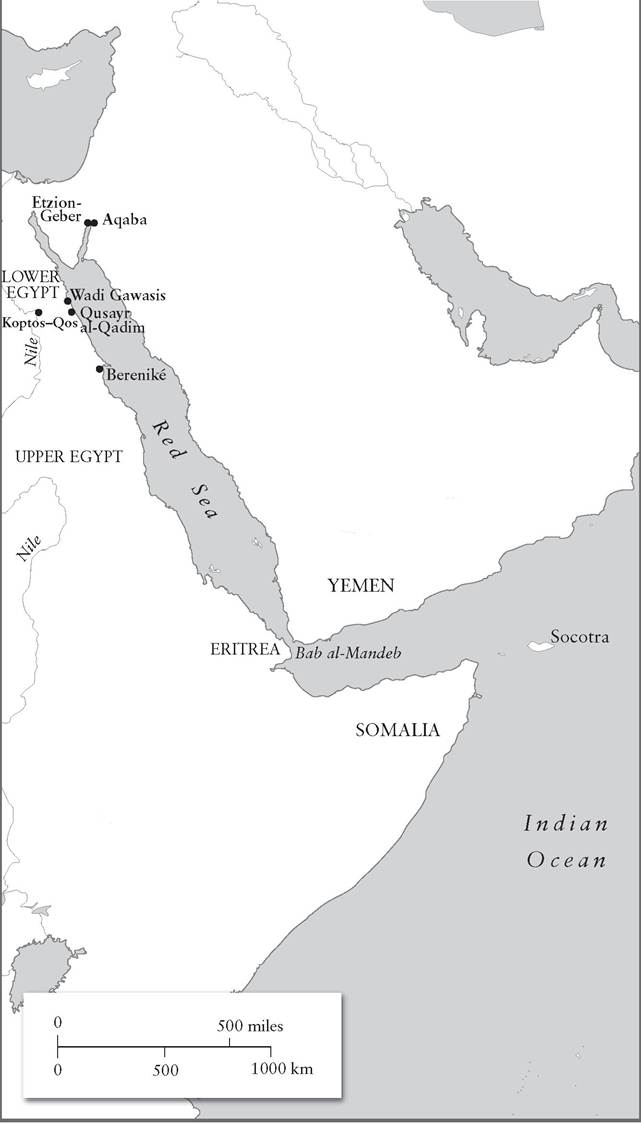
their cultivation spread over a larger area than now, for myrrh has now become a prized rarity in Yemen, which has undergone desiccation over the centuries. Myrrh retains its perfume longer than any other aromatic, and both products have long been prized for their medical uses; myrrh is often an ingredient in high-quality toothpaste. In essence, myrrh was used for anointing, while frankincense was used for burning.6 These were not the only products that the Egyptians brought back from their expeditions, which also included gold and wild animals, dead and alive. For all of these, they turned southwards to the land of Punt, ‘the god’s land’.
II
Just as the Babylonians were often vague about where Dilmun, Magan and Meluhha lay, the ancient Egyptians did not have a clear sense of where or what the land of Punt was. This name, which appears in all the modern literature, is a misreading of a name that generally appears in the form Pwene, and is sometimes defined as ‘the god’s land’.
Punt appears to be the same place as Ophir, which is said to have been visited by the ships of King Solomon and King Hiram of Tyre in the tenth century bc. But their fleet would have sailed out of the Gulf of Aqaba more than 1,600 years after a ship named Praise-of-the-Two-Lands (Upper and Lower Egypt) was mentioned on an inscription containing part of the royal annals that has ended up in Palermo and that dates from the reign of Pharaoh Snefru, around 2600 bc. The ship was built of cedar or pine wood and apparently was involved with sixty or more other boats in a raid on the Nubians that brought back thousands of slaves and an impossible number of cattle (200,000). This ship was impressively large; its length was a hundred Egyptian cubits, or fifty-t wo metres.7 In case this is seen as another example of royal boasting, we can point to the funeral boat buried next to the Great Pyramid at Giza. This was built for Snefru’s son Khufu, or Cheops, and it lay for nearly 4,500 years in a dismantled state before it was unearthed; it is eighty-five cubits long (nearly forty-four metres), and is made of Lebanese cedar, for one of the eternal problems of Egypt has been the general lack of large quantities of good, hard wood.8 It is impossible to be sure that the defeated Nubians about whom Snefru brayed were what we would now call Nubians, that is, inhabitants of the upper reaches of the Nile to the south-east of Egypt; maybe they were other Africans, such as the ancient Libyans who lived to the west of Egypt. And maybe this was an expedition down the Nile rather than the Red Sea. Still, the Palermo Stone and the funerary barge between them show that the Egyptians could build ships with a seagoing capacity, even if many never ventured further than the Nile.The description in Egyptian texts of Punt as ‘the god’s land’ is reminiscent of the way Dilmun was described in Sumerian texts as ‘the abode of the Blessed’. These places had a mysterious aura to those who heard about them in the third millennium bc; and this is a constant feature of maritime history - the news of distant and wonderful lands where (as in Columbus’s Hispaniola many centuries later) neither food nor fresh water was lacking and paradise lay either here or not far away.9 And this sense of awe is abundantly present in the finely crafted ‘Tale of the Shipwrecked Sailor’ written on papyrus somewhere between about 2500 bc and 2200 bc, which tells of a remarkable voyage to the region of Punt, though the story is really a tale of a visit to another world entirely, the world of the spirits.10 Here, a sailor relates the story of his voyage to a royal courtier, who clearly regards him as an ancient mariner full of yarns, and attempts to brush him aside with the words ‘It is tiresome to speak to you.’ However, the courtier was being very unfair.
The sailor had set out for the royal mines, probably gold mines, in a ship 120 cubits long and forty cubits wide, with 120 sailors ‘of the pick of Egypt’, for, ‘whether they looked at the sky or looked at the land, they were more courageous than lions’. It might have helped them more to look at the sea, because although the sailor praised them for their ability to foretell a storm, a wave of eight cubits smashed into the ship, which broke apart and sank with the loss of all lives apart from this sailor, who was cast upon an island rich in fruit and vegetables, fish and fowl, for ‘there was nothing that was not on it’. Indeed, his arms were soon so full of the rich produce of the land that he had to set some of what he had gathered on the ground. Just when he felt so safe and refreshed, a great serpent, with (oddly) a beard two cubits long, came upon him; his body glistened with gold and he had eyebrows of real lapis lazuli. This was a rather different beast to the serpent who led Adam and Eve astray; he wanted to know how the sailor had arrived: ‘Who brought you to the island, with water on all sides?’ He told his story and the serpent seemed satisfied, saying:‘Fear not, fear not, young man! Do not turn pale, for you have reached me. Look, the god has let you live and has brought you to the island of the spirit. There is nothing that is not on it and it is full of all good things. You will spend month upon month until you have completed four months on this island. Then a boat will come from home with sailors whom you know and you will go home with them and die in your city... and you will embrace your children, kiss your wife, and see your house. This is better than anything.’
In gratitude the sailor stretched out on the ground in obeisance and promised to bring word of the noble serpent to his ruler, who would certainly send fine presents of laudanum, malabathrum (cinnamon leaves), terebinth, balsam and incense. He said: ‘I shall have boats brought for you laden with all the wealth of Egypt’; and he would arrange sacrifices in honour of this divine snake.
But the serpent was unimpressed, saying: ‘You don’t have much myrrh, or any form of incense. But I am the ruler of Punt, myrrh is mine. That malabathrum you said would be brought, a large quantity is from this island.’ And he gave the sailor a cargo of myrrh, malabathrum, terebinth, balsam and camphor, as well as black eye-paint (much in demand among noble Egyptian women, as contemporary paintings show), and a big lump of incense. He also gave him hunting dogs, apes and baboons, ‘and all kinds of riches’. Elephant ivory and giraffe tails were there too, the latter presumably used as fly-whisks. He was able to load all this on to the boat, which had duly arrived to pick him up as predicted; and he was told it would take two months to reach home, but when he did so he would feel like a young man again.He and the sailors respectfully thanked the serpent-god and travelled north back home, where the ruler was delighted to see what he had brought and publicly expressed his thanks to this god; besides, he rewarded the sailor by making him a ‘follower’, meaning a feudal lord attached to his court.11 So it is a curious tale that addresses the relationship between the creature comforts of home and a world beyond everyday human experience. But the story also sets out clearly some important features of the land of Punt: what could be obtained there, how long one would need to stop over, how long it would take to return, and the simple fact that it lay to the south, which must mean down the Red Sea. Conceivably the island upon which the sailor was cast was Socotra, which was visited in the first few centuries ad by ships in search of resins and other luxury goods, and which stands 240 miles off Yemen.12
Ill
The existence of southward voyages is confirmed by the major expedition sent out by Queen Hatshepsut or Hashepsowe in the early fifteenth century bc, probably a few years before her death in 1458. She was one of a small and remarkable group of female pharaohs (having previously served as regent), and she aimed to restore the economic vitality of Egypt after the overthrow of the dynasty of the Hyksos, Asiatic rulers under whom political power had fragmented. She took great pride in rebuilding the
76 THE MIDDLE OCEAN: THE INDIAN OCEAN AND ITS NEIGHBOURS temples in central Egypt, abandoned since the Hyksos had ruled Lower Egypt, ‘roving hordes of them overturning what had been made’. She won the deep, indeed passionate, devotion of her officials. Ineni, a much- favoured courtier and master of the royal works, proclaimed: ‘people worked for her, and Egypt bowed the head.’13 This was commemorated in reliefs and accompanying inscriptions within the queen’s magnificent funerary temple at Dair al-Bahri, close to Luxor in Upper Egypt. One of these inscriptions makes it plain that the history of trade with Punt was not a continuous one, as one could easily assume. The fantastic land of the serpent-god was only gradually coming into focus. For the god Amun- Ra makes a curious statement:
No one trod these incense-terraces, which the people did not know; they were heard of from mouth to mouth by hearsay from our ancestors. The marvels brought from there under your fathers, the kings of Lower Egypt, were brought from hand to hand, and, since the time of the ancestors of the kings of Upper Egypt who lived in olden days, they were brought in return for numerous exchanges, and no one reached it except for your royal trading expedition.14
It is reasonable to assume that, before Upper and Lower Egypt were united, fine luxury items such as spices and aromatics brought from further south would have passed through Upper Egypt first; and the same would apply to gold mined further south in Africa. The union of Upper and Lower Egypt to which the god referred must be the relatively recent restoration of native rule by her own dynasty, rather than the original unification of the two kingdoms that had occurred 1,500 years before. But the sense behind the inscription, even allowing for typical pharaonic exaggeration, is that Hatshepsut was in some way a pioneer - perhaps reviving the trade to Punt, and integrating its many stages into a single maritime route managed by royal, rather than private, fleets.15 This may also have meant that she was bypassing the straggly overland routes heading off from the Nile or leading down the west coast of Arabia that were at many times in the past an alternative to the sea route down the Red Sea. Her ambitious building plans and her determination to restore the glittering grandeur of pre-Hyksos days prompted her to look far afield for unguents such as myrrh, luxury materials such as ebony and ivory, exotic animals such as baboons and, of course, gold. That myrrh was a particular prize is clear from the use to which this ‘ntyw was put: it would anoint the limbs of the statue of the god Amun-Ra, which is a possible use for oil of myrrh; however, the inscriptions do not mention the burning of incense, which suggests that large quantities of frankincense were not brought from Punt.
The presence of royal fleets in Punt was intended to make a powerful impression on its inhabitants. The reliefs even portray the ‘great men of Punt’, actually the chieftain Parekhou and his corpulent wife Jtj (vocalizing ancient Egyptian is often pure guesswork, so she is best left in this unpronounceable form). Although one distinguished Egyptologist described Jtj as ‘hideously deformed’, it is more likely that the distortion of her body was a crude attempt to contrast her primitive, servile condition with that of the true queen, the elegant and in some representations beautiful Pharaoh Hatshepsut. So too the portrayal of the people of Punt is hardly flattering; they lived in round huts and had to climb a ladder to go inside their houses. This was not the sophistication of courtly Luxor. The Puntite chieftains subject to this king and queen prostrated themselves before the royal standard, invoking her favour with the words: ‘Hail to you, king of Egypt, female sun who shines like the solar disc.’16 The inscriptions were intended to show that the dignitaries of Punt were Pharaoh’s subjects, even if until now contact had been intermittent or indirect; and therefore what was brought back was not commercial exchange but humble tribute - a common way to conduct trade with supposedly inferior peoples, widely practised throughout Chinese history as well. The tribute was paid over to Pharaoh’s messenger; and back in Egypt Pharaoh herself would appear under a special canopy, ‘the dais of the bringing of tribute’, to receive gifts sent from African peoples to the south of Egypt. Thus one inscription runs: ‘Arrival of the Great Chief of Punt laden with his gifts by the shore of Wadj Wer before the royal envoy.’17 But even Pharaoh bartered for tribute, and before they left Egypt the ships were loaded with gifts of beer, meat, fruit and wine to be sent down to Punt, and these, or supplies for the journey, were illustrated in the reliefs of Hatshepsut’s temple, which display a fleet of rather magnificent ships with billowing sails, oarsmen at the ready and long, heavy stern rudders; even the details of the long, taut ropes can be seen.18
Such ropes actually survive. Admittedly, those that have been found are earlier than Hatshepsut’s expedition, which may have been one of several or many in the period of the so-called New Kingdom. The ups and downs of trade between Egypt and Punt are unknown; the picture is much more blurred than in the case of Dilmun. But, as with Dilmun and Meluhha, there are some basic questions that have to be answered: where Punt was and what route was taken to reach it. And as with Dilmun and Meluhha, a consensus has only slowly come into being, largely as a result of major archaeological discoveries, though they have been made closer to the Egyptian than the Puntite end of the route. For the coast of the Red Sea has yielded more and more fresh evidence for how trade between Egypt and the Indian Ocean operated at key moments in its development: Roman remains at Berenike; medieval ones at Qusayr al-Qadim; and now Bronze Age ones at Wadi and Mersa Gawasis. All these sites lie relatively close to one another; Qusayr is only fifty kilometres to the south of Wadi Gawasis.19 Their proximity is easily explained: to reach the Red Sea from the Egyptian desert there were a number of overland routes that linked the coast to Nile ports, where goods were reloaded on to freighters for passage downriver. There is good evidence that a channel was dug that would enable boats to sail from the Lower Nile through the eastern arms of the delta into the lakes above Suez, and then down into the Red Sea; but it is unlikely that it was used for the large ships that Queen Hatshepsut launched, and the best option remained a short trip overland from the Nile to the coast of the Red Sea. One of the most important Nile stations was at Koptos near Luxor, which gave relatively easy access to Wadi Gawasis because it lay in a bend that carried the river a little way eastwards, and reduced the distance between sea and river, as well as granting access through low passes through the desert. In the Middle Ages it still functioned as the departure point for merchants bound for the Red Sea; medieval Qos was one of the largest towns along the Nile. Koptos-Qos was also well supplied with local timber, which was relatively rare in Egypt. The harbour at Wadi Gawasis (technically known as Mersa Gawasis) was in use between 2000 and 1600 bc, to judge from Carbon 14 dating and from some fragments of pottery from Minoan Crete of around that time, though there are earlier and later dates as well, so it was evidently one of the major trans-shipment stations on the route down the Red Sea.20 But the Egyptians also, at one or two points, left a pile of rubbish in the local caves (or, some think, dedicated some of their equipment to the gods in sealed caverns). The extraordinary dryness of the Red Sea environment has preserved forty-three wooden boxes in which cargo would have been transported, as well as about thirty coils of rope woven from papyrus plants that are still in excellent condition; these date from the Twelfth Dynasty (Middle Kingdom period), c.2000- c.1800 bc. There are also discarded timbers from ships built out of cedar, pine and oak, including the blades of ships’ rudders, for barnacles and worms that had been gathered on the open sea often made heavy repairs necessary; and there were limestone anchors too.21
Once again it is not always the glossy discoveries that really explain the past. Some of the most eloquent evidence about where Punt actually was comes from fragments of smashed pottery: ceramics from Nubia, Eritrea and Sudan, but also from the area around Yemen on the other side of the Bab al-Mandeb Strait. Enough ebony survives to show that it was a favourite export, and it was even prepared before export, because some of the finds consist of wooden rods already fashioned in their place of origin, which, again, was Eritrea.22 Gold was mined in an area known as Bia-Punt, which explains the reference to the ‘royal mines’ in the ‘Tale of the Shipwrecked Sailor’. This too seems to have lain in the highlands of what is now Eritrea. But the most important exports leave few traces other than occasional blocks of resin: the perfumes and aromatics carried up the Red Sea which were intended not just for the living, if they were wealthy enough to afford them, but for the dead, if they were of high enough status to be properly embalmed.
Taken as a whole, the discoveries at Wadi Gawasis confirm the suspicion of many Egyptologists that Punt was a broad region encompassing the southern shores of the Red Sea on both sides, the Eritrean and the Yemeni. Where the Punt fleet tied up when it reached Punt is still a mystery; it does not seem that there was a place called Punt in the way that there was a place called Dilmun, but rather there was an extensive ‘land of Punt’. There must have been roadsteads similar to Mersa Gawasis that provided the facilities any seagoing fleet would require if, as once again the shipwrecked sailor makes plain, a layover of several months was needed before winds and currents made the return journey safe. Some ships may have penetrated further south still, reaching what is now Somalia, but there is no evidence that Egyptian fleets turned east at Aden and encountered vessels from the Persian Gulf. The Red Sea and the Persian Gulf were still separate worlds, and the role of the Red Sea as the principal funnel through which goods from much further east reached the Mediterranean lay long in the future. Indeed, the Egyptian Red Sea trade went into recession around 1100 bc, and the reasons are not hard to guess: the pharaohs were preoccupied with attacks attributed to ‘Sea Peoples’ who came overland from Libya and Syria and from the waters of the Mediterranean; in addition, their control over the Nile Delta was undermined by local separatists. As their power weakened, their ability to fund lavish expeditions to Punt, or to maintain quite such luxurious courts, also faltered.23 This does not mean that the trade in perfumes and resins vanished; over many centuries others, including the Nabataeans of Petra, would maintain the connection by sea and by land.24 For the creation of this route marked an important moment in the expansion of the trade not just of the Red Sea but of a much vaster world.
IV
What happened to the Red Sea trade following the crisis in Egypt has to be reconstructed out of very short references in the Bible that speak of the trade not to Punt but to Ophir, which seems to have been more or less the same place, since it lay in a similar direction and produced similar goods. Curiously, though, the Bible speaks of gold from Ophir but seems uninterested in incense, even though vast quantities of it were burned in the Temple; rituals requiring the waving of censers containing incense by the High Priest Aaron and his successors are described in some detail in the books of Exodus and Leviticus, which it is now generally agreed took their current shape around 500 bc. Since these texts, at least in the form we have them, are so late, archaeology provides the best clues to the use of incense in the area inhabited by the Canaanites and Israelites at the end of the second millennium bc. Incense stands or vessels have been found at sites in modern Israel such as Hazor (from the fourteenth century bc) and Megiddo (from the eleventh century bc). But the incense may well have been made out of substances other than frankincense. Sumerian and Assyrian incense was not made from frankincense (which is further proof that there was no contact with south-western, as opposed to south-eastern, Arabia); aromatic wood from the cedar, cypress, fir or juniper tree was favoured instead; some myrrh was used, but probably a lesser grade of Indian origin.25 According to the Talmud, the incense used in the Jewish Temple was very carefully mixed from a great variety of ingredients, beaten fine: eleven spices, including frankincense, balm, myrrh, cassia, saffron, cinnamon and Cyprus wine; ‘he who omitted any one of the ingredients was liable to the penalty of death’, though there is no evidence anyone ever committed such carelessness.26 Even if this is an elaboration of what was actually used, it is a reminder that the creation of incense, like that of modern perfume, was a complex art and that no single ingredient was likely to be used on its own.
The Israelites were content with their supply of incense, for when, in the tenth century bc, the king of Israel, Solomon, and his great ally Hiram, king of Tyre, launched their own expeditions down the Red Sea, the aim was to acquire gold rather than resins. Archaeologists argue, almost at fisticuffs, about how real the picture of Solomon in the books of Kings and Chronicles was; they differ profoundly about the reliability of the stories that record the foundation of the Davidic dynasty, though the latest evidence, from Khirbet Qeiyafa and Tell Qasile in Israel, shows that the biblical version is not all fantasy. Kings tells how Solomon put together a fleet of ships at a place called Etzion-Geber on the Gulf of Aqaba-Eilat, where Israel and Jordan share one of the two northern tips of the Red Sea. The fleet was accompanied by sailors familiar with the sea, supplied by King Hiram, who was presumably also closely involved in the building of these ships. They travelled down to Ophir, where they obtained 420 talents’ weight of gold, a massive amount (about sixteen tons), which they brought back to King Solomon.27 Soon after, following the famous visit to Jerusalem of the queen of Sheba (who came overland in a great camel caravan), more ships were sent south, described this time as King Hiram’s ships, which makes more sense. They brought gold, sandalwood and jewels from Ophir, and Solomon used the wood in the building both of the Temple in Jerusalem and of his palace next door. Some of the fine wood was even fashioned into harps and other stringed instruments, for ‘it was the best sandalwood anyone in Israel had ever seen’. Kings then asserts that at that time silver was of no special value, so everything was made of gold, even cups and dishes; after this expedition, he received 666 talents of gold, according to the Bible, whose authors were almost certainly conjuring a figure out of the air. ‘Solomon had many ships of Tarshish. Every three years he sent them out with Hiram’s ships to bring back gold, silver and ivory, as well as monkeys and peacocks [or baboons]’ - a passage that suggests silver was not quite so worthless after all.28 So much silver was being brought from Spain by the Phoenicians at this period that it is conceivable silver was not exactly worthless, but was at least easy to obtain and lacked prestige.
This was the time when the Phoenicians were beginning to create their outposts as far afield as Cadiz, even if their settlement there is not as old as the traditional date, 1104 bc (the term ‘Phoenician’ was invented by the Greeks and refers to Canaanite traders, whether by sea or by land, who thought of themselves more as natives of particular cities such as Tyre or Carthage than as a distinct people).29 The land rich in silver that they were visiting was called, in classical sources, Tartessos, and it corresponds to parts of southern Spain; it is often assumed that ‘Tarshish’, mentioned again and again in the Bible, was the same place, but the Bible is emphatic that Solomon’s ships were launched on the Red Sea, and the goods they brought back were not the produce of the Mediterranean.30 The phrase ‘ships of Tarshish’, rather like the term ‘argosy’ derived from the city of Ragusa (Dubrovnik) in early modern times, indicated any fleet of capacious sailing vessels able to breast the high seas. Hiram supplied Solomon with fine timber not just from distant Ophir but from the cedar forests of Lebanon in the hinterland of Tyre; and he sent other goods from all over the Phoenician trading world, as can be seen from the biblical account of how the Temple was built. The Red Sea was a subsidiary, but exotic, addition to the Phoenician trade routes that led across the sea to north Africa, Sardinia and Spain and overland to Assyria. In the sixth century the prophet Ezekiel poured verbal fire and brimstone on Hiram’s erstwhile capital, Tyre, and listed all the lands where Tyre traded - among the easiest to identify are Persia and Yavan (Ionia, that is, Greece), but also Arabia and Sheba, meaning Yemen or somewhere nearby.31
It is possible that the story of Solomon’s fleet is a projection backwards from later times, and it is even possible that a memory lingered of Queen Hatshepsut’s mission to Punt. Reading between the lines, one can see that Hiram played a bigger role than Solomon in this enterprise. But the gold of Ophir was not an illusion; even if the fleets of Ophir were not sailing in the tenth century, they aroused interest in the ninth. A curious passage in Kings, accompanied, as usual, by a much later recasting in Chronicles, tells how Jehosaphat, king of Judah (c.873-849 bc), ‘made ships of Tarsh- ish to go to Ophir for gold, but they did not go, for they were wrecked at Etzion-Geber; then Ahaziah the son of Ahab said to Jehosaphat, let my servants go with your servants in the ships. But Jehosaphat was unwilling.’ Chronicles knew, or pretended to know, rather more than Kings, though the author was thoroughly confused between Ophir and Tarshish and offered a different chronology. Jehosaphat received quite a good press in the Bible; for instance, just before the decision was made to build the ships he had expelled the male temple prostitutes against whom the prophets inveighed. Ahaziah, on the other hand, aroused the ire of the authors of the Bible; he was the king of the rival northern kingdom of Israel, which came into existence after the death of Solomon; yet the two kings set aside past enmities, political and religious, and joined together in a pact, constructing a fleet of ships at Etzion- Geber bound for ‘Tarshish’. A mercantile consortium of this type, guaranteed by the ruler’s protection, was perfectly normal at this time. With the prospect of high profits but the danger of heavy losses, the royal court had the resources to bear the risk, and at the same time welcomed the opportunity to acquire gold and luxury goods.32
All went well until Jehosaphat, who tended to have trouble with the very many prophets telling him what to do, became the target of a certain Eliezer, son of Dodavahu, who strongly disapproved of the alliance with the ruler of Israel, a king still tainted with the Canaanite beliefs that his father Ahab had willingly tolerated. ‘And the ships were wrecked, so they were unable to go out to Tarshish.’ The exact meaning of the term vayishaberu, translated here as ‘wrecked’, is not clear, as it could mean ‘destroyed’ in all sorts of ways, and in the standard English translations the word ‘broken’ is used instead. But surely what the Bible points to is ships coming apart, whether because they were poorly constructed, or because they foundered in a storm or on the many reefs of the Red Sea. For even with Phoenician help it cannot have been easy to navigate a little- known sea, either for Hatshepsut’s fleet, or Solomon’s, or this one.
The obvious task of the archaeologists would be to locate Etzion-Geber. The meaning of the name is not much help; it may indicate something like ‘town of the cockerel’; this is not an area, like some in the Middle East, where fairly continuous occupation has preserved old names. However, since the Red Sea ends in a point, now marked by the modern Israeli city of Eilat and its older Jordanian neighbour, Aqaba, one should not have to seek too far. In 1938 the American archaeologist Nelson Glueck, much respected for his work on biblical sites, identified the hillock of Tell elKheleifeh, which stands just inside the Jordanian border with Israel, as the location of Etzion-Geber. He thought he had found tenth-century pottery there, of varied origin but dating roughly to King Solomon’s time; but more recent investigations have shown the pottery to be somewhat later, later even than King Jehosaphat, and dating to the eighth to early sixth centuries bc, around the time that the book of Kings was probably being pieced together. Still, it contains clues: some pieces are stamped with the inscription ‘belonging to Qaws’anal, servant of the king’, who may well be the king of Judah.33 Another discovery at this site was a potsherd with south Arabian writing, dating from the seventh century bc or a little later, so traffic up the Red Sea certainly existed. Others looking for Etzion- Geber have pointed to ‘Pharaoh’s island’ a little offshore, the site of a crusader castle; the island possesses an enclosed inner harbour of a type familiar from the Phoenician colonies. The Phoenicians preferred to found their trading settlements on offshore islands, as can be seen at Tyre itself and at Motya near Sicily or Cadiz beyond the Strait of Gibraltar. It would not have been odd to have done the same when they tried to set up a sea route down the Red Sea, whether in the tenth century bc or, more likely, in later centuries.34
All this may appear very tenuous, so the best piece has been saved up till last. The mound of Tell Qasile, now contained within the Land of Israel Museum in Tel Aviv, contains the quite substantial remains of a town that the Philistines established on the coast a little north of Jaffa when, arriving from Crete, Cyprus and the Aegean, these Mycenaean warriors migrated across the Mediterranean during the convulsions that saw the collapse of the great Bronze Age civilizations in the region. The town was still active in the eighth century bc, when someone threw away a fragment of a pot inscribed in early Hebrew: ‘the gold of Ophir to Beth- Horon, thirty shekels’.35 As for Beth-Horon, this was either a temple dedicated to the god Horon or a town a little way to the north-west of Jerusalem, in the West Bank, which - rather than lapsing into obscurity - is now the seat of one of the Israeli settlements that have become an obstacle to peace in the Middle East.
v
‘And when they were come into the house, they saw the young child with Mary his mother, and fell down, and worshipped him: and when they had opened their treasures, they presented unto him gifts; gold, and frankincense, and myrrh.’36 It has been seen that these three luxuries already shared their history 1,450 years before the birth of Jesus. About fifteen years ago, a colleague at Cambridge was returning from a visit to the Middle East around Christmas-time. When his luggage was inspected by British customs officials they asked him what he had bought, and he declared that he had been visiting Yemen and that his luggage contained frankincense and myrrh. ‘And gold as well, I suppose!’ came the ironic reply, and he was let through without further ado. These items were certainly the prestige products of the earliest trade routes to navigate down all, or most of, the Red Sea. On the other hand, preferences shifted. The Egyptians had a special interest in myrrh, though they were also great burners of incense; the Phoenicians and the Israelites were most interested in gold and had other sources for their incense. And, as in the case of the early navigators down the Persian Gulf, the expeditions to Punt and Ophir were punctuated by long periods of silence, during which, if Queen Hat- shepsut is to be believed, contact was lost. Fits and starts characterized this maritime route even more than that of the Persian Gulf. Difficulties in navigating past the reefs and shoals of the Red Sea were one discouragement; the possibility of using land routes was another. One could reach Eritrea by river and land, and one could reach Arabia by following the coast of western Arabia overland. This traffic was rendered much easier by the domestication of the camel, whose date is disputed but may have been achieved, at least in parts of Arabia, by 1000 bc.37 Competition between land and sea routes to south Arabia and the facing shores of Africa would last many centuries. It was not always clear what comparative advantage a sea route offered those seeking frankincense and myrrh. The Red Sea would only be used intensively when ships regularly sailed south beyond the fabled lands of Punt, Sheba and Ophir into the wide expanses of the ocean, and that would only happen when the attractions of the Indies and of the shores of Africa became clear. In other words, the Red Sea flourished not for itself but as a passageway linking Egypt, and beyond that the Mediterranean, to Africa, India and even Malaya.
More on the topic 4 The Journey to the Land of the God:
- Ukraine is God-given and God-chosen.
- [Abu Usama:] Abu 'Abd Allah said, “None of the children of Adam is in need of anything for which a standard has not already been established by God and His Messenger (may God's prayer and peace be upon him and his Family).
- A SPIRITUAL-SCIENTIFIC JOURNEY
- The Shaman’s Trance Journey
- 5.04 By virtue of s 1(1) of the 1986 Act, an ‘agricultural holding’ is defined to mean the ‘aggregate of the land (whether agricultural land or not) comprised in a contract of tenancy which is a contract for an agricultural tenancy’
- The unexpected journey
- THE NORDIC BRONZE AGE MYTH OF THE ETERNAL JOURNEY OF THE SUN
- CHAPTER TEN Journey into Avernus Death, burial and perceptions of afterlife
- Journey of Money from Its Brief History to Internet
- FROM MICROFINANCE TO MICROSAVINGS: A PERSONAL JOURNEY
- The Journey of a Tribal Deity into Hindu Pantheon
- Reid Anna. Borderland. A Journey Through the History of Ukraine. Boulder: Westview Press, 2000, 2000
- Article 2.2 Hard times force UK seller of gilts on a globe-trotting journey
- “God” as a proper name
- God’s Rationality
- The Hindu Gods and God
- III God-Problem
- God’s Speech