Deformity and Decline in Amphibian Populations: A Case Study
On a field trip in the summer of 1995, a group of elementary and middle school students from Henderson, Minnesota, made a gruesome discovery as they caught leopard frogs (Lithobates pipiens) for a summer science project: 11 of the 22 frogs they found were severely deformed.
Some of the frogs had missing or extra limbs, others had legs that were too short or bent in odd directions, and still others had bony growths coming out of their backs (FIGURE 1.1). The students reported their findings to the Minnesota Pollution Control Agency, which investigated and found that 30%-40% of the frogs in the pond the students studied were deformed.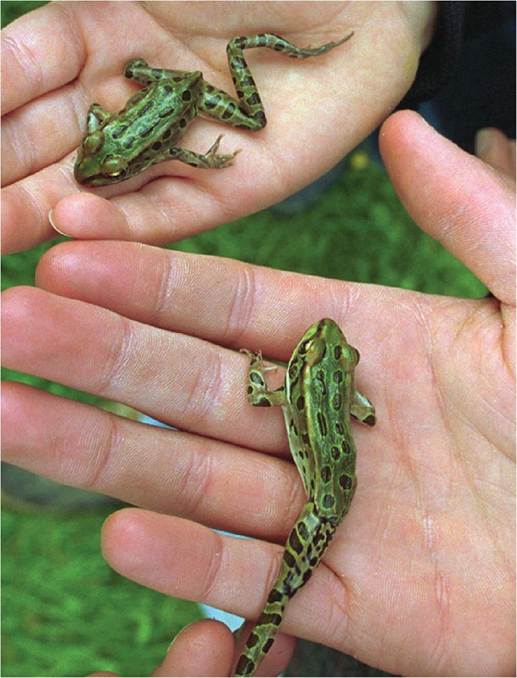
FIGURE 1.1 DeformedLeopardFrog With its misshapen legs, these frogs show one of the types of limb deformities that have become common in leopard frogs and other amphibian species. © Craig Line/Associated Press View larger image
News of the students' discovery traveled fast, capturing public attention and spurring scientists to check for similar deformities in other parts of the country and in other amphibian species. It soon became apparent that the problem was widespread. In the United States, misshapen individuals were found in 46 states and in more than 60 species of frogs, salamanders, and toads. In some localities, more than 90% of the individuals were deformed. Deformed amphibians were also found in Europe, Asia, and Australia. Worldwide, the frequency of amphibian deformities was high and increasing.
Adding to the alarm caused by the gruesome deformities were observations, beginning in the late 1980s, of another disturbing trend: global amphibian populations seemed to be in decline. By 1993, over 500 populations of frogs and salamanders from around the world were reported to be decreasing in size, and some were under threat of extinction.
In some cases, entire species were in danger; across the globe, hundreds of species were extinct, missing, or critically endangered (FIGURE 1.2). Since 1970, an estimated 200 species of frogs have gone extinct, and the rate of extinctions is increasing (Alroy 2015).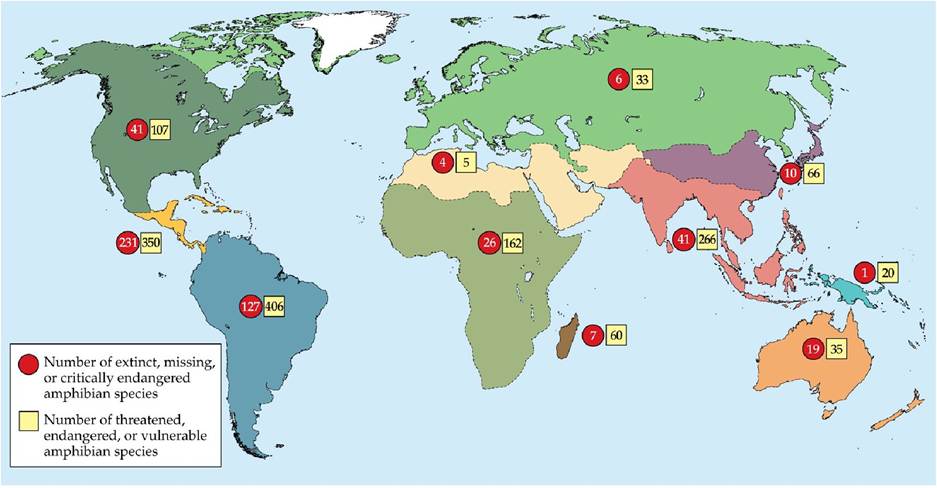
FIGURE 1.2 AmphibiansinDecline In many regions of the world, amphibian species face increased risk of extinction. Each pair of numbered circles and squares is associated with one color-coded region on the map. (Map after AmphibiaWeb. 2019.
https://amphibiaweb.org/declines/declines.html. University of California, Berkeley, CA, USA. Accessed 25 Sep 2019; B. G. Holt et al. 2013. Science 339: 74-78. Data archived at http://macroecology.ku.dk/resources/wallace.) View larger image
Species in other groups of organisms were also showing signs of decline, but scientists were especially worried about amphibians for three reasons. First, the decline appeared to have started recently across wide regions of the world. Second, some of the populations in decline were located in protected or pristine regions, seemingly far from the effects of human activities. Third, some scientists view amphibians as “biological indicators” of environmental conditions. They hold this view in part because amphibians have permeable skin and eggs that lack shells or other protective coverings, which increases their sensitivity to toxic pollutants. In addition, most amphibians spend part of their lives in water and part on land. As a result, they are exposed to a wide range of potential threats, including water and air pollution as well as changes in temperature and in the amount of ultraviolet (UV) light in their environment. Moreover, many amphibians remain close to their birthplace throughout their lives, so the decline of a local population is likely to indicate a deterioration of local environmental conditions.
Because amphibians worldwide were showing declining numbers and frequent deformities, scientists initially tried to find one or a few global causes that might explain these problems. However, as we'll see in this chapter, the story turned out to be more complicated than that: a single “smoking gun” has not emerged. What, then, has caused the global decline of amphibian populations?
More on the topic Deformity and Decline in Amphibian Populations: A Case Study:
- A Sea in Trouble: A Case Study
- Small populations are at much greater risk of extinction than large populations
- Case Study: Darug Clan, Australia
- Case study
- Snowshoe Hare Cycles: A Case Study
- Case study contributors
- The First Farmers: A Case Study
- Management of Spinal Deformity
- A Case Study of Solomon islands
- A Case Study of the Idu Mishmi
- “Killer Algae!”: A Case Study
- Enslaver Parasites: A Case Study