NPP in terrestrial ecosystems is controlled by climate
Variation in terrestrial NPP at the continental to global scales correlates with variation in temperature and precipitation. NPP increases as average annual precipitation increases up to a maximum of about 2,400 mm per year, after which it decreases in some ecosystems (e.g., highland tropical forests), but not in others (e.g., lowland tropical forests) (FIGURE 20.10A).
NPP may decrease at very high precipitation levels for several reasons. Cloud cover over long periods lowers available sunlight. High amounts of precipitation leach nutrients from soils, and high soil water content results in hypoxic conditions that cause stress for both plants and decomposers.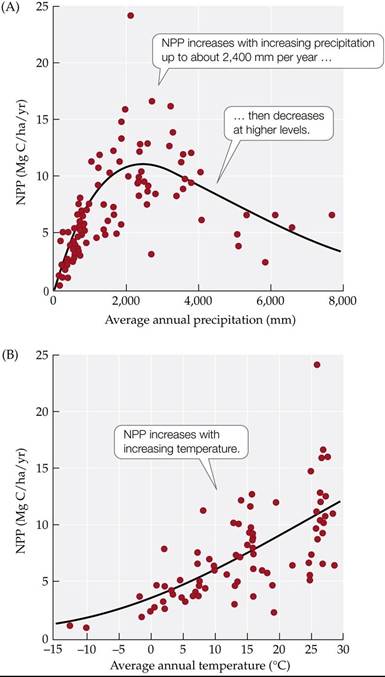
FIGURE 20.10 Global Patterns of Terrestrial NPP Are Correlated with Climate The graphs show the relationships between NPP and (A) precipitation and (B) temperature in terrestrial ecosystems worldwide. (Mg = 106 g.) (After E. A. G. Schuur. 2003. Ecology 84: 1165-1170.) View larger image
NPP increases with average annual temperature (FIGURE 20.10B). This does not mean, however, that ecosystem carbon storage (NEE, discussed earlier) does the same. The loss of carbon from ecosystems due to respiration of heterotrophic organisms also increases at warmer temperatures, so NEE may potentially decrease. Several lines of evidence suggest that climate change over the past decades has changed NEE in some ecosystems. For example, tundra sites that were once carbon sinks (with GPP greater than carbon loss due to respiration) are now carbon sources (with respiratory carbon loss greater than GPP). These changes are increasing CO2 losses to the atmosphere.
These correlations of NPP with climate suggest that NPP is directly linked to water availability and temperature. Such links make sense when we consider the direct influence of water availability on photosynthesis via the opening and closing of stomates and the influence of temperature on the enzymes that facilitate photosynthesis (see Concept 5.2).
In deserts and in some grassland ecosystems, water availability has a clear, direct influence on NPP. In other ecosystems where water limitation is not as severe, the causal connection between precipitation and NPP is less clear.The links between climate and NPP may also be indirect, mediated by factors such as climate effects on nutrient availability or the particular plant species found within an ecosystem. How can we detect whether the influence of climate on NPP is direct or indirect? Several approaches, both observational and experimental, have been used. William Lauenroth and Osvaldo Sala examined how NPP in a short-grass steppe ecosystem responded to year-to-year variation in precipitation (Lauenroth and Sala 1992). They also examined the average annual NPP and precipitation across several grassland ecosystems at different locations in the central United States. When they compared the correlations between NPP and precipitation in their two analyses, they found that NPP increased more as precipitation increased for the site-to-site comparison than for the comparison among years in the short-grass steppe (FIGURE 20.11). They attributed the difference in the response of NPP to precipitation to variation in plant species composition among the grasslands. Some grass species have a greater inherent capacity to increase growth than others in response to enhanced water availability, associated with greater ability to produce new shoots and flowers. Lauenroth and Sala also suggested that there was a time lag in the response to increased precipitation in the short-grass steppe ecosystem; that is, the increase in NPP in response to an increase in precipitation did not occur in the same year, but was delayed one to several years. Within the grassland biome, differences in the abilities of species to respond to climate variation can contribute to site-to-site variation in NPP, influencing the correlation between climate and NPP among sites.
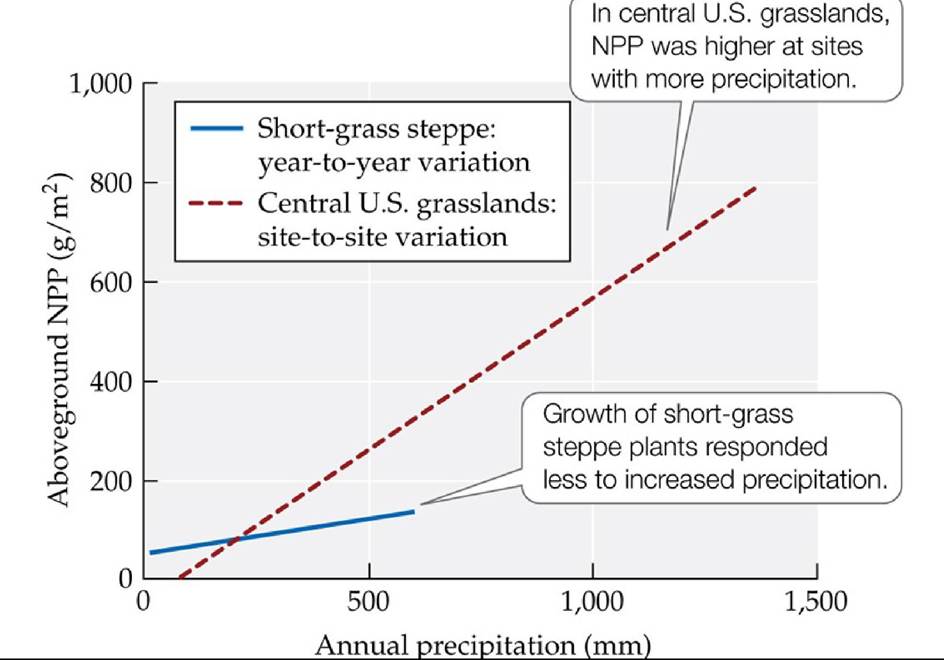
FIGURE 20.11 The Sensitivity of NPP to Changes in Precipitation Varies among
Grassland Ecosystems The relationship between aboveground NPP and precipitation is shown for a short-grass steppe ecosystem and for several grassland ecosystems of different types at different sites in the central United States.
(After W. K. Lauenroth and O. E. Sala. 1992. Ecol Appl 2: 397-403.) View larger imageExperimental manipulations of water, nutrients, carbon dioxide, and plant species composition have been used to examine the direct influence of those factors on NPP. The results of numerous experiments indicate that nutrients, particularly nitrogen, control NPP in terrestrial ecosystems. For example, William Bowman, Terry Theodose, and their colleagues used a fertilization experiment in alpine communities of the southern Rocky Mountains to determine whether the supply of nutrients limits NPP (Bowman et al. 1993). They knew that spatial differences in NPP among alpine communities were correlated with differences in soil water availability, as in the grassland ecosystems described above. Bowman and colleagues' fertilization experiment was performed in two communities, a nutrient-poor dry meadow and a more nutrient-rich wet meadow. They sought to determine whether the supply of nutrients influenced NPP and, if so, whether the response differed between the two communities. They added nitrogen or phosphorus or both nitrogen and phosphorus to different plots in both communities, and they maintained plots with no nutrient additions as controls. Their results indicated that the supply of nitrogen limited NPP in the dry meadow, while nitrogen and phosphorus both limited NPP in the wet meadow (FIGURE 20.12). An additional experiment indicated that the addition of water to the dry meadow did not increase NPP, despite the positive relationship between NPP and soil moisture across the communities. These results suggest that the correlation between soil moisture and NPP in these alpine communities does not indicate a direct causal relationship, but rather is determined by the effect of soil moisture on nutrient supply through its effects on decomposition and movement of nutrients in the soil (described in Concept 22.2).
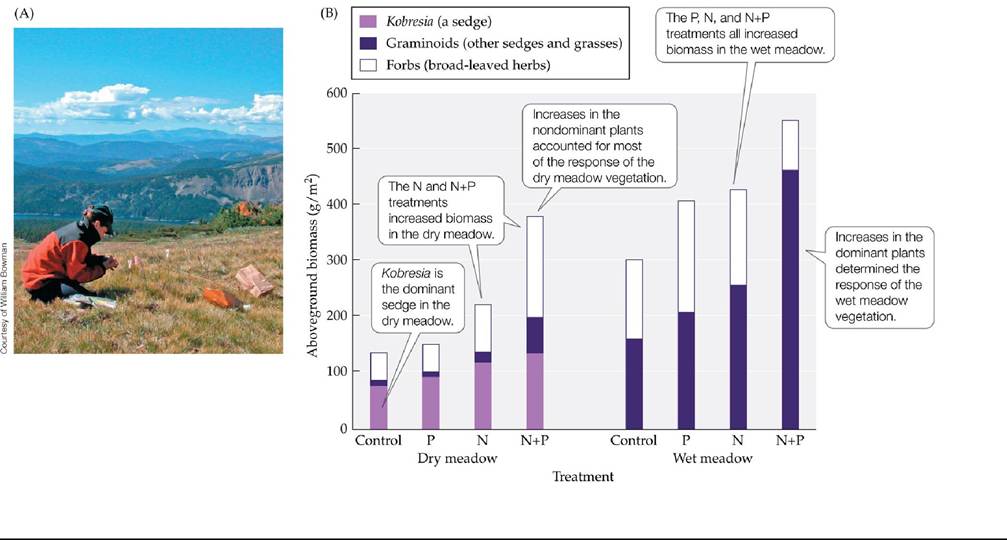
FIGURE 20.12 Nutrient Availability Influences NPP in Alpine Communities (A)Fertilized plots in an alpine dry meadow community in the Colorado Rocky Mountains, dominated by sedges, forbs, and grasses (see Figure 3.11).
(B) Fertilization of plots in a resource-poor dry meadow and a resource-rich wet meadow with nitrogen (N), phosphorus (P), and both N and P showed that nutrient availability limits NPP.In which community would you expect a higher proportion of belowground NPP? Would the allocation to belowground NPP change in response to fertilization?
(B after W. D. Bowman et al. 1993. Ecology 74: 2085-2098.) View larger image
Closer examination of Figure 20.12B shows that the increase in NPP was not uniform across all plant species groups. The dominant plant type of the alpine dry meadow (Kobresia myosuroides) did not increase its biomass as much as the less common sedge and grass species. The change in NPP in the dry meadow occurred largely as a result of a change in plant species composition within the experimental plots. This was not the case in the wet meadows, where the dominant sedges increased their growth more than the subdominant forb species. These results are consistent with the general trend of results from many fertilization experiments, which indicate that plant species from resource-poor communities have lower growth responses to fertilization than species from resource-rich communities. This apparent contradiction is the result of differences in the capacity of plant species to respond to fertilization. Plants of resource-poor communities tend to have low intrinsic growth rates, a characteristic that lowers their resource requirements. Plants of resource-rich communities tend to have higher growth rates, which make them better able to compete for resources, particularly light. Although NPP increases in nutrientpoor communities when they are fertilized, the change in plant species composition that occurs in many such experiments indicates that plant species composition can determine the intrinsic capacity of an ecosystem to increase its NPP when resources are increased (FIGURE 20.13). This study provides an example of the important roles that community dynamics can play in ecosystem
function.
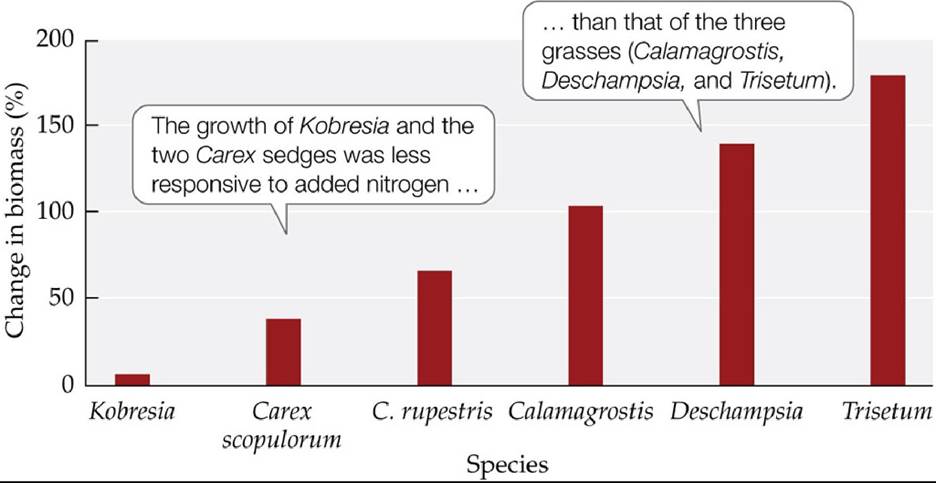
FIGURE 20.13 Growth Responses of Alpine Plants to Added Nitrogen Theeffecton
plant growth of low to high nitrogen levels (with all other nutrients maintained at optimal concentrations) indicated that alpine plant species vary substantially in their ability to increase growth in response to an increase in nitrogen availability. (After W. D. Bowman and C. J. Bilbrough. 2001. Plant Soil 233: 283-290.) View larger image
NPP is often limited by nutrients in non-desert terrestrial ecosystems. Some general differences among terrestrial ecosystem types have emerged from resource manipulation experiments and measurements of plant and soil chemistry. In lowland tropical rainforests, NPP is often limited by the supply of phosphorus, since the relatively old, leached tropical soils in which they grow are low in available phosphorus relative to other nutrients. Other nutrients, such as calcium and potassium, can also limit production in lowland tropical ecosystems. Montane tropical ecosystems, and most temperate and Arctic ecosystems, are limited by the supply of nitrogen, and occasionally by phosphorus. Even in some desert ecosystems, NPP is co-limited by water and
nitrogen.
More on the topic NPP in terrestrial ecosystems is controlled by climate:
- NPP in aquatic ecosystems is controlled by nutrient availability
- Terrestrial and oceanic NPP are nearly equal
- Differences among biomes in NPP reflect climate and biotic variation
- CONCEPT 22.4 Freshwater and marine nutrient cycles occur in a moving medium and are linked to terrestrial ecosystems.
- NPP changes during ecosystem development
- NPP can be estimated by a number of methods
- Terrestrial biomes reflect global patterns of precipitation and temperature
- Which biomes and marine biological zones have the highest NPP and, as a consequence, the greatest effect on atmospheric CO2 dynamics?
- Terrestrial Biomes
- Almost seven years of war and civil strife had left the Bolshevik-controlled parts of the former Russian Empire in shambles.
- TRANSMISSION OF TERRESTRIAL AND BAT RABIES
- Ecosystems
- Environmental Controls on NPP
- Global Patterns of NPP
- There are two possible ways to look at the control of energy flow through ecosystems.
- The potential distributions of terrestrial biomes differ from their actual distributions due to human activities
- In the sphere of controlled violence and state-sponsored ‘terrorism' (in its literal sense), ancient Egypt is a prime example and object lesson among the complex societies of the Near East.
- CONCEPT 3.1 Terrestrial biomes are characterized by the growth forms of the dominant vegetation.
- Effects of Climate Change