The Supply of Labor
Discuss factors that affect the supply of labor.
Beyond any psychological satisfaction gained from having a job, the principal benefit of working is the income earned, which can be used to buy necessities and luxuries.
The principal cost of working is that it involves time and effort that are no longer available for other activities. Economists use the term leisure[40] for all off-the-job activities, including eating, sleeping, working around the house, spending time with family and friends, and so on. To make themselves as well off as possible, individuals should choose to supply labor up to the point at which the income obtained from working an extra hour just makes up for the extra hour of leisure they have to forgo.The Income-Leisure Trade-Off
To illustrate how the trade-off between income and leisure affects the labor supply decision, let's look at an example. Consider a tennis instructor named Ace who offers tennis lessons. After paying taxes and job-related expenses, Ace can earn $60 per hour, which we will call his (after-tax) nominal wage rate. Ace enjoys a reputation as an outstanding tennis instructor and could work as many hours per year as he chooses. He is reluctant to work too much, however, because every day he spends teaching tennis means one less day available to devote to his real passion, skydiving. The decision Ace faces is how many hours to work this year—or, in other words, how much labor to supply.
Ace approaches this question by asking himself: Economically speaking, what really makes me happy? After a little reflection, Ace concludes that his level of happiness, or utility, depends on the amount of goods and services he consumes and on the amount of leisure time he has available to jump out of airplanes. His question can therefore be recast as follows: How much should I work this year so as to obtain the highest possible level of utility?
To find the level of labor supply that maximizes his utility, Ace must compare the costs and benefits of working an extra hour.
The cost of an extra hour of work is the loss of an hour of leisure; this cost can be measured as the loss in utility that Ace experiences when he must work for an hour instead of skydive. The benefit of working an extra hour is an increase of $60 in income, which allows Ace to enjoy more consumption.If the benefit of working an extra hour (the utility gained from extra income) exceeds the cost (the utility lost by reducing leisure), Ace should work the extra hour. In fact, he should continue to increase his time at work until the utility he receives from the additional income of $60 just equals the loss of utility associated with missing an hour of leisure. Ace's labor supply at that point is the one that maximizes his utility.[41] Using the idea that the labor supply decision results from a trade-off of leisure against income, we can discuss factors that influence the amount of labor supplied by Ace.
Real Wages and Labor Supply
The real wage is the amount of real income that a worker receives in exchange for giving up a unit of leisure (an hour, a day, or a week, for example) for work. It is an important determinant of the quantity of labor that is supplied.
Generally, an increase in the real wage affects the labor supply decision in two ways. First, an increase in the real wage raises the benefit (in terms of additional real income) of working an additional hour and thus tends to make the worker want to supply more labor. The tendency of workers to supply more labor in response to a higher reward for working is called the substitution effect of a higher real wage on the quantity of labor supplied.
Second, an increase in the real wage makes workers effectively wealthier because for the same amount of work they now earn a higher real income. Someone who is wealthier will be better able to afford additional leisure and, as a result, will supply less labor. The tendency of workers to supply less labor in response to becoming wealthier is called the income effect of a higher real wage on the quantity of labor supplied.
Note that the substitution and income effects of a higher real wage operate in opposite directions, with the substitution effect tending to raise the quantity of labor supplied and the income effect tending to reduce it.A Pure Substitution Effect: A One-Day Rise in the Real Wage. We can illustrate the substitution effect by supposing that, after some consideration, Ace decides to work 48 hours per week, by working eight hours per day for six days each week. He leaves every Wednesday free to go skydiving. Although Ace could work and earn $60 per hour each Wednesday, his highest utility is obtained by taking leisure on that day instead.
Now imagine that one Tuesday, an eccentric tennis player calls Ace and requests a lesson on Wednesday to help him prepare for a weekend amateur tournament. He offers Ace his regular wage of $60 per hour, but Ace declines, explaining that he plans to go skydiving on Wednesday. Not willing to take "no" for an answer, the tennis player then offers to pay Ace $600 per hour for an all-day lesson on Wednesday. When Ace hears this offer to work for 10 times his usual wage rate, he thinks: "I don't get offers like this one every day. I'll go skydiving some other day, but this Wednesday I'm going to work."
Ace's decision to work rather than skydive (that is, to substitute labor for leisure) on this particular Wednesday represents a response to a very high reward, in terms of additional income, that each additional hour of work on that day will bring. His decision to work the extra day results from the substitution effect. Because receiving a very high wage for only one day doesn't make Ace substantially wealthier, the income effect of the one-day wage increase is negligible. Thus the effect of a one-day increase in the real wage on the quantity of labor supplied by Ace is an almost pure example of the substitution effect.
A Pure Income Effect: Winning the Lottery. In addition to skydiving, Ace enjoys playing the state lottery.
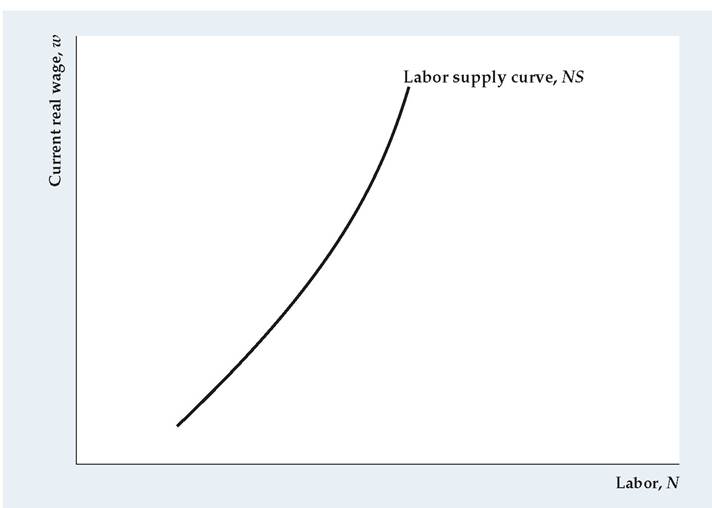
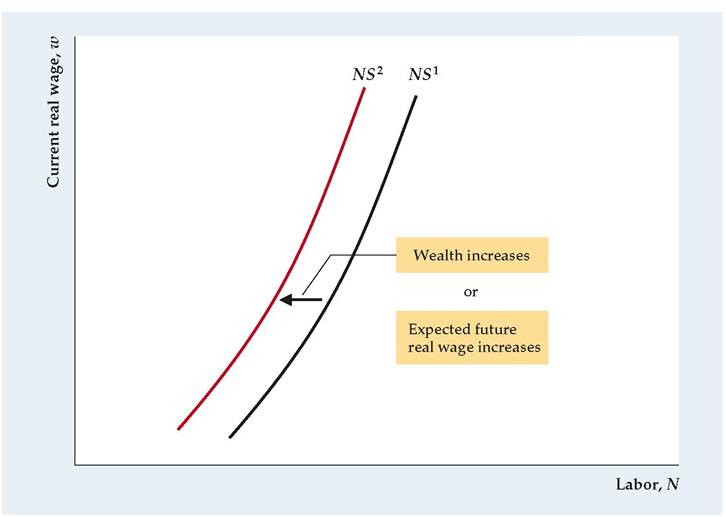
As luck would have it, a week after spending the Wednesday teaching the eccentric tennis player, Ace wins $300,000 in the state lottery. Ace's response is to reduce his workweek from six to five days, because the additional $300,000 of wealth enables him to afford to take more time off from work—and so he does. Because the lottery prize has made him wealthier, he reduces his labor supply. As the lottery prize does not affect the current reward for giving up an hour of leisure to work—Ace's wage is still $60 per hour—there is no substitution effect. Thus, winning the lottery is an example of a pure income effect.Another example of a pure income effect is an increase in the expected future real wage. Suppose that the aging tennis pro at the posh country club in Ace's community announces that he will retire the following year, and the country club agrees to hire Ace beginning one year from now. Ace will earn $100 per hour (after taxes) for as many hours as he wants to teach tennis.[42] [43] Ace recognizes that this increase in his future wage has effectively made him wealthier by increasing the future income he will receive for any given amount of labor supplied in the future. Looking at his lifetime income, Ace realizes that he is better able to afford leisure today. That is, the increase in the future real wage has an income effect that leads Ace to reduce his current labor supply. Because this increase in the future wage does not change Ace's current wage, and thus does not affect the current reward for giving up an hour of leisure to work an additional hour, there is no substitution effect on Ace's current labor supply. Thus the increase in the future real wage has a pure income effect on Ace's labor supply. The Substitution Effect and the Income Effect Together: A Long-Term Increase in the Real Wage. The aging tennis pro at the country club quits suddenly, and the country club asks Ace to start work immediately. Ace accepts the offer and earns $100 per hour (after taxes) for as many hours as he wants to teach tennis. On his new job, will Ace work more hours or fewer hours than he did before? In this case, the two effects work in opposite directions. On the one hand, because the reward for working is greater, Ace will be tempted to work more than he did previously. This tendency to increase labor supply in response to a higher real wage is the substitution effect. On the other hand, at his new, higher wage, Ace can pay for food, rent, and skydiving expenses by working only three or four days each week, so he is tempted to work less and spend more time skydiving. This tendency to reduce labor supply because he is wealthier is the income effect. Which effect wins? One factor that will influence Ace's decision is the length of time he expects his new, higher wage to last. The longer the higher wage is expected to last, the larger its impact on Ace's lifetime resources is, and the stronger the income effect is. Thus, if Ace expects to hold the new job until he retires, the income effect is strong (he is much wealthier) and he is more likely to reduce the amount of time that he works. In contrast, if Ace believes that the job may not last very long, the income effect is weak (the increase in his lifetime resources is small) and he may choose to work more so as to take advantage of the higher wage while he can. In general, the longer an increase in the real wage is expected to last, the larger the income effect is and the more likely it is that the quantity of labor supplied will be reduced. Empirical Evidence on Real Wages and Labor Supply. Because of conflicting income and substitution effects, some ambiguity exists regarding how a change in the real wage will affect labor supply. What is the empirical evidence? Research on labor supply generally shows that the aggregate amount of labor supplied rises in response to a temporary increase in the real wage but falls in Application The Gig Economy in the ASEAN Nations The term gig economy describes an economy where firms prefer to recruit independent contractors for short-term commitments or positions. In surveys of employment and earnings, gig workers are not easily identified. Singapore, Vietnam, and Indonesia, for instance, use "self-employed" as a proxy to identify gig workers, while Malaysia lists them as "own-account workers." The prevalence of gig workers in Vietnam and Indonesia were recorded at 59.6% and 5θ.9% respectively. Singapore has the lowest percentage of self-employed workers in the Association of Southeast Asian Nations (ASEAN) group, at only 10%. In terms of earnings, the Philippines has the sixth fastest-growing gig economy in the world.[44] Several explanations have been put forward for the rising trend in the gig economy: Vietnam, for example, reported that 53% of their graduates and intellectuals choose freelancing jobs because of the flexibility in working hours and location, while Indonesia attributes the trend to the rise of digitalization.[45] 15Luis Pinedo Caro, Niall O'Higgins, and Janine Berg 2021, "Young People and the Gig Economy," May 7, 2021, https://www.ilo.org/wcmsp5/groups/public/---ed_emp/documents/publication/wcms_790117.pdf. 16Payoneer, "Global Gig-Economy Index: Q2 2019," https://explore.payoneer.com/q2_global_freelancing_ index/. 17Fairwork, "Fairwork Indonesia Ratings 2021: Labour Standards in the Gig Economy," Yogyakarta, Indonesia; Oxford, United Kingdom, 2021, https://fair.work/wp-content/uploads/sites/17/2021/12/211209_ Fairwork_Report_Indonesia-2021.pdf. caring for an aging parent) and the tax rate (which determines how much income can be kept after taxes are paid). The Labor Supply Curve We have discussed how the amount of labor supplied by an individual depends on the current and expected future real wage rates. The labor supply curve of an individual relates the amount of labor supplied to the current real wage rate, holding constant all other factors (including the expected future real wage rate) that affect the amount of labor supplied. Figure 3.7 presents a graph of a typical labor supply curve. The current real wage is measured on the vertical axis, and the amount of labor supplied is measured on the horizontal axis. The labor supply curve slopes upward because an increase in the current real wage (holding constant the expected future real wage) leads to an increase in the amount of labor supplied. Factors That Shift the Labor Supply Curve. Any factor that changes the amount of labor supplied at a given level of the current real wage shifts the labor supply curve. Specifically, any factor that increases the amount of labor supplied at a given level of the real wage shifts the labor supply curve to the right, and any factor that decreases the amount of labor supplied at a given real wage shifts the labor supply curve to the left. We have already discussed how an increase in wealth (say, from winning the lottery) has a pure income effect that reduces the amount of labor supplied at a given real wage. Thus, as shown in Figure 3.8, an increase in wealth shifts the labor supply curve to the left. We have also discussed how an increase in the expected future real wage has a pure income effect that reduces the amount of labor supplied at a given real wage. Figure 3.8 also depicts the response of the labor supply curve to an increase in the expected future real wage. FIGURE 3.7 The labor supply curve of an individual worker The horizontal axis shows the amount of labor that a worker will supply for any given current real wage on the vertical axis. The labor supply curve slopes upward, indicating that—with other factors, including the expected future real wage, held constant—an increase in the current real wage raises the amount of labor supplied. FIGURE 3.8 The effect on labor supply of an increase in wealth An increase in wealth reduces the amount of labor supplied at any real wage. Therefore an increase in wealth causes the labor supply curve to shift to the left. Similarly, an increase in the expected future real wage, which has the effect of making the worker wealthier, reduces the amount of labor supplied at any given current real wage and shifts the labor supply curve to the left. Aggregate Labor Supply As we mentioned earlier, the aggregate supply of labor is the total amount of labor supplied by everyone in the economy. Just as the quantity of labor supplied by an individual rises when the person's current real wage rises, the aggregate quantity of labor supplied increases when the economywide real wage rises. An increase in the current economywide real wage raises the aggregate quantity of labor supplied for two reasons. First, when the real wage rises, people who are already working may supply even more hours—by offering to work overtime, by changing from part-time to full-time work, or by taking a second job. Second, a higher real wage may entice some people who are not currently in the labor force to decide to look for work. Because higher current real wages induce people to want to work more, the aggregate labor supply curve—which shows the relation between the aggregate amount of labor supplied and the current real wage— slopes upward. Changes in the hours worked by people who are already working are said to be changes in the intensive margin; if people who had not been employed decide to take jobs, they are said to be changing the extensive margin. So, the intensive margin refers to hours worked per employed worker, while the extensive margin refers to the number of employed workers.[46] Factors other than the current real wage that change the amount of labor that people want to supply cause the aggregate labor supply curve to shift. Summary table 4 lists the factors that shift aggregate labor supply. We have discussed the first two factors in the table, wealth and the expected future real wage. Aggregate labor supply will also increase if the country's working-age population increases (for example, because of an increased birth rate or immigration), or if changes in the social or legal environment cause a greater proportion of the working-age population to enter the labor force (increased labor force participation). For example, evolving attitudes about the role of women in society contributed to a large increase in the number of women in the U.S. labor market from the late 1960s to the mid-1990s; and the elimination of mandatory retirement in many fields may increase the participation rates of older workers. 3.4
SUMMARY 4 Factors That Shift the Aggregate Labor Supply Curve An increase in Causes the labor supply curve to shift Reason Wealth Left Increase in wealth increases amount of leisure workers can afford. Expected future real wage Left Increase in expected future real wage increases amount of leisure workers can afford. Working-age population Right Increased number of potential workers increases amount of labor supplied. Participation rate Right Increased number of people wanting to work increases amount of labor supplied.
More on the topic The Supply of Labor:
- NUMERICAL PROBLEMS
- Transitional Dynamics in the DiscreteTime Solow Model
- Price Stickiness
- Trade, Technology Diffusion and the Product Cycle
- The FE Line: Equilibrium in the Labor Market
- CHAPTER SUMMARY
- Labor Contracts and Nominal-Wage Rigidity
- Abel A.B., Bernanke B., Croushore D.. Macroeconomics. 10th Edition, Global Edition. — Pearson,2021. — 690 pp., 2021
- CHAPTER SUMMARY
- Political Institutions and Growth-Enhancing Policies