Bones
Introduction
Osteology is the study of bones. The skeleton provides the basic scaffolding for the body. The skeletal system includes the bones, cartilage, ligaments, and connective tissues that hold everything together.
Classification of bones
The human skeleton contains 206 major bones whereas the number of bones in different animals varies. The bones can be classified into five categories, including long bones, short bones, flat bones, irregular bones, and sesamoid bones (Fig. 6.1), named due to the resemblance to sesame seeds.
Anatomy and Physiology of Domestic Animals, Second Edition. R. Michael Akers and D. Michael Denbow. © 2013 John Wiley & Sons, Inc. Published 2013 by John Wiley & Sons, Inc.
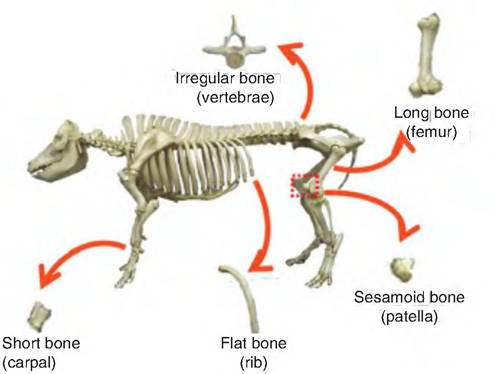
Fig. 6.1. Types of bones. Examples of the various types of bones as found in the pig skeleton.
• Long bones. These are bones that are longer than they are wide. Some of the bones of the limbs are long bones. Long bones are characterized by an elongated shaft and somewhat enlarged extremities that bear articular surfaces. Examples of long bones include the humerus, radius, femur, tibia, metacarpal bones, and metatarsal bones.
• Short bones. These are generally shaped somewhat like a cube; examples include the carpal bones of the wrist and tarsal bones of the ankle.
• Flat bones. As the name implies, these are thin and flattened bones. They include two plates of compact bone separated by cancellous or spongy bone. Examples include the sternum (breastbone), ribs, scapula (shoulder blade), and certain skull bones.
• Irregular bones. These are complex and irregularly shaped bones. Examples include the vertebrae and certain facial bones.
• Sesamoid bones. These are small bones embedded in a tendon and resemble the shape of a sesame seed. The most prominent example is the patella (kneecap).
More on the topic Bones:
- Pelvic bones and fetal skull
- Bones
- Sample collection
- Axial skeleton
- Bones and skeleton
- Chapter summary
- Bones of the forelimb (Fig. 3.1)
- Bone structure
- Contents
- The Skeletal System