HOOF OVERGROWTH
The size and shape of the hoof at any one time will be a balance between the rate of growth and the rate of wear. As one might expect, there are a variety of factors which influence both processes.
For example, horn growth is faster• in young animals
• with high concentrate feeding
• with more exercise
• on rough surfaces
The rate of wear is increased by factors such as:
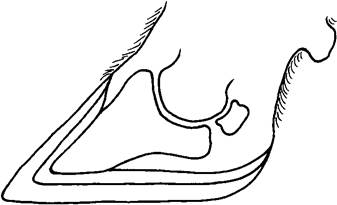
A - normal hoof shape
• wet conditions underfoot, leading to softer horn which wears faster
• excessive walking
• hard and/or abrasive floor surfaces
Overgrowth at the toe
The horn of the wall is generally harder than the horn of the heel, so although both may grow at the same rate, horn is worn away more slowly from the toe than from the heel. This results in overgrowth occurring primarily at the toe. The additional horn at the toe lifts up the front of the foot and the front wall then forms a more shallow angle, decreasing from 45° to 30° or 20°, or even to the horizontal. In extreme cases the front wall becomes concave and the toe is lifted off the ground (Plate 9.4). These changes are shown in Figure 9.8. Internally the pedal bone is rotated backwards, thereby putting even more pressure on its rear edge and further increasing the risk of sole ulcers.
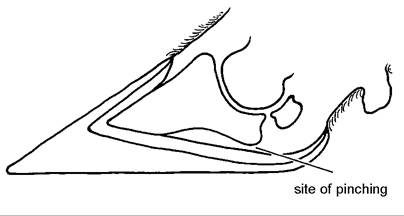
B - overgrowth at the toe
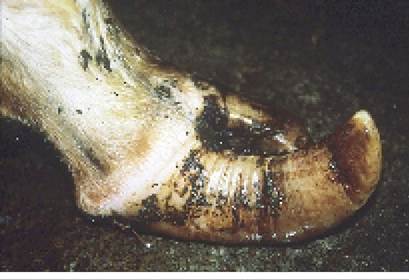
Plate 9.4. Gross claw overgrowth. There is no longer any height of heel and the toe does not make contact with the ground.
Figure 9.8. Overgrowth at the toe produces a backward rotation of the pedal bone, so that the corium becomes pinched between the pedal bone above and the horn of the sole beneath.
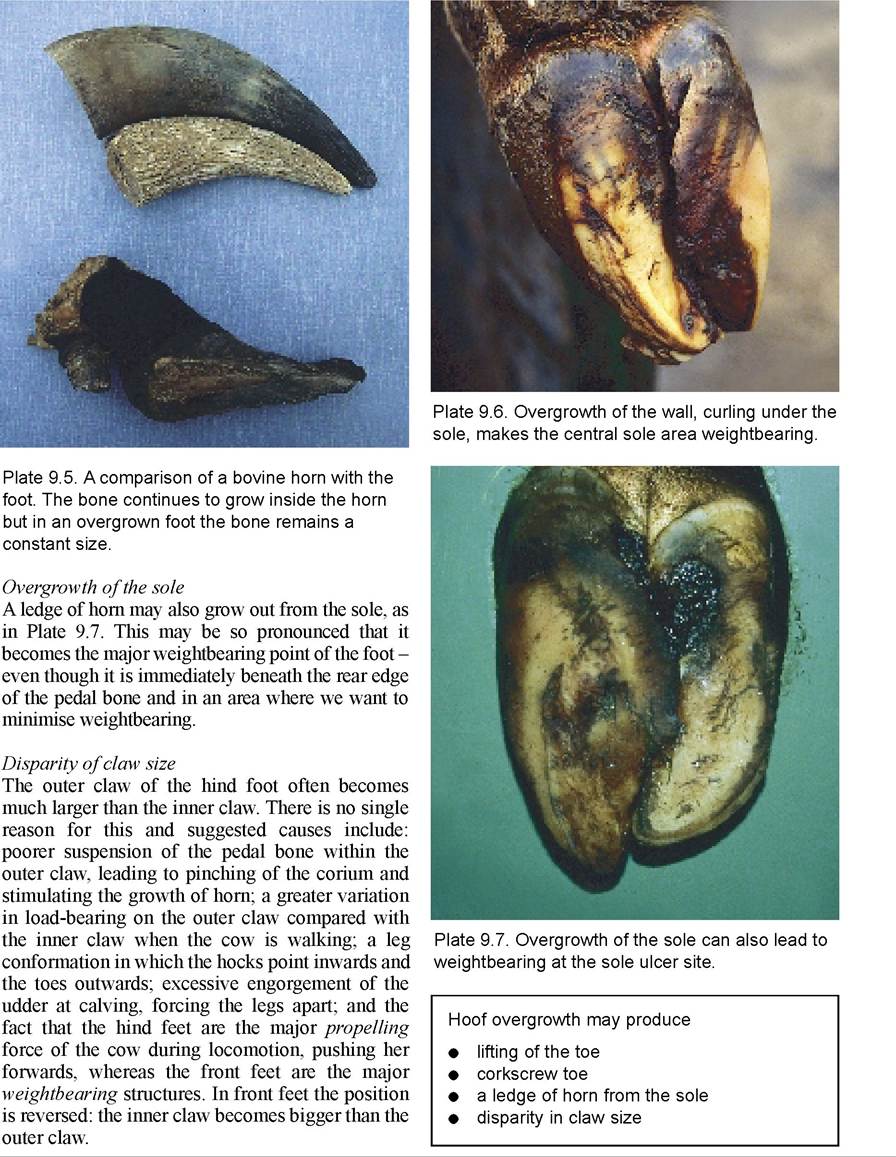
The pedal bone remains the same size, irrespective of the degree of overgrowth. In this respect the hoof is very different from the cow’s horn. As the horn grows out from the cow’s head the bone inside the horn elongates at an equal rate, as shown in Plate 9.5. This does not happen with the pedal bone.
Overgrowth of the lateral wall
In some animals the outer wall of one claw grows faster than the inner and starts to curl under the sole. This produces a corkscrew effect at the toe, as shown in Plate 9.6. Corkscrew claw may be a genetic trait, or can be a result of coriosis/laminitis.
Effects of Overgrowth
The cumulative effects of overgrowth at various parts of the foot lead to distortion of foot shape, disruption of gait, discomfort when walking and a predisposition to diseases such as sole ulcers. If you have any doubt about this, try walking on your heels and see how it feels! Foot trimming attempts to correct these defects and to restore the foot to its correct weightbearing surfaces.
More on the topic HOOF OVERGROWTH:
- Malocclusion due to improperly aligned upper and lower incisor teeth may result in marked overgrowth, particularly of the lower incisors. This condition has a hereditary basis and is relatively common among B6 mice.
- CORRECT WEIGHTBEARING
- THE STRUCTURE OF THE FOOT
- Malocclusion
- FOOT CONDITIONS CAUSING LAMENESS
- CAUSES OF DISEASE
- FOOT TRIMMING
- Reasons for including resource dynamics
- Physical Injury
- Contamination Rate
- Other Gram-Positive Bacterial Infections Aerococcus viridans Infection
- Lameness is not only a major economic problem, but it is also a major welfare issue - for both the cow and the herdsman!
- Investing in Livestock
- Malocclusion
- Malassezia spp. Infection: Malasseziasis
- Conclusions
- Segmented Filamentous Bacteria
- FRACTURES IN CHILDHOOD
- Clostridium difficile and Clostridium perfringens: Clostridial Enteropathy
- DISORDERS OF DERMIS DISORDERS OF SUBCUTANEOUS FA