FOOT TRIMMING
Much has been written about different approaches to foot trimming. To a certain extent the procedures used must be a matter of personal preference. Points to consider are:
• lifting the foot
• equipment used
• claw trimming technique
Lifting the Foot
I prefer the cow to be standing, with her leg securely tied at both the hock and fetlock.
With my head well above hock level (Plate 9.8) I am able to look downwards across the sole surface of both claws and can visualise how the weightbearing surfaces of the foot should make contact with the ground. If the leg was also secured at the fetlock (which it is not in Plate 9.8), the foot would be more firmly fixed in position and I find this makes hoof trimming both easier and safer. Like trying to hammer a nail into a flexible branch, if the foot is not securely fastened, trimming it is much more difficult.Others prefer to have more freedom of movement around the cow’s leg and so use the Wopa box type of crush, shown in Plate 9.9. If large numbers of cows have to be examined I can see the attraction of using the mobile rotating crush shown in Plate 9.10, which remains attached to the truck while in use. The cows entered the crush easily, were tipped over onto their sides using a hydraulic pump, the legs were strapped into position using hydraulic belts and most of the foot trimming was done using electric
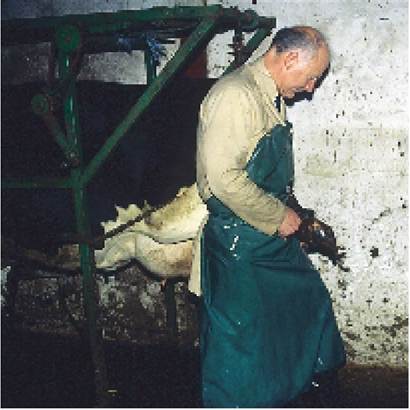
sanding discs. I tried trimming like this with a knife and did not like it, but it is probably something to which you would grow accustomed.
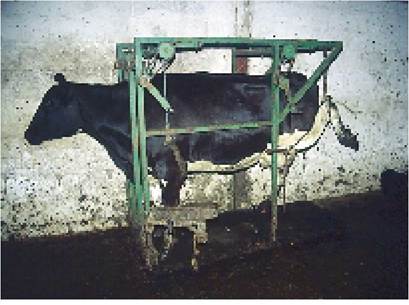
Plate 9.8. With the cow in a standing position, it is possible to look across the sole and visualise the weightbearing surfaces.
Plate 9.9.
AWopa box gives freedom of access around the foot, but does not restrain the foot as well as tying at the fetlock does.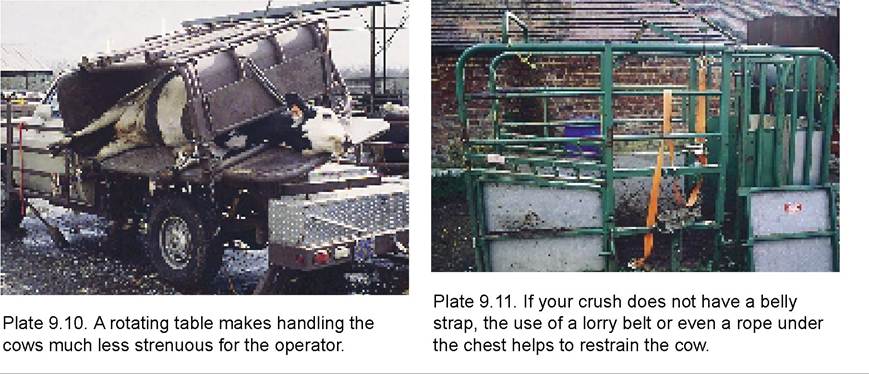
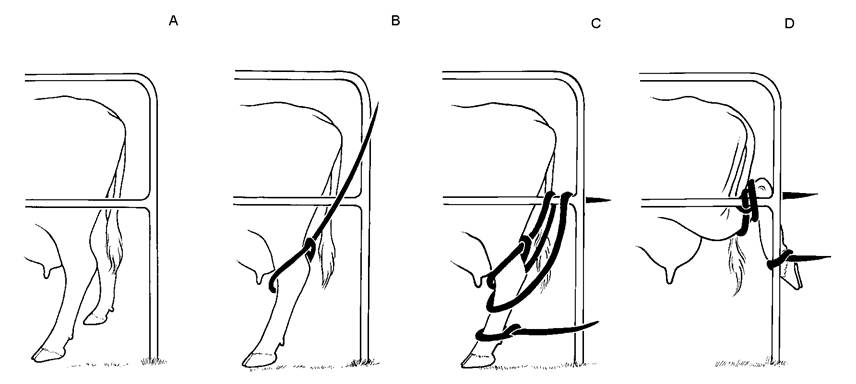
Figure 9.9. A system of using two ropes to lift the hind leg of a cow and tie the fetlock securely to the vertical bar at the rear of the crush.
In conventional crushes a mechanical winch for lifting the foot is ideal, but make sure that the ratchet is secure, so that it does not fly open when the cow kicks. Belly belts help in restraint, especially for the front feet. If your crush does not have a belt, simply use a rope or a belt from the side of a lorry, as in Plate 9.11. If using ropes to lift the hind leg, attach the first rope around the hock with a slip knot (B), and then run it twice around a horizontal bar of the crush to produce a pulling action (C). Place a second rope around the fetlock. By pulling the fetlock rope backwards, the cow will kick, making it easy to lift and tie the hock firmly to the horizontal bar using the first rope and tie the fetlock to the vertical with the lower rope (D). This is shown diagrammatically in Figure 9.9. Whatever system is chosen, the cow should be securely restrained for safety of both animal and operator.
Equipment Used
Again, this is a personal choice, based on what you get accustomed to. If knives are used they must be kept sharp. I prefer to place both hands on the knife, as in Plate 9.12. The knife should be held at a slight angle, as shown in Figure 9.10. It thus passes diagonally through the hoof in a slicing/sawing action, moving down towards the toe and out towards the wall at the same time. A direct push to the toe can be much more difficult. Some people use electric sanders. While these may be safe in skilled hands, there is a greater risk of overtrimming the sole (causing lameness) and of failing to get a good claw shape.
Concern has also been expressed about the possible adverse effects of overheating the horn during cutting.Gloves are useful, both for increasing the speed of hoof trimming and for safety reasons. I also like to wear an arm protector (Plate 9.13) to reduce soiling and grazing of my forearm as it slides over the edge of the hoof at the end of a cutting stroke.
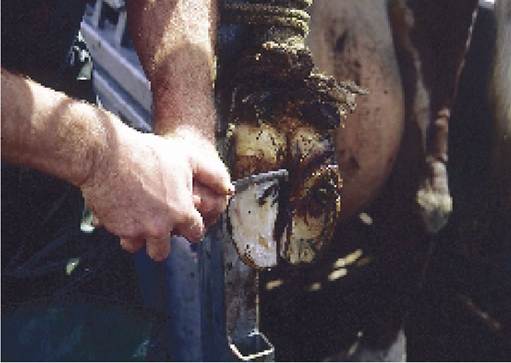
Plate 9.12. Using both hands on the knife gives a good controlled cutting stroke. It would be better if the knife was held slightly diagonally.
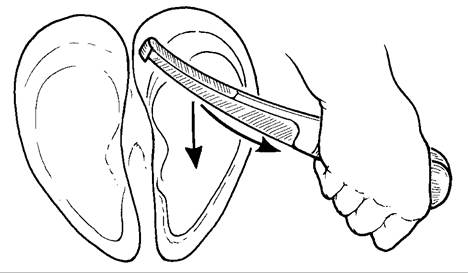
Figure 9.10. Trimming is made easier by holding the knife at an angle and pushing it through the hoof in a slicing action.
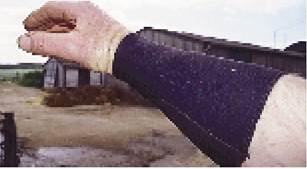
Plate 9.13. An arm protector makes foot trimming more comfortable.
Trimming Technique
Although the technique described in the following is a four stage process, the stages are not necessarily discrete steps and in reality one part of the trimming process merges with another.
Cut One
Cut the overgrown toe back to its correct length, which is approximately 75 mm from the coronary band to the toe, or one handspan. When learning to trim, it is probably better to actually measure the distance.
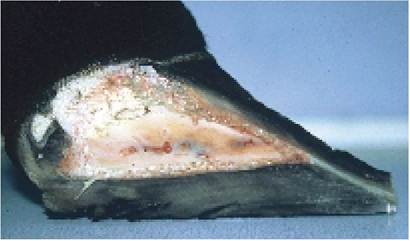
Plate 9.14. Hoof trimming: after Cut One the toe is still too high and the wall no longer makes contact with the ground.
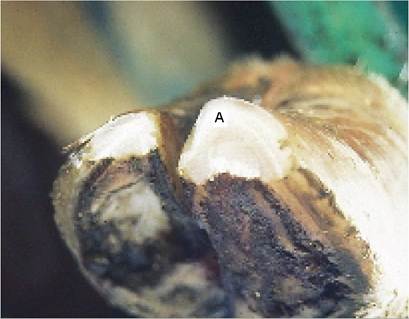
After Cut One the cow is left with a so-called square-ended toe, as in Plates 9.14 and 9.15. In Plate 9.15 it can be seen that the white line now passes across the end of the toe at A and that the wall of the hoof is no longer weightbearing at this point.
Although the wall is now the correct length, the toe is still too high and the front angle of the wall remains too shallow. This is demonstrated in Figure 9.11.Cut Two
The next stage is to remove the excess horn from beneath the toe, thus bringing the front wall back to a more upright position, as shown in Plate 9.16. The horn to be removed in Cut Two lies beneath the line AB (Figure 9.11), which is a line joining Cut One to the base of the heel. The first part of Cut Two can be performed by removing part of the wall using hoof clippers (Plate 9.17), but later stages should be carried out with a hoof knife, continually checking the area of the sole for signs of softening. A softening of the horn should not occur, but if it does then you must stop. You will have only a few millimetres of horn before the corium is penetrated and exposure of the corium in this area of the foot can lead to quite severe and protracted lameness.
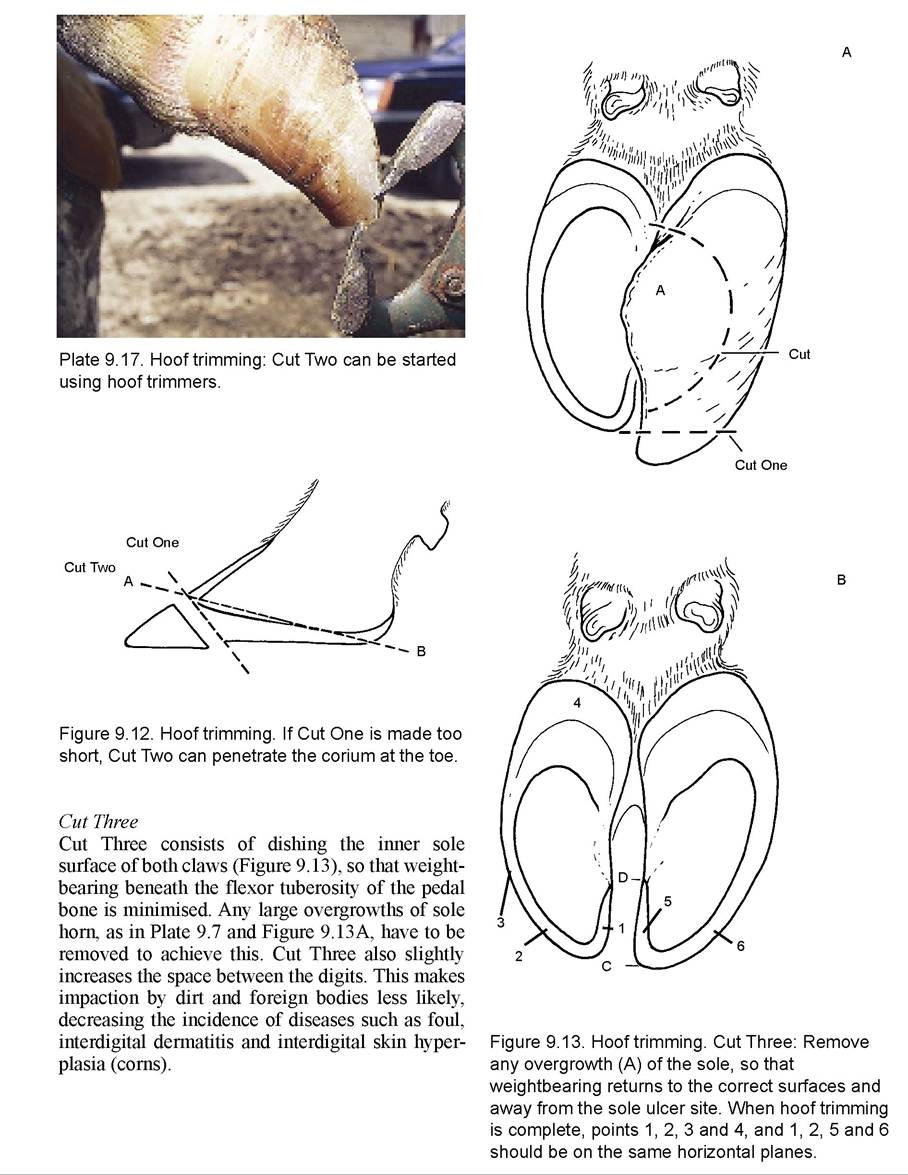
It is vital that Cut One does not make the hoof too short. This scenario is shown in Figure 9.12. Because Cut One was too short, a line drawn from the top of Cut One to the bottom of the heel (AB in Figure 9.12) would lead to penetration and exposure of the corium at the toe, and this would produce severe lameness. If you are unlucky enough to significantly expose the corium at the toe, I would recommend immediate application of a Cowslip or similar shoe to the sound claw (see page 319).
Plate 9.15. Hoof trimming: the white line (A) can be seen running across the square end of the toe after Cut One.
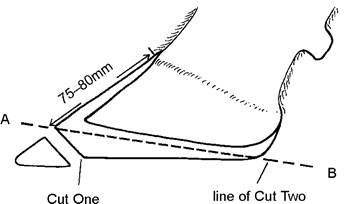
Figure 9.11. Hoof trimming. Cut One: Trim toe to 75-80 mm. Cut Two: remove excess sole horn beneath AB, i.e. mainly from the toe, thereby bringing the front wall back to 45°.
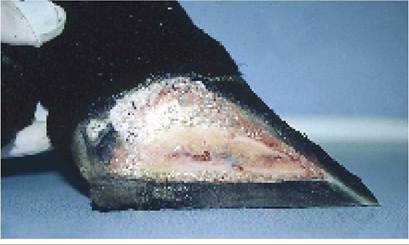
Plate 9.16. Hoof trimming: after Cut Two, correct weightbearing is re-established.
Cut Four
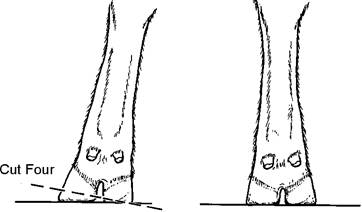
The final stage is to trim the two claws back to approximately the same size.
This usually means removing additional horn from the outer claw of hind feet and the inner claw of front feet, bringing the legs back to the upright position, as shown in Figure 9.14. This produces more even weightbearing.General points
When trimming is complete, points 1, 2, 3 and 4 on Figure 9.13B and points 1, 2, 5 and 6 should all be on the same horizontal plane, to provide adequate weightbearing. The two claws should also be of equal size and their two sole surfaces on the same horizontal plane. Removal of the inner wall CD (Figure 9.13B) is a common mistake made by
Figure 9.14. Hoof trimming. Cut Four: Trim the outer and inner claws back to an even size, thus bringing the cow back to an upright position (right). This normally involves trimming additional horn off the lateral claws of the hind feet and off the medial claws of the front feet.
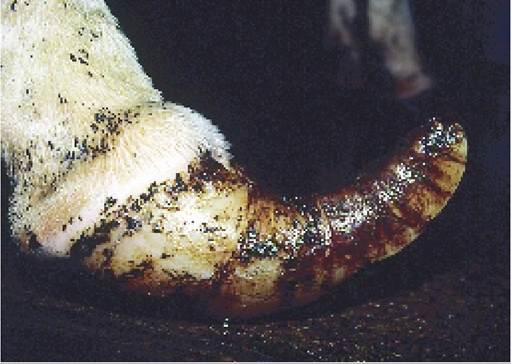
Plate 9.18. An overgrown claw before trimming. Note the concave front wall and the swelling above the coronary band, both indicative of a previous coriosis/laminitis.
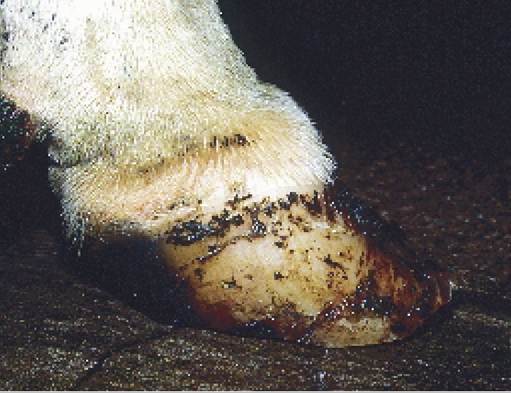
Plate 9.19. Aftertrimming: the concave wall has been removed and the sole makes reasonable contact with the ground (although I should have filed it off to give it a more pleasing appearance!).
some herdsmen who feel that the toes should not be touching once trimming is complete. This is a fallacy. If the wall CD is lowered, the claw will be seriously destabilised, causing it to rotate inwards and allowing overgrowth of the lateral wall, as in Plate 9.6. In the worst case excessive removal of the inner wall might expose the corium, leading to severe lameness.
I prefer not to remove any heel horn unless it is badly under-run, other than as part of Cut Four. If the heel is only slightly pitted, I would leave it alone, since removal of the heel could lead to backwards rotation of the pedal bone and so predispose to sole ulcers (Plate 9.24).
Probably the best time to trim feet is at drying off, and any cow which is lame or overgrown should be trimmed. As many of the management and feeding ‘insults’ leading to lameness occur at the time of calving, it seems sensible to have feet in optimum shape at this stage. If claws do become accidentally overtrimmed, lameness is less likely after drying off because dry cows do not usually have to do as much walking as milkers.
If feet are allowed to reach the stage of overgrowth shown in Plate 9.4, the tendons become stretched and it is unlikely that they will return to the upright position in a single trimming session. This cow could well be damaged for life. However, it is surprising how much can be achieved in a single trimming. Plates 9.18 and 9.19 show a before and after sequence of a fairly badly overgrown claw. Although the toe is not quite making contact with the ground in Plate 9.19, the improvement is obviously considerable.
More on the topic FOOT TRIMMING:
- CHAPTER 9 LAMENESS AND FOOT TRIMMING
- FOOT CONDITIONS CAUSING LAMENESS
- OTHER CAUSES OF FOOT LAMENESS
- FOOT-AND-MOUTH DISEASE
- THE STRUCTURE OF THE FOOT
- Immersion Injury (Trench Foot)
- An Infeasible Assumption and Limited Information Hinder Veterinarian Workforce Planning Efforts for a Catastrophic Outbreak of Foot-and-Mouth Disease
- It was with “great wonderment” that Peter I learned of “the deed of the new Judas, Mazepa, who, after twenty-one years of loyalty to me and with one foot already in the grave, has turned traitor and betrayer of his own people.
- American religious history began some 30,000 to 50,000 years ago when, according to archaeologists, the first human beings set foot on the North American continent.
- CORRECT WEIGHTBEARING
- Feet
- Sacral Segments
- Lameness is not only a major economic problem, but it is also a major welfare issue - for both the cow and the herdsman!
- Contents
- LAMENESS DUE TO LEG DISORDERS
- SOLE ULCERS AND WHITE LINE DISEASE
- CLINICAL PEARLS
- Shoe Inserts