The Largest Ecological Experiment on Earth: A Case Study
There is probably only one place on Earth where a person can hear the calls of 100 species of birds or smell the fragrances of 1,000 species of flowering plants or see the leaf patterns of 300 species of trees, all in 1 hectare (2.5 acres) of land.
That place is the Amazon, where half the world's remaining tropical rainforests and species reside. Just 1 hectare (ha) of rainforest in the Amazon contains more plant species than all of Europe! Of course, not all of the species diversity of the Amazon is confined to the rainforest itself. The Amazon Basin contains the largest watershed in the world; one-fifth of all the fresh water on Earth falls on its slopes, collects in over 1,000 forested tributaries, and eventually flows into the Amazon River and out to sea. A trip to a fish market in Manaus, Brazil, would reveal the amazing diversity of aquatic life in these rivers (FIGURE 18.1). The number of fish species in the Amazon Basin exceeds that of the entire Atlantic Ocean.
FIGURE 18.1 DiversityAboundsintheAmazon FreshwaterfishcaughtintheAmazon
River on display in a market in Manaus, Brazil. © Alexandre Rotenberg/Alamy Stock Photo View larger image
Ironically, with this incredible species diversity can come devastating species losses when these ecosystems are disturbed. The main destructive force in the Amazon Basin has been deforestation, which began in earnest with the building of roads in the 1960s (Bierregaard et al. 2001). Before then, most of the region had no roads and was relatively isolated from the rest of society. Within 50 years, however, 20% of the rainforest has been converted to pastureland, towns, roads, and mines. Although this percentage might seem modest, it is deceiving, both because of the sheer number of species involved and because of the pattern of deforestation.
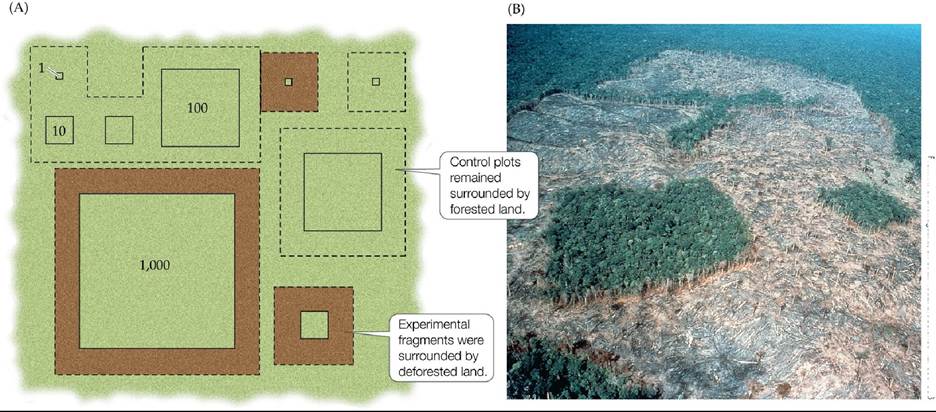
Logging practices have caused extreme habitat fragmentation, sometimes resulting in a “fishbone” pattern in which thin linear fragments of rainforest are surrounded by strips of nonforested land. These fragments of forest can be thought of as isolated “islands” of forest within a “sea” of deforested habitat. As we will see, habitat fragmentation, by isolating species, can have serious consequences for species diversity.The fragmentation of the Amazon rainforest motivated Thomas Lovejoy and his colleagues to initiate one of the largest and longest-running ecological experiments ever conducted. The Biological Dynamics of Forest Fragments Project (BDFFP) began in 1979, and Lovejoy seized a unique opportunity to find out what was happening to the species diversity of the Amazon as logging eliminated more and more of the forest. He was guided by an elegant model in Robert MacArthur and Edward O. Wilson's 1967 book The Theory of Island Biogeography, which presents an explanation for the observation that more species are found on large islands than on small islands. By taking advantage of a Brazilian law requiring landowners to leave half of their land as forest, Lovejoy arranged to designate different-sized forest plots (“islands”) that would be surrounded by either forested land (controls) or deforested land (“sea”) (FIGURE 18.2). The control plots and fragments were designated before logging took place and were either 1, 10, 100, or 1,000 ha in size. Baseline data collected immediately after logging showed little difference in species diversity between control plots and fragments.
From R. O. Bierregaard, Jr. et ai. 1992. BioScience 42: 859-S66
FIGURE 18.2 Studying Habitat Fragmentation in Tropical Rainforests The Biological
Dynamics of Forest Fragments Project (BDFFP) near Manaus, Brazil, was designed to study the effects of habitat fragment size on species diversity.
(A) Plots of four sizes (1, 10, 100, and 1,000 ha) were designated before logging took place, then either isolated by logging or left surrounded by forest as controls. (B) Aerial photo of a 10-ha and a 1-ha fragment isolated in 1983.Why didn't the experimental manipulation involve removing forest from the fragments?
(A after R. O. Bierregaard, Jr. et al. 2001. Lessons from Amazonia: The Ecology and Conservation of a Fragmented Forest. Yale University Press: New Haven, CT.) View larger image
By the mid-1980s, the ecologists had a fully replicated experiment at a scale unimaginable in the past. For more than 40 years, the BDFFP has evolved from a study that asks the simple question, What is the minimum area of rainforest needed to maintain species diversity? to one that asks, What roles do the shape, configuration, and connectivity of forest fragments play in maintaining species diversity? How does the surrounding habitat influence that diversity? And what is the prognosis for the Amazon rainforest, one of the most deforested but species-rich terrestrial biomes on Earth?
More on the topic The Largest Ecological Experiment on Earth: A Case Study:
- The Largest Ecological Experiment on Earth: A Case Study
- The scale of an ecological study affects what can be learned from it
- Competition in Plants That Eat Animals: A Case Study
- One of the most obvious ecological patterns on Earth is the variation in species composition and diversity among geographic locations.
- Edge effects change abiotic conditions and species abundances in fragments
- Seasonality results from the tilt of Earth's axis
- A field experiment suggests that multiple factors influence frog deformities
- A laboratory experiment tests the role of parasites
- In 1986, a massive hydroelectric project in the Caroni River valley of Venezuela inundated a large area of uneven terrain to create a reservoir known as Lago Guri (FIGURE 24.10).
- Invasive species can displace native species and alter ecosystem properties