Clostridium perfringens: Epizootic Rabbit Enteropathy
Epizootic rabbit enteropathy is a major economically important disease in European rabbit farms. It was initially observed in 1996 among rabbitries in France, but has since become endemic in most European countries.
ERE frequently affects rabbits that are 6-14 weeks of age, but sporadic cases can affect suckling rabbits prior to weaning. Mortality at the onset of epizootics may reach 80%. Affected rabbits stop drinking, then later stop eating, and develop a distended abdomen with mild diarrhea. Diagnosis is based upon clinical signs and gross lesions, which typically include gastric and small intestinal dilation with liquid and gas (Fig. 6.33). The cecum may be impacted or contain watery material and the colon may contain copious mucous (mucoid enteropathy). Microscopically, lesions are mild or absent. Mild villus attenuation and low-grade inflammation have been variably found in the jejunum, and some rabbits may have coccobacillary bacteria attached to the brush border. In many cases, no histologic lesions can be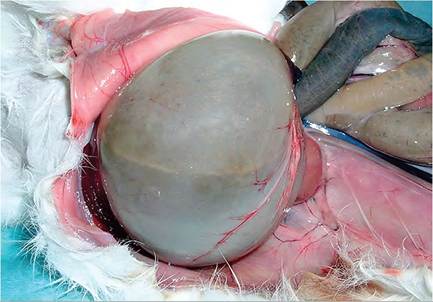
FIG. 6.33. Acute gastric and intestinal tympany in a rabbit that died acutely with epizootic rabbit enteropathy. The stomach and intestine are distended with gas and fluid, but histologic lesions are minimal or absent in this syndrome. (Source: Licois et al 2005. Reproduced with permission from EPD Sciences.)
found. Nonenteropathogenic (eae-negative) E. coli and C. perfringens in large numbers are typically isolated from feces of affected rabbits. A significant correlation has been found between gross lesions of ERE and the presence of C. perfringens alpha toxin. ERE can be readily reproduced in SPF rabbits inoculated with cecal contents from affected rabbits. Although the role of C. perfringens and its toxin in ERE pathogenesis remain to be confirmed, a notable lesion (to the authors of this book) is degeneration of neurons in the myenteric plexus, similar to dysautonomia.
More on the topic Clostridium perfringens: Epizootic Rabbit Enteropathy:
- Clostridium difficile, Clostridium perfringens, and Clostridium spiroforme: Clostridial Enteropathy
- Clostridium difficile and Clostridium perfringens: Clostridial Enteropathy
- Rotavirus Infection: Epizootic Diarrhea of Infant Mice
- Mucoid Enteropathy
- RABBIT HAEMORRHAGIC DISEASE
- Clostridium difficile Infection
- Clostridium botulinum Dysautonomia: Grass Sickness
- Clostridium piliforme Infection: Tyzzer’s Disease
- 25 Protein losing enteropathy in a dog
- Rabbit
- Clostridium piliforme Infection: Tyzzer’s Disease