Ovine Models
16.5.1 Long-term ovine MAP challenge model
This model is used primarily for pathogenesis and vaccine efficacy studies but could also be used for evaluating diagnostic assays. Some sheep breeds, including the Merino may be more susceptible to MAP than others (see Chapter 12, this volume).
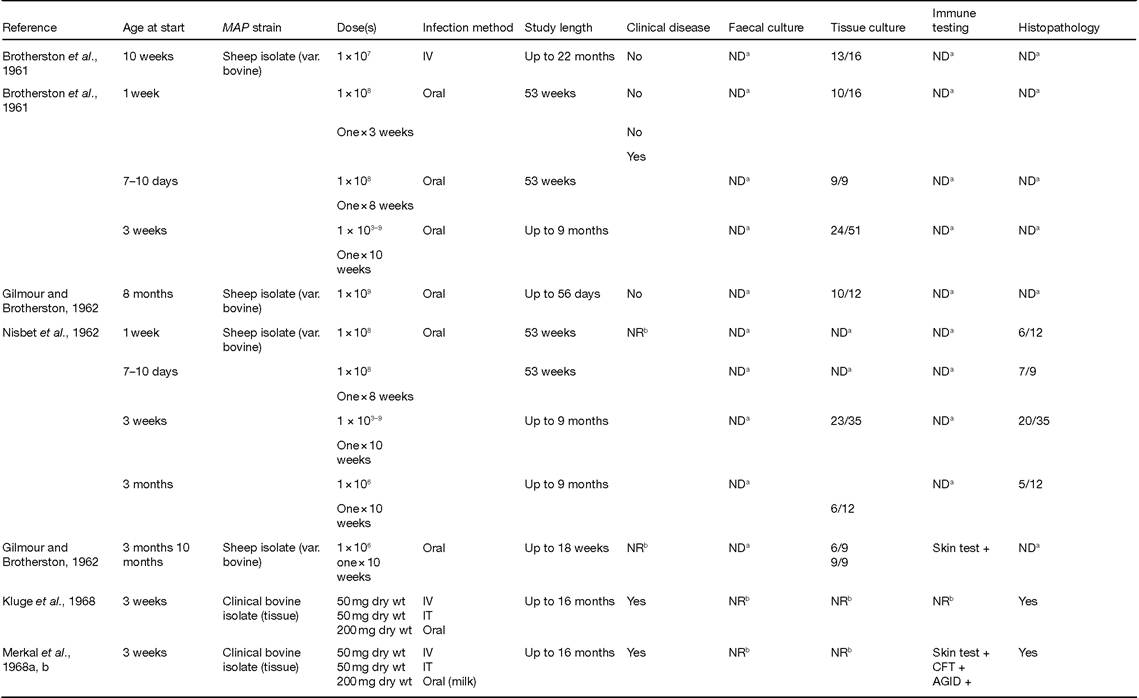
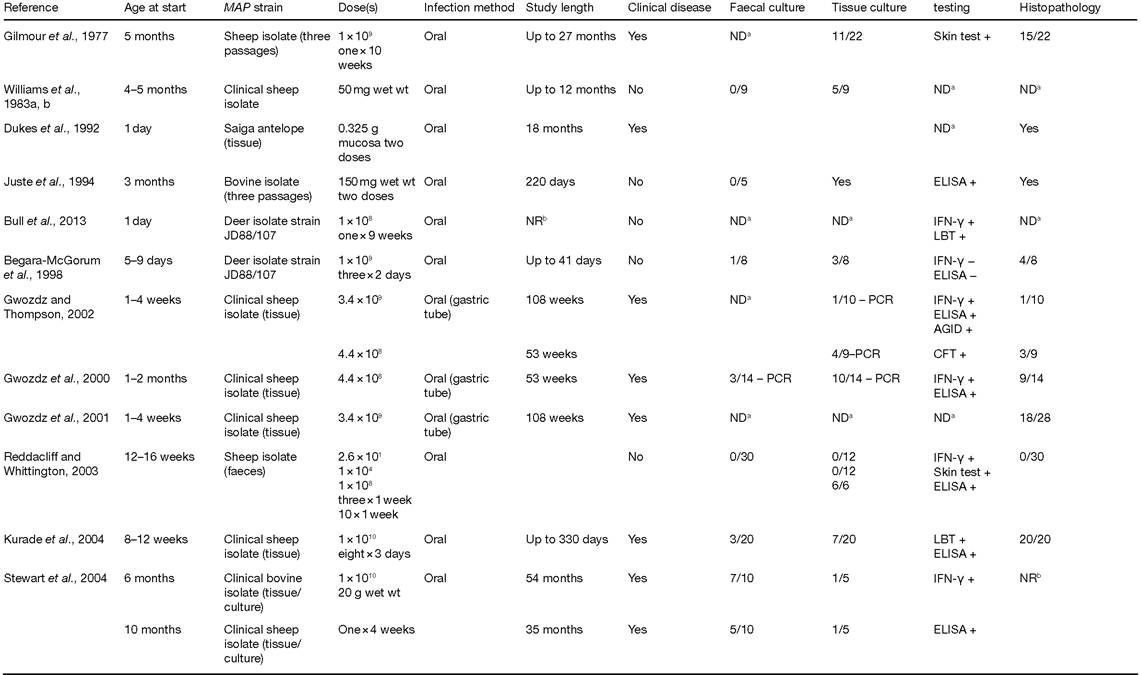
While the Merino breed is preferred by members of the AMSC, any breed shown to be susceptible to MAP is acceptable (Hines et al., 2007b).Homogenized lymphoid tissue or intestinal mucosal scrapings from a clinically diseased animal appear to be the best source for reproducing the ovine infection (Table 16.4), but this method is not recommended by the AMSC as a standard for experimental challenge studies in sheep. Successful ovine experimental studies have used MAP isolates from cattle, sheep, wildlife and humans (Table 16.5). Until 2000, the majority of experimental studies in sheep did not use characterized ovine strains of MAP (MAP-S, see Chapter 6, this volume). In contrast, later strains have used tissue homogenates or low-passage MAP-S strains grown in vitro (Gwozdz et al., 2000; Stewart et al., 2004; Begg et al., 2005). Because of the marked genetic diversity detected among ovine, caprine and bovine isolates (Motiwala et al., 2004; Ghosh et al., 2012), we recommend using a confirmed virulent ovine isolate. Therefore, to most closely reproduce natural ovine infections, any confirmed-virulent ovine clinical isolate that can be cultivated in vitro is considered acceptable (Hines et al., 2007b). Begg and co-workers more recently have successfully used lyophilized, low-passage, pure culture, seed stock of MAP for challenge studies and recommend an international bank of master seed stock to be established, containing low- passage isolates representing the major S and C lineages of MAP for research (Begg et al., 2010, 2018a, b).
Culture media used in published ovine studies have included Middlebrook 7H11 broth, Middlebrook 7H10 agar and BACTEC™ 460 medium with increased egg concentration.
Middlebrook 7H11 broth is the medium preferred by the AMSC for inoculum preparation, but any medium capable of supporting the growth of ovine strains is acceptable. The quantification of organisms and handling and storage of the inoculum should be similar to those described for cattle (Hines et al., 2007b).The usual route of administration has been oral, using either saline or milk suspensions, but other protocols have also been successfully used (Table 16.5). Since the oral route most closely parallels natural exposure, it is generally considered the best route of administration. The challenge inoculum in previous studies has ranged from 15 to 200 mg wet weight of organisms, 2.6 ? 101 to 2.6 ? 1011 CFU and 0.65 to 80 g of macerated infected tissue from a clinical case (Table 16.4). The lowest doses have generally not been effective in establishing infection (Reddacliff et al., 2004). Route and frequency of dosing have varied widely between studies (Table 16.5). Based on recent experimental evidence, three consecutive daily oral doses consisting of 109 organisms per dose (~100 mg pelleted wet weight/dose; 300 mg total) should be used to establish infection (Begg and Griffin, 2005).
The age at inoculation has ranged from day of birth to 10 months (Table 16.5). Experimental challenge at any time up to 4 months of age is considered appropriate. However, age at time of challenge will be influenced by experimental objectives. The AMSC made no recommendation as to when a paratuberculosis vaccine or other intervention should be administered. As for other species' models, positive faecal cultures 2 weeks or more post-inoculation should be considered to be due to infection. Faecal culture is less reliable in animals infected with sheep MAP strains (as compared with cattle strains), and expense is a major
Table 16.5. Ovine models for Mycobacterium avium subsp. paratuberculosis (MAP) infection.
Immune
234 A.M.
Talaat eta∕.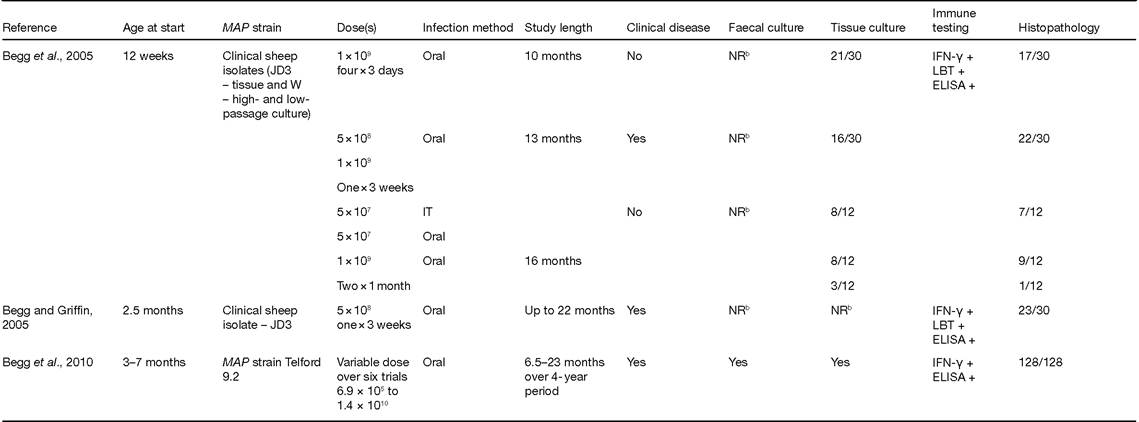
3ND = not determined.
bNR = not reported.
ELISA, enzyme-linked immunosorbent assay; PCR1 polymerase chain reaction; IT, intrathecal; IV, intravenous; AGID, agar gel immunodiffusion test; CFT, complement fixation test; LBT, lymphocyte blastogenesis test; IFN, Interferon.
consideration in large ovine studies, particularly in the field; none the less, all animals should have periodic faecal cultures using validated methods.
Animals to be included in challenge studies should be validated as infection-free based upon the infection-free status of the foundation flock. Lambs for experimental studies should only be selected from closed flocks in which all adults have been negative on ELISA and faecal culture for at least 1 year and paratuberculosis vaccination is not practised. All lambs should receive adequate quantities of colostrum.
A combination of necropsy with histopathology and bacterial culture to determine levels of tissue colonization is recommended by the AMSC as the minimal requirement to determine infection status of experimental animals (Hines et al., 2007b). The lesion grading system used for gross and histopathology findings should have a sufficient range in values to allow for statistical analysis (Hines et al., 2007a, Hines et al., 2007b; Juste et al., 1994). Animals should be observed until clinical signs develop in a proportion of the group. The type, quantity and processing of samples collected will vary with the purpose, number of animals, goals and cost of the study. All samples should be collected, handled and processed in the same way to ensure uniformity. Ovine strains apparently grow better in liquid medium, and BACTEC™ 460 was suggested by the AMSC to be the best system by which to recover ovine strains at that time, but no single standard culture medium or method for culture of faeces or tissues was recommended.
However, in 2012 the BACTEC™ 460 system was discontinued by its manufacturer and is being replaced by other non-radiometric types of liquid culture. Decontamination and culture should be performed similarly to those previously described for cattle, providing, at a minimum, semi- quantitative results (Hines et al., 2007b).16.5.2 Short-term ovine MAP challenge models
In general, these models are most useful for short-term study of host-pathogen interactions. Many parameters should be the same as for long-term challenge, including strain, inoculum preparation and quantification, storage, animal selection criteria and quality control issues.
Ileal cannulation model
An ileal cannulation model similar to that previously described for cattle has not been investigated in sheep. This model is considered to have only limited practical use in sheep. However, Hein and co-workers have developed a model for investigating enteric diseases where the afferent lymphatics draining the small intestine are cannulated (Hein et al., 2004). This model allows longitudinal sampling of immune cells and fluids draining the small intestine, which may be useful in evaluating the immunology associated with paratuberculosis in sheep.
Intestinal loop and everted intestine sleeve models
No study describing an intestinal loop or everted intestinal sleeve model for sheep was found in our literature review. Models similar to that described previously in goats should be equally applicable in sheep for studying the initial bacterial-host interactions in vivo.
16.6
More on the topic Ovine Models:
- Host and Pathogen Characteristics That Define Ovine Paratuberculosis
- Rodent Models
- Vaccine Models
- 3. Models and definitions
- Cervid Models
- Competition in other 2-consumer-l-resource models
- Bovine Models
- Lottery and neutral models rely on equality and chance
- A brief guide to externalities in growth models
- Analysis of models of competition
- Demographic models can guide management decisions
- Models for the Painting
- THE PROMISES AND PITFALLS OF FINTECH BUSINESS MODELS
- Arguments against resource-based definitions and models
- Assessing Vaccine Efficacy in Different Animal Models
- Multiple models of succession were stimulated by lack of scientific consensus