THE MITES AND TICKS
Arachnids can be distinguished easily from the insects because adults have only one conspicuous body region (as opposed to the three of insects), and nymphs and adults have four pairs of legs (larval stages of parasitic arachnids have only three pairs of legs), whereas adult insects have three pairs of legs.
Three subclasses of arachnids are associated with diseases of wildlife, including the Scorpi- onida (scorpions), Araneae (spiders), and Acari (ticks and mites). The spiders and scorpions are all free-living predators or detritivores. Spiders and scorpions utilize toxins (venoms) to capture their prey; their association with wildlife diseases results from toxins injected into animals along with their bites or stings, respectively. Although this group is interesting, their natural histories will not be addressed further; interested readers are referred to texts covering general entomology or medical and veterinary entomology (Mullen and Durden 2009).The parasites within the Subclass Acari are classified as belonging to one of four orders: the ticks (Order Ixodida), the gamascid mites (Order Mesostigmata), the follicle mites and related species (Order Prostigmata), and the mange mites and related species (Order Astigmata). The Order Oribatida includes free-living species that serve as intermediate hosts of some species of tapeworms. Different authors have used different names for the higher taxonomy of the mites and ticks, causing inevitable confusion for readers; we're following the traditional classification scheme as used by Mullen and O'Connor (2009).
The potential life stages of mites and ticks include eggs, prelarvae, larvae, three potential nymphal stages (the protonymph, deutonymph, and tritonymph), and sexual adults. However, the details of the life cycles vary among taxa in which the prelarva and one of more of the nymphal stages may be suppressed or repeated, and in the necessity of feeding between successive molts.
Some, such as the chiggers (Order Mesostigmata: Family Trombiculidae) develop through all of these life stages, while others, such as the hard ticks (Order Ixodida: Family Ixodidae), have a single larval stage, a single nymphal stage, and adult females that feed only once prior to oviposition (Mullen and O'Connor 2009, Nicholson et al. 2009).Ticks and mites are characterized by having a single body segment (the idiosoma), the absence of compound eyes (although many ticks have simple eyes), and no antennae. Ixo- did ticks differ from other orders of Acari in having a toothed hypostome, used to anchor the tick to the host during feeding, sensory Haller's organs on the dorsal tarsus of the first pair of legs, and in having lateral stigmatal openings; stigmata are located either posterior to the first segment (coxa) of the fourth pair of legs (Family Ixodidae) or dorsolateral to coxae II or III (Family Argasidae). There are three families of ticks, but one (the Nuttalliellidae) includes only a single species from Southern Africa about which little is known. The other two families (the Argasidae and Ixodidae) differ considerably in their anatomy (Fig. 5.6), their life history characteristics, and their potential to cause disease. Although mosquitoes transmit more serious pathogens than other types of insects, and more to humans than any other group of arthropods, the ticks surpass them as vectors to domestic and wild animals (Allan 2001b, Jongejan and Uilenberg 2004, Nicholson et al. 2009).
The Family Ixodidae includes approximately 683 described species of ticks (Brown et al. 2005, Nicholson et al. 2009), and these species are commonly referred to as hard ticks due to the characteristic cuticular, plate-like dorsal scutum. Most species (>90%) are 3-host ticks, having life stages that feed on three different hosts (larvae, nymphs, and adults feed once per life stage, each typically on a different host). Larvae of 3-host ticks find a host, feed for several days until replete (meaning fully fed), and drop off the host onto the soil, leaf litter, or nesting material, where they molt into nymphs.
When the season is right, resulting nymphs seek a second host, feed for several more days, and drop off to molt into adult males or females. Mating occurs either in the environment before feeding or on a host as the female feeds; interestingly, the adults of some species (including the Ixodes ricinus group of ticks that vector the spirochetes causing Lyme borreliosis) are commonly found mating in both circumstances. Finally, blood-engorged, mated females detach and drop off their hosts to oviposit their eggs in the environment and to continue the life cycles. In fact, most (again, >90%) of the life cycle of 3-host ticks is spent in the environment and separated from the hosts (Nicholson et al. 2009). The entire life cycles of tropical ixodids may include several generations per year. However, species occurring in regions with more temperate, or colder, climates may require two or more years to complete their cycles. As an example, Ixodes ricinus, an important vector of Lyme disease spirochetes, tick-borne encephalitis viruses, human anaplasmosis, and several other pathogens in Europe, may require up to four years to complete a single life cycle in the northern regions of its distribution (Hoogstraal 1985).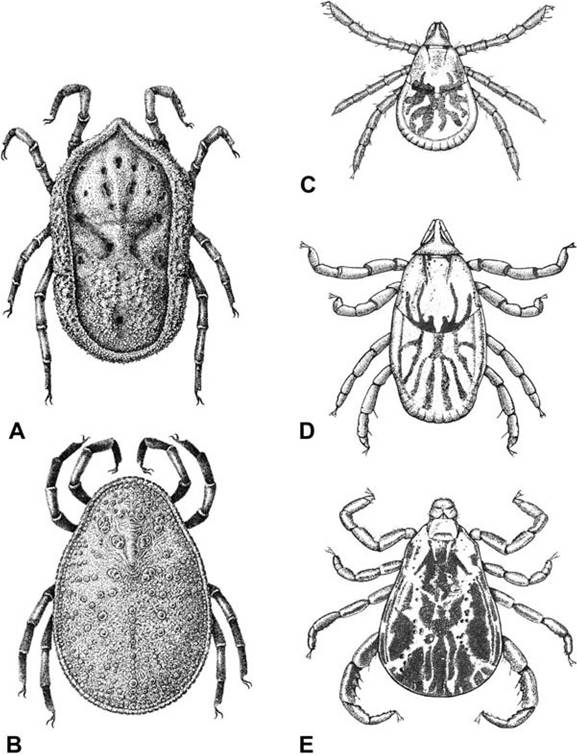
FIGURE 5.6 Comparison of representatives of the families Argasidae and Ixodidae: A and B, respectively, are drawings of an Ornithordoros sp. and of the fowl tick, Argus persicus (both argasids); C, D, and E, respectively, are drawings of a larva, nymph and adult male of the American dog tick, Dermacentor variabilis (Family Ixodidae) (from Capinera 2010, copyright © John Wiley and Sons, by permission).
Less commonly, tick life cycles are focused on only two individual hosts; such species are called 2-host ticks. For these species (including Dermacentor hunteri, several species of the genus Rhipicephalus, and some populations of Hyalomma marginatum), fed larvae remain on the first host following feeding, molt, and then re-feed on the same host as a nymph; as with 3-host ticks, the fed nymphs drop off', molt to adults in the environment, and then seek another host (Allan 2001b, Nicholson et al. 2009).
The extreme modification of the ixodid life cycle is that of the і-host ticks. Species, including Rhipicephalus (Boophilus) annulatus and the winter tick, Dermacentor albipictus, remain on the host during the larval and nymphal molts. Replete (mated) females drop off of the host to oviposit their large mass of eggs in the environment; these are often large-bodied ticks, and females commonly oviposit more than 4,000 eggs after a single blood meal (Allan 2001b, Nicholson et al. 2009).
Ticks of the Family Argasidae are referred to as soft ticks because they lack the dorsal scutum characteristic of the Family Ixodidae. Argasids also differ from ixodids in having ventrally oriented mouthparts (actually the entire capitulum, composed of hypostome, palps, and chelicerae) covered dorsally by a hood; the mouthparts of argasids cannot be seen when looking directly at the dorsum of the tick. In contrast, the capitulum of ixodids projects anteriorly well beyond the margin of the body (idio- soma) and is obvious when viewed from above (Nicholson et al. 2009).
Most importantly for our purposes, the life histories of argasids and ixodids differ in ways that affect their potential to serve as vectors of pathogens. Argasids have life cycles with two or more nymphal stages, and females that undergo several gonotropic cycles; they feed multiple times, laying small batches of eggs after successive blood meals. Many species of ixodids and most argasids are nidicolous, being typically associated with the burrows or nests of their hosts. Nidicolous species tend to specialize on similar types of hosts; some species specialize on colonially nesting sea birds, others on burrowing rodents, and so on. Females of non-nidicolous species detach from hosts and oviposit in the environment irrespective of proximity to host burrows or nests. Non- nidicolous species tend to be host generalists, but the different stages may be found more commonly on some host groups than on others (e.g., lizards, birds, small mammals, large mammals, etc.).
As examples, Ixodes pacificus and Ixodes scapularis are generalists in the western and eastern United States, respectively. Larvae and nymphs of both species feed on reptiles, birds, and small mammals, while most adults tend to feed on medium- and large-sized mammals (Nicholson et al. 2009).Mesostigmatid mites are often large, semi-free-living, intermittent parasites or predators that live in nests or burrows where they seek cover between blood meals. These mites include the American bird mite Dermanyssus americanus, rodent mites in the genus Liponys- soides, the tropical rat mite Ornithonyssus bacoti, the free-tailed bat mite Chiroptonyssus robust- ipes, snake mites in the genus Ophionyssus, the spiny rat mite and others in the genus Laepaps, and chiggers, including Eutrombicula spp. and Neotrombicula spp.
The large Family Trombiculidae includes species that are parasitic as larvae, referred to as chiggers, on a wide range of hosts, including amphibians, reptiles, birds, and mammals (Mullen and O'Connor 2009). Many species are known only from their parasitic larvae; the prelarvae, protonymphs, and tritonymphs are inactive and do not feed, while the deutonymphs and adults are predators of other arthropods. Larval chiggers pierce areas of thin skin and feed on cells of the epidermal lining, lymph, or serum. Approximately 20 genera have larvae that are adapted to life as internal parasites of the nasal passages or respiratory airways of reptiles, birds, and mammals. Although larvae are very small, they are often encountered in large numbers, and their infestations can cause considerable annoyance and dermatitis, especially in abnormal hosts (Mullen and O'Connor 2009).
Prostigmatid mites include the parasitic Families Demodicidae, Cheyletidae, and Psor- ergatidae. The Family Demodicidae includes follicle mites that are tiny and elongated (cigarshaped), with very short, stumpy legs (Mullen and O'Connor 2009). Follicle mites live in hair follicles and skin glands of mammals, where they pierce cell membranes to feed on cell contents.
The entire life cycle of these mites takes place on the host, and host specificity is typically quite high. Transmission of mites from infested hosts to new hosts is accomplished by intimate contact such as occurs between a female and her offspring. Most individuals in a population tolerate small numbers of these mites without apparent disease. For example, approximately 20% of people 20 years of age, and nearly 100% of elderly people, have follicle mites living in the follicles of their eyelashes, eyebrows, or other facial hair. Young animals may develop areas of alopecia (hair loss) or abscessed follicles (depending on the species). Cheyletid mites are small, oval-shaped mites that live on organic debris or that parasitize other mites associated with feathers or fur; parasitic cheyletids of dogs and cats are often referred to as walking dandruff because they appear to be very small bits of skin moving over the pelage. Psorergatid mites include Psorergates ovis, an economically important parasite of domestic sheep, and Psorergates simplex, a parasite of house mice (Mullen and O'Connor 2009).Astigmatid mites are tiny parasites that may spend their entire lives, indeed generations, on individual hosts. Examples of parasites of birds and mammals may live in the fur, in the waxy secretions of the ears, under scabs that form on the skin, in dermal burrows, or in the lungs or airways of their hosts. The Families Myobiidae, Listrophoridae, and Myo- coptidae are fur mites that parasitize specific species of marsupials, insectivores, rodents, or bats. Most species attach to individual hair shafts and feed on extracellular fluids in the skin, but some myobiids pierce capillaries to feed directly on blood. Dermatitis may be associated with infestations of some species of fur mites, and individual rodents may become irritated enough to chew away areas of fur (known as barbering), but most infestations are apparently well tolerated by their hosts (Mullen and O'Connor 2009).
More on the topic THE MITES AND TICKS:
- EXAMPLES OF DISEASES CAUSED BY INSECTS, MITES, AND TICKS
- Ticks
- Ear Mites
- FIVE The Parasitic Insects, Mites, and Tick
- CONTENTS
- GENERAL INTRODUCTION
- CO-FEEDING
- Demodectic Mange
- CONTENTS
- TICK-BORNE DISEASES
- Psoroptes cuniculi Infestation: Psoroptic Mange; Ear Canker
- Follicle Mite Infestations
- Parasitic Dermatosis
- Fur Mite Infestations: Acariasis
- Cheyletiella parasitovorax Infestation
- RELAPSING FEVER SPIROCHAETE- Associated disease in birds and MAMMALS
- Leporacarus gibbus Infestation
- Predator-prey cycles can persist in the field
- Ectoparasitic Infestations Demodex spp. Infestation